
Euler's Eyes
2026-10-27
The algebra of matrices
Arrays of numbers had been in mathematics for a long time. Seki, Leibniz and Cramer used them to solve systems of equations; Gauss and Cauchy developed the theory of determinants. But in all this work the array was only a means: what mattered was the number computed from it. In 1850 Sylvester gave the array a name, matrix, the “womb” from which the minor determinants are born. The next step was still missing, and it was Cayley who took it.
The memoir of 1858
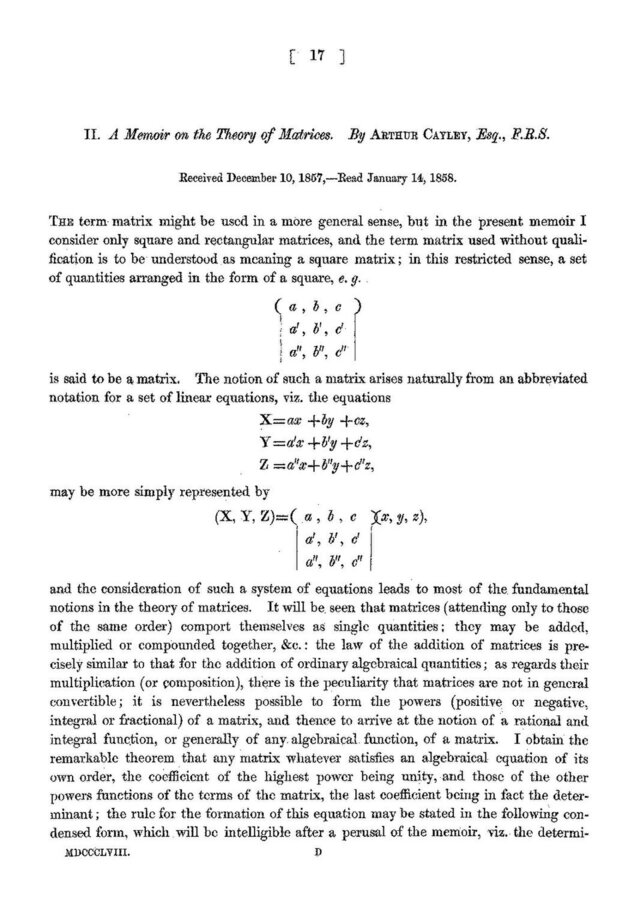
On 10 December 1857 Cayley sent the Royal Society A memoir on the theory of matrices, published the following year in the Philosophical Transactions. The idea appears on the very first page: a system of linear equations such as
$$X = ax + by + cz, \quad Y = a'x + b'y + c'z, \quad Z = a''x + b''y + c''z$$can be written in an abbreviated form in which the array of coefficients stands on its own, as a single quantity acting on $(x, y, z)$. Cayley then asks: what operations can be carried out on these arrays?
Addition is the obvious one, entry by entry. So is multiplication by a number. The product of two matrices Cayley defines by composition: if the matrix $B$ takes $(x, y)$ to $(x', y')$ and the matrix $A$ takes $(x', y')$ to $(x'', y'')$, then $AB$ is the matrix that takes $(x, y)$ straight to $(x'', y'')$. Working it out gives the “row by column” rule:
$$\begin{pmatrix} a & b \\ c & d \end{pmatrix}\begin{pmatrix} e & f \\ g & h \end{pmatrix} = \begin{pmatrix} ae + bg & af + bh \\ ce + dg & cf + dh \end{pmatrix}.$$Order matters
With $A = \begin{pmatrix} 1 & 2 \\ 3 & 4 \end{pmatrix}$ and $B = \begin{pmatrix} 0 & 1 \\ 1 & 0 \end{pmatrix}$,
$$AB = \begin{pmatrix} 2 & 1 \\ 4 & 3 \end{pmatrix}, \qquad BA = \begin{pmatrix} 3 & 4 \\ 1 & 2 \end{pmatrix}.$$Multiplying $A$ by $B$ on the right swaps the columns of $A$; on the left, it swaps the rows. The result is different. Cayley noted this quite calmly: matrices add like ordinary algebraic quantities, but as regards multiplication “there is the peculiarity that matrices are not in general convertible”. Hamilton’s quaternions, fifteen years earlier, had already shown that a coherent algebra could have $ij \ne ji$. Matrices gave the phenomenon a concrete, geometric form.
In the figure, choose two transformations of the plane and compare what happens to the letter F when one is applied first and then the other:
The inverse
Cayley also defined the identity matrix $I$, which leaves everything in place, and the inverse: the matrix $A^{-1}$ such that $AA^{-1} = A^{-1}A = I$. For a $2 \times 2$ matrix,
$$\begin{pmatrix} a & b \\ c & d \end{pmatrix}^{-1} = \frac{1}{ad - bc}\begin{pmatrix} d & -b \\ -c & a \end{pmatrix},$$and it exists exactly when the determinant $ad - bc$ is not zero. With this, solving a linear system $AX = Y$ becomes a division: $X = A^{-1}Y$. Cramer’s rule, which gave each unknown as a quotient of determinants, turns out to be the written form of this product.
In the same memoir Cayley went much further: he defined powers and polynomials of a matrix, stated the theorem that now bears his name and Hamilton’s, and even studied the square roots of a $2 \times 2$ matrix, showing that in general there are four, but that some matrices have infinitely many and others none.
Exercise: an inverse
Compute the inverse of $A = \begin{pmatrix} 2 & 1 \\ 5 & 3 \end{pmatrix}$ and check that $AA^{-1} = I$.
The determinant is $2 \cdot 3 - 1 \cdot 5 = 1$, so
$$A^{-1} = \begin{pmatrix} 3 & -1 \\ -5 & 2 \end{pmatrix}.$$Checking: $\begin{pmatrix} 2 & 1 \\ 5 & 3 \end{pmatrix}\begin{pmatrix} 3 & -1 \\ -5 & 2 \end{pmatrix} = \begin{pmatrix} 6 - 5 & -2 + 2 \\ 15 - 15 & -5 + 6 \end{pmatrix} = \begin{pmatrix} 1 & 0 \\ 0 & 1 \end{pmatrix}$.
Exercise: what commutes with a shear?
Find all matrices $X = \begin{pmatrix} a & b \\ c & d \end{pmatrix}$ that commute with $S = \begin{pmatrix} 1 & 1 \\ 0 & 1 \end{pmatrix}$.
We have $SX = \begin{pmatrix} a + c & b + d \\ c & d \end{pmatrix}$ and $XS = \begin{pmatrix} a & a + b \\ c & c + d \end{pmatrix}$. Equating entries: $a + c = a$ gives $c = 0$, and $b + d = a + b$ gives $d = a$. The matrices that commute with $S$ are those of the form $\begin{pmatrix} a & b \\ 0 & a \end{pmatrix}$, a family with only two parameters out of the four possible entries.
Sources: Arthur Cayley, “A memoir on the theory of matrices”, Philosophical Transactions of the Royal Society 148 (1858) · Thomas Hawkins, “Another look at Cayley and the theory of matrices”, Archives internationales d’histoire des sciences 26 (1977) · Tony Crilly, Arthur Cayley: Mathematician Laureate of the Victorian Age (2006).
All topics on Arthur Cayley · ← The life of Arthur Cayley · The Cayley–Hamilton theorem →