
Euler's Eyes
2026-09-26
ENEM 2023 – Solved mathematics: questions 136 to 150
Source: INEP – proof and template of the 2nd day, Notebook 5 – Yellow.
The ENEM Mathematics and Technologies test 2023 was administered on the 2nd day and will from question 136 to 180. This post addresses questions 136 to 150. The numbering used here is that of the Notebook 5 – Yellow; us In other notebooks the same questions appear in a different order.
Template
| Question | Subject | Template |
|---|---|---|
| 136 | Proportion and rounding up | D |
| 137 | Trigonometry in the right triangle | C |
| 138 | Scale | E |
| 139 | Tables: caloric expenditure | C |
| 140 | Discount proportion and percentage | A |
| 141 | Conversion between calendars | C |
| 142 | Pythagoras and the law of cosines: areas of circles | C |
| 143 | Units of measurement | B |
| 144 | Arithmetic progressions: sales comparison | D |
| 145 | Statistics: mean, median and mode | E |
| 146 | Cylinder flow and volume | C |
| 147 | Capable arc (inscribed angle) | B |
| 148 | Magic triangle and arithmetic progression | E |
| 149 | Probability with weights | E |
| 150 | Cylinder volume and water consumption | A |
Question 136: Packets of bread for the walk (proportion)
Statement
Some studies prove that carbohydrates provide the body with energy, preserve the structural proteins of muscles during activity physics and also give strength to the brain to coordinate movements, which in fact has a positive impact on the practitioner’s development. The ideal is to consume 1 grams of carbohydrates for every minute of walking.
CIRINO, C. Good question: consuming carbohydrates before exercise improves athlete performance? Health Magazine! It’s Vital, n. 330, nov. 2010 (adapted).
A couple will walk 30 minutes daily, taking, before this, activity, the ideal amount of carbohydrates recommended. To have consumption ideal only through the consumption of wholemeal bread, the couple plans guarantee the supply of bread for a period of 30 uninterrupted days. It is known that each package of this bread comes with 18 slices, and that each of them has 15 grams of carbohydrates.
The minimum quantity of sliced bread packages needed to provide the supply to this couple is
- A) 1.
- B) 4.
- C) 6.
- D) 7.
- E) 8.
Resolution
1. Necessary carbohydrate. There are 2 people, each needing 30 g per day (1 g per minute, 30 minutes), during 30 days:
$$2 \cdot 30 \cdot 30 = 1800 \text{ g}$$2. Carbohydrate in a pack. 18 15 g slices:
$$18 \cdot 15 = 270 \text{ g}$$3. Number of packages.
$$\frac{1800}{270} \approx 6{,}67$$With 6 packages ($1620$ g) there is a lack of carbohydrates; you have to buy entire packages, so the minimum is 7.
Answer: alternative D (7 packages).
Be careful with the catch: alternative C (6) comes from rounding 6,67 to low, and B (4) comes from forgetting that there are two people ($900 / 270 \approx 3{,}3$, which rounded up gives 4).
To review, see Proportions.
Question 137: Mast steel cables (trigonometry)
Statement
A flagpole was installed perpendicular to the ground in a region flat. Due to the strong winds, three steel cables of the same length will be installed to support the mast. Each steel cable will be perfectly stretched, with one end at a point $P$ of the mast, at a height $h$ from the ground, and the other end, at a point on the floor, as shown in the figure.
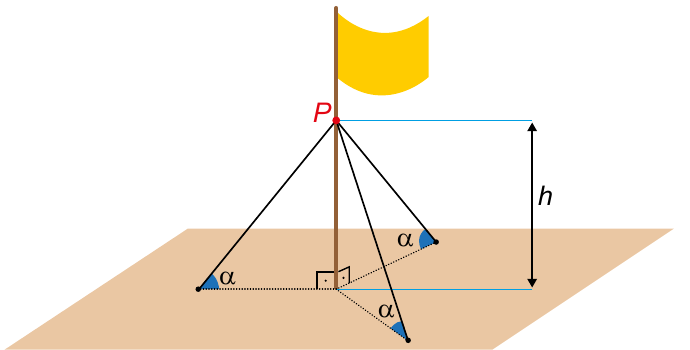
The steel cables form an angle $\alpha$ with the floor plane.
For security reasons, there are only three installation options:
- option I: $h = 11$ m and $\alpha = 30°$
- option II: $h = 12$ m and $\alpha = 45°$
- option III: $h = 18$ m and $\alpha = 60°$
The option to be chosen is the one in which the cables are as small as possible.
What will be the size, in meters, of each of the cables to be installed?
A) $\dfrac{22\sqrt{3}}{3}$
B) $11\sqrt{2}$
C) $12\sqrt{2}$
D) $12\sqrt{3}$
E) $22$
Resolution
1. The right triangle. The mast, ground and cable form a triangle rectangle. The handle is the hypotenuse $L$, the height $h$ is the leg opposite to the angle $\alpha$. Then
$$\operatorname{sen} \alpha = \frac{h}{L} \quad\Rightarrow\quad L = \frac{h}{\operatorname{sen} \alpha}$$2. Calculate each option.
- option I: $L = \dfrac{11}{\frac{1}{2}} = 22$ m;
- option II: $L = \dfrac{12}{\frac{\sqrt{2}}{2}} = \dfrac{24}{\sqrt{2}} = 12\sqrt{2} \approx 16{,}97$ m;
- option III: $L = \dfrac{18}{\frac{\sqrt{3}}{2}} = \dfrac{36}{\sqrt{3}} = 12\sqrt{3} \approx 20{,}78$ m.
3. Choose the smallest. The smallest measurement is option II, $12\sqrt{2}$ m.
Answer: alternative C ($12\sqrt{2}$ m).
Be careful with the catch: the smallest height (option I, $h = 11$) does not give the shorter cable: with a small angle, the cable is long. Alternatives E and D are the cables from options I and III. A ($\frac{22\sqrt{3}}{3}$) appears if we use the cosine instead of sine in option I: $\frac{11}{\cos 30°} = \frac{22}{\sqrt{3}}$.
Question 138: Flight controller screen scale
Statement
A flight controller has an instrument that describes the altitude of a aircraft in flight, depending on the distance on the ground. This ground distance is the measured horizontally between the point of origin of the flight to the point representing the orthogonal projection of the aircraft’s position, in flight, on the ground. These two quantities are given in the same unit of measurement.
The instrument screen proportionally represents the actual dimensions of the distances associated with the flight. The figure shows the instrument screen after completed the plane trip, with the measurement of the side of each square of the mesh equal to 1 cm.
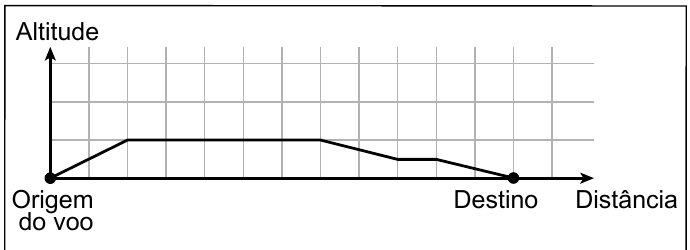
This screen presents data from a flight whose highest altitude reached was 5 km.
The scale at which this screen represents the actual measurements is
- A) 1 : 5.
- B) 1 : 11.
- C) 1 : 55.
- D) 1 : 5 000.
- E) 1 : 500 000.
Resolution
1. Measurement in the drawing. The highest part of the graph (the horizontal part) is at the height of 1 square, that is, 1 cm on the screen.
2. Actual measurement in the same unit. The scale compares measurements in the same unit:
$$5 \text{ km} = 5\thinspace 000 \text{ m} = 500\thinspace 000 \text{ cm}$$3. Scale. 1 cm on the screen corresponds to 500 000 cm in reality:
$$\text{escala} = 1 : 500\thinspace 000$$Answer: alternative E (1 : 500 000).
Be careful with the catch: alternative A (1 : 5) forgets to convert km to cm, and D (1 : 5 000) converts only up to meter.
Question 139: Day of highest caloric expenditure
Statement
A person engages in four physical activities — walking, running, riding cycling and playing football — as part of his weight loss program. These activities are practiced weekly according to the table, which presents the number of hours per day per activity.
| Days of the week | To walk | Run | To go by bicycle | Play football |
|---|---|---|---|---|
| Monday | 1,0 | 0,5 | 0,0 | 2,0 |
| Tuesday | 0,5 | 1,0 | 0,5 | 1,0 |
| Wednesday | 0,0 | 1,5 | 1,0 | 0,5 |
| Thursday | 0,0 | 2,0 | 0,0 | 0,0 |
| Friday | 0,0 | 0,5 | 0,0 | 2,5 |
She wants to celebrate her birthday and chooses the day of the week to spend it caloric intake from physical activities is the highest. To this end, consider that the values of caloric expenditure of activities per hour (cal/h) are the following:
| Physical activity | To walk | Run | To go by bicycle | Play football |
|---|---|---|---|---|
| Caloric expenditure (cal/h) | 248 | 764 | 356 | 492 |
The day of the week on which the birthday will be celebrated is
- A) Monday.
- B) Tuesday.
- C) Wednesday.
- D) Thursday.
- E) Friday.
Resolution
On each day, spending is the sum of (activity hours) × (spending per hour).
1. Calculate day by day.
| Day | Calculation | Spent (lime) |
|---|---|---|
| Second | $1 \cdot 248 + 0{,}5 \cdot 764 + 0 + 2 \cdot 492$ | 1 614 |
| Third | $0{,}5 \cdot 248 + 1 \cdot 764 + 0{,}5 \cdot 356 + 1 \cdot 492$ | 1 558 |
| Fourth | $0 + 1{,}5 \cdot 764 + 1 \cdot 356 + 0{,}5 \cdot 492$ | 1 748 |
| Fifth | $2 \cdot 764$ | 1 528 |
| Friday | $0{,}5 \cdot 764 + 2{,}5 \cdot 492$ | 1 612 |
2. Choose the biggest one. The biggest expense is on Wednesday (1 748 cal).
Answer: alternative C (Wednesday).
Be careful with the catch: Thursday has the highest number of hours of the most “expensive” activity (running), but in total you spend less. And second (1 614) and sixth (1 612) are very close; You need to do the math carefully.
Question 140: Discount on the purchase of legal paper
Statement
Every two months, the director of a school purchases a quantity of sheets of legal paper proportional to the number of students enrolled. Last two months, she purchased 6 000 sheets to be used by 1 200 enrolled students. This two months, some students canceled their enrollments and the school now has 1 150 students. The director can only spend R$ 220,00 on this purchase, and knows that the The school’s supplier sells sheets of legal paper in 100 packaging units at R$ 4,00 per package. Therefore, it will be necessary to convince the supplier to give the school a discount so that the full quantity can be purchased of legal paper required for the two months.
The necessary discount on the final purchase price, in percentage, belongs to the interval
- A) (5,0 ; 5,5).
- B) (8,0 ; 8,5).
- C) (11,5 ; 12,5).
- D) (19,5 ; 20,5).
- E) (3,5 ; 4,0).
Resolution
1. Sheets per student. $\dfrac{6\thinspace 000}{1\thinspace 200} = 5$ sheets per student.
2. Sheets needed now. $1\thinspace 150 \cdot 5 = 5\thinspace 750$ sheets.
3. Packaging. The sheets come in packs of 100, and you cannot buy half pack: $5\thinspace 750 / 100 = 57{,}5$, then 58 packaging.
4. Price without discount. $58 \cdot 4 = 232$ reais.
5. Discount required. Price needs to drop from 232 to 220, a reduction of 12 real:
$$\frac{12}{232} \approx 0{,}0517 = 5{,}17\%$$which is in the range (5,0 ; 5,5).
Answer: alternative A.
Be careful with the catch: whoever uses 57,5 packaging (R$ 230,00) finds a discount of $\frac{10}{230} \approx 4{,}35\%$, which is not in any interval. In practice, only entire packages are purchased.
To review, see Increases and Discounts.
Question 141: Mayan calendar (Tzolkim and Haab years)
Statement
The Mayan calendar presents two simultaneous counts of years, the so-called year Tzolkim, composed of 260 days and which determined the religious calendar, and the year Haab, composed of 365 days and which determined the agricultural calendar. One Historian found evidence that generations of the same family ruled certain Mayan community for a period of 20 cycles, each cycle being formed by 52 Haab years.
Available at: www.suapesquisa.com. Accessed on: 20 Aug. 2014.
According to the information provided, for how many years did Tzolkim Mayan community was governed by such a family?
- A) 741
- B) 1 040
- C) 1 460
- D) 2 100
- E) 5 200
Resolution
1. Total Haab years. $20 \cdot 52 = 1\thinspace 040$ Haab years.
2. Convert to days. Each Haab year has 365 days:
$$1\thinspace 040 \cdot 365 = 379\thinspace 600 \text{ dias}$$3. Convert to Tzolkimyears (260 days each):
$$\frac{379\thinspace 600}{260} = 1\thinspace 460$$(Fastest: $\frac{1040}{260} = 4$, and $4 \cdot 365 = 1\thinspace 460$.)
Answer: alternative C (1 460 Tzolkim years).
Be careful with the catch: alternative B (1 040) is the number of years Haab, not Tzolkim. And A (741) comes from doing the conversion in reverse ($1\thinspace 040 \cdot \frac{260}{365} \approx 741$): as the year Tzolkim is shorter, the same period is more Tzolkim years.
Question 142: The teacher’s pizzas (Pythagoras)
Statement
Let $a$, $b$ and $c$ be the measurements of the sides of a right triangle, having $a$ as a measure of the hypotenuse. These values $a$, $b$ and $c$ are, respectively, the diameters of the circles $C_1$, $C_2$ and $C_3$, as shown in the figure.
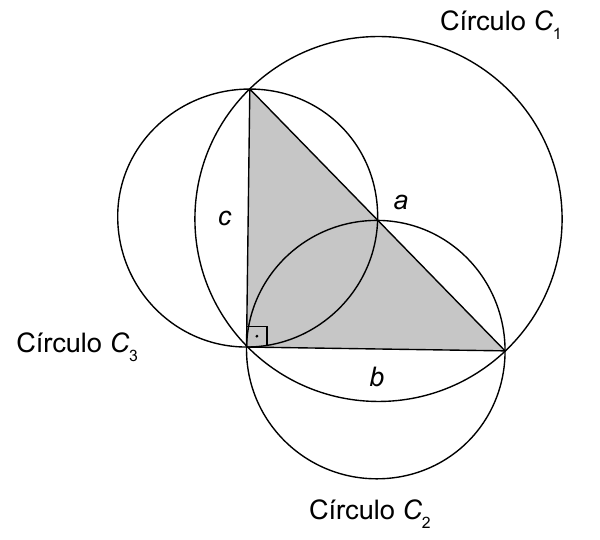
Note that this construction ensures, by the Pythagorean theorem, that area ($C_1$) = area ($C_2$) + area ($C_3$).
A mathematics teacher was familiar with this construction and, fraternizing with two friends in a pizzeria where pizzas are only sold in the shape of circle, launched a challenge: even without using a measuring instrument, could say with certainty whether the area of the circle corresponding to the pizza he ordered was greater, equal to or less than the sum of the areas of the two friends’ pizzas. So, three pizzas were ordered. The teacher divided them in half and formed a triangle with the diameters of the pizzas, as shown in the figure.
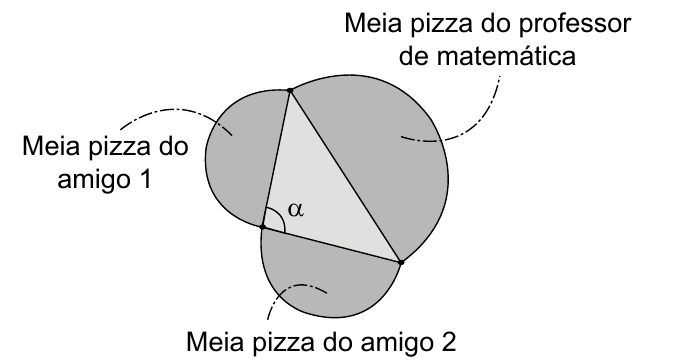
From the measurement of the angle $\alpha$, the professor stated that the area of his pizza is greater than the sum of the areas of the other two pizzas.
The area of the math teacher’s pizza is greater than the sum of the areas of the two other pizzas, because
- A) $0° < \alpha < 90°$
- B) $\alpha = 90°$
- C) $90° < \alpha < 180°$
- D) $\alpha = 180°$
- E) $180° < \alpha < 360°$
Resolution
1. Area and diameter. A circle of diameter $d$ has an area $\pi \left(\frac{d}{2}\right)^2 = \frac{\pi}{4} d^2$. So comparing areas is the same as comparing the diameter squares.
Let $p$ be the diameter of the teacher’s pizza and $m$, $n$ be the diameters of the pizzas of friends. The teacher’s area is greater than the sum of the others when
$$p^2 > m^2 + n^2$$2. The opposite angle. In the triangle formed, the angle $\alpha$ is between the sides $m$ and $n$, facing the side $p$. By the law of cosines:
$$p^2 = m^2 + n^2 - 2mn \cos \alpha$$- if $\alpha = 90°$, $\cos\alpha = 0$ and $p^2 = m^2 + n^2$ (this is the case of Pythagoras, equal areas);
- if $\alpha > 90°$, $\cos \alpha < 0$ and $p^2 > m^2 + n^2$;
- if $\alpha < 90°$, $\cos \alpha > 0$ and $p^2 < m^2 + n^2$.
3. Limits of the angle. $\alpha$ is the interior angle of a triangle, so it is less than $180°$.
Therefore the teacher area is largest exactly when $90° < \alpha < 180°$.
Answer: alternative C.
Be careful with the catch: alternative B ($\alpha = 90°$) is the situation of figure with circles, which gives equal areas, not larger. Alternatives D and E are impossible: an internal angle of a triangle is always smaller than 180°.
For review, see Pythagorean Theorem and Circle Area.
Question 143: Racing Economy Unit
Statement
Among marathon runners, a parameter used is running economy (CE). O value of this parameter is calculated by the ratio between oxygen consumption, in milliliter (mL) per minute (min), and the mass, in kilograms (kg), of the athlete running at a constant speed.
Available at: www.treinamentoonline.com.br. Accessed at: 23 Oct. 2019 (adapted).
A marathon runner, aiming to improve his performance, assisted by a doctor, measures your oxygen consumption per minute at constant speed. Based on this consumption and the athlete’s mass, the doctor calculates the athlete’s EC.
The unit of measurement of the quantity described by the EC parameter is
A) $\dfrac{\text{min}}{\text{mL} \cdot \text{kg}}$
B) $\dfrac{\text{mL}}{\text{min} \cdot \text{kg}}$
C) $\dfrac{\text{min} \cdot \text{mL}}{\text{kg}}$
D) $\dfrac{\text{min} \cdot \text{kg}}{\text{mL}}$
E) $\dfrac{\text{mL} \cdot \text{kg}}{\text{min}}$
Resolution
1. Unit of oxygen consumption. “Milliliter per minute”: mL/min.
2. Divide by mass (kg). The EC is the ratio between consumption and mass:
$$\text{EC} = \frac{\text{consumo}}{\text{massa}} \quad\Rightarrow\quad \frac{\;\frac{\text{mL}}{\text{min}}\;}{\text{kg}} = \frac{\text{mL}}{\text{min} \cdot \text{kg}}$$Dividing by kg is multiplying the denominator by kg.
Answer: alternative B (mL/(min · kg)).
Be careful with the catch: the alternative E multiplies by the mass instead of to divide. Remember: “ratio between X and Y” is $X \div Y$.
To review, see Fees.
Question 144: When to stop production of product II
Statement
The manager of a factory wants to compare the evolution of sales of two similar products (I and II). To do this, he started checking the number of units sold of each of these products each month. The results of this verification, for the months of April to June, are presented in the table.
| Product | Sales in April (unit) | Sales in May (unit) | Sales in June (unit) |
|---|---|---|---|
| I | 80 | 90 | 100 |
| II | 190 | 170 | 150 |
The manager was determined to cease production of product II the following month to one in which sales of product I exceed those of product II.
Suppose that the variation in the number of units sold of products I and II is maintained, month by month, as in the period represented in the table.
In which month did product II stop being produced?
- A) June.
- B) July.
- C) August.
- D) September.
- E) October.
Resolution
1. Monthly variation. Product I increases 10 units per month and product II decreases 20 units per month (two arithmetic progressions).
2. Continue table.
| Month | Product I | Product II |
|---|---|---|
| June | 100 | 150 |
| July | 110 | 130 |
| August | 120 | 110 |
3. First month in which I surpasses II. In July we still have $110 < 130$; in August, $120 > 110$. So sales of I surpass those of II in August.
4. Next month. Production of II stops the following month: September.
Answer: alternative D (September).
Be careful with the catch: alternative C (August) is the month in which I surpasses II; the statement asks for the month following this one.
To review, see Arithmetic Progression.
Question 145: Mean, median and mode of trips
Statement
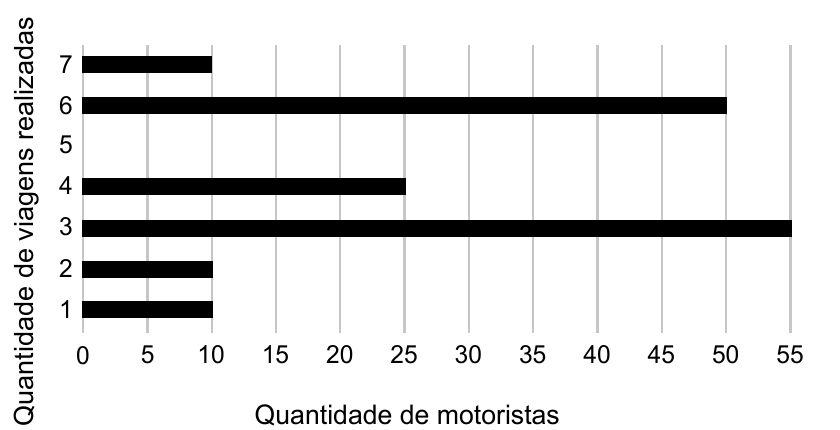
A transport company regularly surveys the number of trips carried out during the day by all 160 drivers registered in your application. On a certain day, a report was generated using a graph bars, in which the number of drivers was related to the number of trips made up to that moment of the day.
Comparing the values of the mean, median and mode of the distribution of number of trips made by drivers registered with this company, you get
- A) median = mean < mode.
- B) median = mode < mean.
- C) median < mean < mode.
- D) mode < mean < median.
- E) mode < median < mean.
Resolution
1. Read the graph. Each bar tells you how many drivers made that number travel:
| Trips | 1 | 2 | 3 | 4 | 5 | 6 | 7 |
|---|---|---|---|---|---|---|---|
| Drivers | 10 | 10 | 55 | 25 | 0 | 50 | 10 |
Total: $10 + 10 + 55 + 25 + 0 + 50 + 10 = 160$ drivers, as the statement says.
2. Fashion. The value with the most drivers is 3 trips (55 drivers).
3. Median. With 160 data, the median is the average of the 80th and 81st values (in order). Accumulating: up to 1 trip, 10; up to 2, 20; up to 3, 75; to 4, 100. The 80th and 81st are in the group of 4 trips, so the median is 4.
4. Average.
$$\bar{x} = \frac{1 \cdot 10 + 2 \cdot 10 + 3 \cdot 55 + 4 \cdot 25 + 6 \cdot 50 + 7 \cdot 10}{160} = \frac{665}{160} \approx 4{,}16$$5. Compare. $3 < 4 < 4{,}16$, that is, mode < median < mean.
Answer: alternative E.
Be careful with the catch: in the graph, the trip numbers are on the axis vertical and the number of drivers horizontally. Who changes the papers (treating 10, 55, 25… as the data) arrives at wrong comparisons.
To review, see Position Measurements.
Question 146: Flow that fills the cistern
Statement
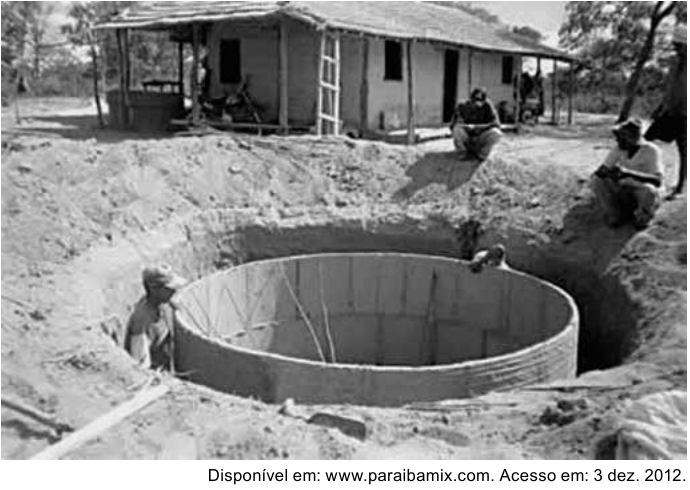
The photo shows the construction of a cistern intended for storing water. A cistern like this, in the form of a straight circular cylinder with 3 m² of floor area, base, was supplied by a watercourse with a constant flow. Your owner recorded the height of the water level inside the cistern during the supply at different times of the same day, according to the table.
| Time (h) | Water level (m) |
|---|---|
| 6:00 | 0,5 |
| 8:00 | 1,1 |
| 12:00 | 2,3 |
| 15:00 | 3,2 |
What was the flow rate, in cubic meters per hour, of the watercourse that supplied the cistern?
- A) 0,3
- B) 0,5
- C) 0,9
- D) 1,8
- E) 2,7
Resolution
1. Level rising speed. Between 6:00 and 8:00 (2 hours) the level rose $1{,}1 - 0{,}5 = 0{,}6$ m, i.e. $0{,}3$ m per hour. Checking on others ranges: $\frac{2{,}3 - 1{,}1}{4} = 0{,}3$ and $\frac{3{,}2 - 2{,}3}{3} = 0{,}3$.
2. Volume per hour. In a cylinder, volume = base area × height. Every time to enter
$$3 \text{ m}^2 \cdot 0{,}3 \text{ m} = 0{,}9 \text{ m}^3$$Answer: alternative C (0,9 m³/h).
Be careful with the catch: alternative A (0,3) is the ascent speed of the level (in m/h), not the flow rate. It remains to multiply by the base area.
Question 147: Pass to the player with the same angle (arc capable)
Statement
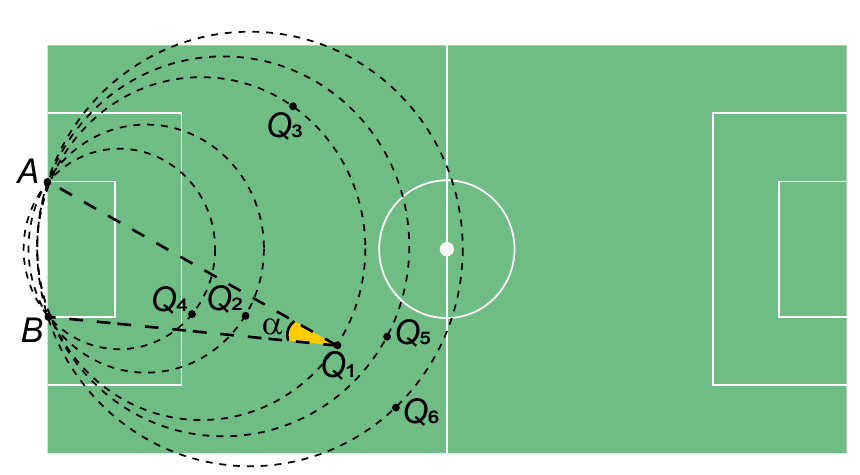
At a certain point in a digital game, the screen displays the image represented in the figure. The point $Q_1$ represents the position of a player who has the ball, the Points $Q_2$, $Q_3$, $Q_4$, $Q_5$ and $Q_6$ also indicate player positions of the same team, and the points $A$ and $B$ indicate the two feet of the nearest goalpost of them. At the moment of the match depicted, player $Q_1$ has possession of the ball, which will be passed to one of the other players in positions $Q_n$, $n \in \lbrace 2, 3, 4, 5, 6 \rbrace$, whose angle $A\widehat{Q_n}B$ has the same measurement as the angle $\alpha = A\widehat{Q_1}B$.
Which player will receive the ball?
- A) $Q_2$
- B) $Q_3$
- C) $Q_4$
- D) $Q_5$
- E) $Q_6$
Resolution
1. Capable arc. All points on the same circular arc that passes through by $A$ and $B$ “see” the segment $AB$ from the same angle. This comes from inscribed angle theorem: inscribed angles that determine the same arc $AB$ have the same measurement (half the arc).
2. Find the circumference of $Q_1$. The dashed circumferences of the figure all pass through $A$ and $B$. Following the one that passes through $Q_1$, we see that it also passes through $Q_3$ (on the same side as $AB$).
3. The other players. $Q_2$ and $Q_4$ are on smaller circumferences (closer to the beam, see $AB$ from a greater angle); $Q_5$ and $Q_6$ are in larger circumferences (see $AB$ at a smaller angle).
Therefore, the angle $A\widehat{Q_3}B$ is equal to $\alpha$.
Answer: alternative B ($Q_3$).
Be careful with the catch: $Q_2$ is on the same straight as $A$ and $Q_1$, which can be misleading, but being aligned does not guarantee the same angle. What What matters is being on the same circle that passes through $A$, $B$ and $Q_1$.
To review, see Inscribed Angle.
Question 148: Magic triangle
Statement
The triangle in the figure is called the magic triangle. In the circles, write the numbers from 1 to 6, without repetition, with a number in each circle. The objective is distribute the numbers so that the sums of the numbers on each side of the triangle are equal.
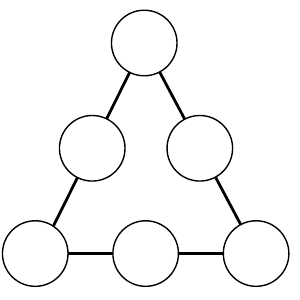
Consider that the numbers placed at the vertices of the triangle are in arithmetic progression with a ratio equal to 2.
Under the proposed conditions, what are the possible solutions for the sums of numbers What form the sides of the triangle?
- A) There is only one possible solution, and the sums on each side of the triangle are equal to 7.
- B) There is only one possible solution, and the sums on each side of the triangle are equal to 9.
- C) There are only two possible solutions, one in which the sums on each side of the triangle are equal to 7 and one in which the sums are equal to 9.
- D) There are only two possible solutions, one in which the sums on each side of the triangle are equal to 9 and one in which the sums are equal to 12.
- E) There are only two possible solutions, one in which the sums on each side of the triangle are equal to 10 and one in which the sums are equal to 11.
Resolution
1. Possible vertices. Three numbers from 1 to 6 in PA of ratio 2: $\lbrace 1, 3, 5 \rbrace$ or $\lbrace 2, 4, 6 \rbrace$. There is no other option (starting at 3, the third term would be 7).
2. Sum of each side. Adding the three sides, each vertex is counted two times (belongs to two sides) and each middle number once. How $1 + 2 + \dots + 6 = 21$, if $V$ is the sum of the vertices and $S$ the sum of each side:
$$3S = 21 + V$$- vertices $1, 3, 5$: $V = 9$, then $3S = 30$ and $S = 10$;
- vertices $2, 4, 6$: $V = 12$, then $3S = 33$ and $S = 11$.
3. Check that each case works.
- $S = 10$: between 1 and 3 is $10 - 4 = 6$; between 3 and 5 is $10 - 8 = 2$; between 1 and 5 is $10 - 6 = 4$. Uses 2, 4, 6. ✔
- $S = 11$: between 2 and 4 is $11 - 6 = 5$; between 4 and 6 is $11 - 10 = 1$; between 2 and 6 is $11 - 8 = 3$. Uses 1, 3, 5. ✔
There are two solutions, with sums 10 and 11.
Answer: alternative E.
To review, see Arithmetic Progression.
Question 149: Room draw with cards (probability)
Statement
In university accommodation, there are some rooms with a higher standard than of the others. One of these rooms became available, and many students applied to live there. To choose who will get the room, a draw will be held. For this draw, individual cards with the names of all registered students will be deposited in a ballot box, and, for Each first-year student will have a single card with their name on it; for each second-year student, two cards with their name; and, for each third-year student, three cards with his name. 200 were registered first-year, 150 second-year and 100 third-year students. All cards have the same probability of being drawn.
What is the probability that the winner of the draw will be a third-year student?
- A) $\frac{1}{2}$
- B) $\frac{1}{3}$
- C) $\frac{1}{8}$
- D) $\frac{2}{9}$
- E) $\frac{3}{8}$
Resolution
It is the cards that are equiprobable, not the students. So we count cards.
1. Cards from each year.
- 1st year: $200 \cdot 1 = 200$ cards;
- 2nd year: $150 \cdot 2 = 300$ cards;
- 3rd year: $100 \cdot 3 = 300$ cards.
Total: $800$ cards.
2. Probability.
$$P = \frac{300}{800} = \frac{3}{8}$$Answer: alternative E ($\frac{3}{8}$).
Be careful with the trick: counting students instead of cards gives $\frac{100}{450} = \frac{2}{9}$, alternative D.
To review, see Introduction to Probability.
Question 150: Reservoir water rationing
Statement
The water used by 75 residents of a village comes from a water reservoir. straight circular cylindrical shape whose base radius measures 5 meters, always supplied on the first day of each month by tanker trucks. Every resident of this village consumes, on average, 200 liters of water per day.
In the month of June of a certain year, the village celebrated its patron saint’s day. and there was an extra use of water in the first 20 days. After this period, the people checked the amount of water present in the reservoir and found that the level of the water column was at 1,5 meter. They then decided to make a water rationing during the 10 following days. Consider 3 as an approximation to $\pi$.
What is the minimum amount of water, in liters, that each resident, on average, should save per day, so that the reservoir does not run out of water in the next 10 days?
- A) 50
- B) 60
- C) 80
- D) 140
- E) 150
Resolution
1. Remaining water. Volume of the cylinder with radius 5 m and height 1,5 m:
$$V = \pi r^2 h = 3 \cdot 5^2 \cdot 1{,}5 = 112{,}5 \text{ m}^3 = 112\thinspace 500 \text{ L}$$(1 m³ = 1 000 L.)
2. How much each resident can spend per day. The water needs to last 10 days for 75 people:
$$\frac{112\thinspace 500}{75 \cdot 10} = \frac{112\thinspace 500}{750} = 150 \text{ L por pessoa por dia}$$3. Economy. Each one consumed 200 L and can now use 150 L:
$$200 - 150 = 50 \text{ L por dia}$$Answer: alternative A (50 liters).
Be careful with the catch: alternative E (150) is how much each resident still can consume, not how much it should save.