
Euler's Eyes
2026-10-30
The legacy of Siméon Denis Poisson
Things of every kind are subject to a universal law which may be called the law of large numbers. It consists in this: if we observe very considerable numbers of events of the same nature, we shall find among these numbers ratios that are almost constant.
— Siméon Denis Poisson, Researches on the probability of judgements (1837)
Poisson published more than three hundred works and several treatises, among them a Treatise on mechanics (1811, enlarged in 1833) that trained generations of engineers, the New theory of capillary action (1831) and the Mathematical theory of heat (1835). But his name has survived above all through what spread as formulas.
What bears his name
- Poisson’s equation, $\nabla^2 V = -4\pi\rho$, of gravitation, electrostatics and, today, the simulation of chips and fluids.
- Poisson brackets and Poisson’s theorem in mechanics, together with the Poisson manifolds of modern geometry.
- The Poisson distribution and the Poisson process, the standard model for random arrivals: customers in a queue, machine failures, mutations in DNA, photons in a detector.
- The law of large numbers, which he named, and Poisson’s theorem on trials with different probabilities.
- Poisson’s ratio in elasticity.
- The Poisson summation formula of Fourier analysis.
- The Poisson kernel and Poisson integral, which give the solution of Laplace’s equation in a disc from the values on its boundary.
- Poisson’s spot, or Arago’s spot, in optics.
On the wrong side
Poisson was the last great champion of Laplace’s programme, which sought to explain all of physics by forces between particles. The programme bore fruit, such as the equation of 1813, but put him on the losing side of several disputes: against Fresnel’s wave theory of light, which he ended up confirming unwittingly with the spot; in defending a single elastic constant, contradicted by the ratio that bears his name; and in a long rivalry with Fourier over the theory of heat, in which Fourier accused Poisson of redoing his results by more tortuous methods without giving him due credit.
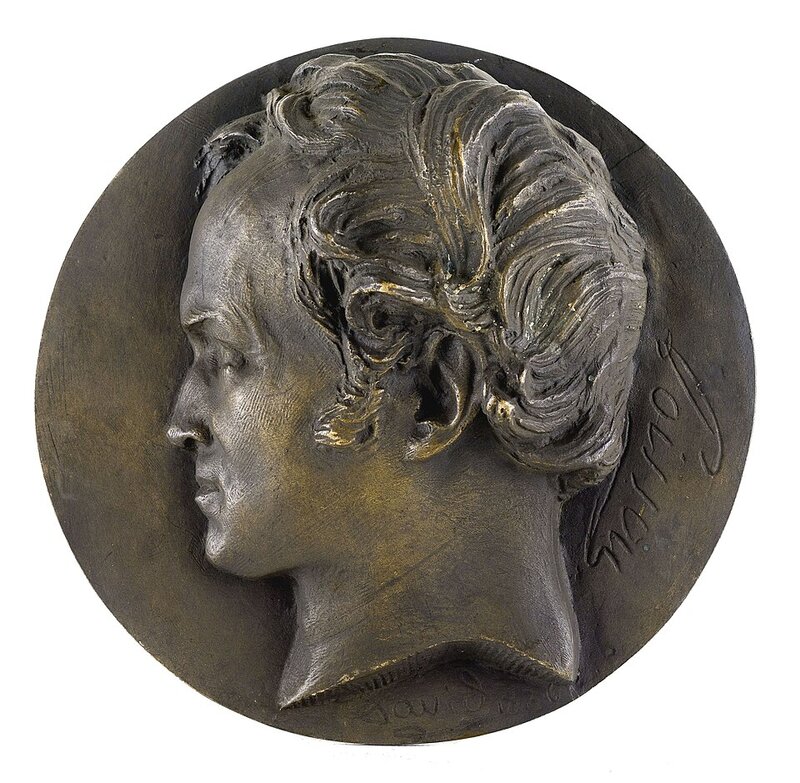
The teacher
Poisson’s greatest immediate legacy was teaching. For almost forty years he was a professor and examiner at the École Polytechnique, and as a member of the Royal Council of Public Instruction he had great influence on the teaching of mathematics in French secondary schools. Many of the French engineers and scientists of the nineteenth century learned mechanics in his classes and from his treatise.
Places
Poisson’s name is one of the 72 engraved by Gustave Eiffel on the Eiffel Tower. There is a crater Poisson on the Moon, and in Pithiviers, his home town, a school and a square bear his name.
Exercise: random arrivals
In a Poisson process, events occur at random with mean rate $r$ per unit time, and their number in an interval of length $t$ follows the Poisson distribution with $\lambda = rt$. If on average 3 customers per minute arrive at a till, what is the probability that nobody arrives in 30 seconds?
In half a minute, $\lambda = 3 \cdot 0.5 = 1.5$. The probability of zero arrivals is $e^{-1.5} \approx 0.223$. This also says that the waiting time until the next arrival exceeds 30 seconds with probability $0.223$: in a Poisson process, the intervals between arrivals follow the exponential distribution.
Exercise: mean and variance
Show that, in the Poisson distribution, the mean is $\lambda$. (The variance is also $\lambda$.)
The mean is $\sum_{k \ge 0} k\, e^{-\lambda}\frac{\lambda^k}{k!} = e^{-\lambda}\lambda \sum_{k \ge 1} \frac{\lambda^{k-1}}{(k-1)!} = e^{-\lambda}\lambda\, e^{\lambda} = \lambda$, using the series $e^\lambda = \sum_{j \ge 0} \frac{\lambda^j}{j!}$. This equality of mean and variance is a practical test: if a count has a variance much larger than its mean, the events are not independent, and the Poisson model does not apply.
Sources: François Arago, “Poisson”, in Œuvres complètes de François Arago, vol. 2 (1854) · Michel Métivier, Pierre Costabel and Pierre Dugac (eds.), Siméon-Denis Poisson et la science de son temps (1981) · Ivor Grattan-Guinness, Convolutions in French Mathematics, 1800–1840 (1990).
All topics on Siméon Denis Poisson · ← The Poisson distribution · Image credits →