
Euler's Eyes
2026-10-14
Mean curvature: how much a surface bends
To write the equation of vibrating plates, Sophie Germain had to answer a question that sounds simple: how much is a surface bent at a point? Her answer, mean curvature, is still used today to study soap bubbles, cell membranes and aircraft skins.
The curvature of a curve
Let us start with a line. A straight line does not bend, and we say its curvature is zero. A circle bends equally at every point, and the smaller it is, the more it bends. That is why the curvature of a circle of radius $R$ is defined as
$$\kappa=\frac1R.$$A circle of radius 1 cm has curvature 1; one of 1 metre, $0.01$ per centimetre. For any curve, one takes at each point the circle that fits it best there, the osculating circle, and the curvature is the reciprocal of its radius.
A surface has many curvatures
On a surface, things get more complicated. Think of a point on the side of a can. If you walk along the can, vertically, the path is straight: curvature zero. If you walk around it, the path is a circle of radius $r$: curvature $\frac1r$. In intermediate directions, intermediate values.
In 1760 Euler showed that this always happens in an organised way. At each point there is a direction of maximum curvature, $\kappa_1$, and one of minimum curvature, $\kappa_2$, perpendicular to each other. These are the principal curvatures. In a direction making an angle $\theta$ with the first, the curvature is
$$\kappa(\theta)=\kappa_1\cos^2\theta+\kappa_2\sin^2\theta.$$Sophie Germain’s idea
Sophie Germain needed one number to say how much the plate resists being bent. Her hypothesis was to add the two principal curvatures. Today we use half that sum, called the mean curvature:
$$H=\frac{\kappa_1+\kappa_2}{2}.$$The name is exact. If you average $\kappa(\theta)$ over all directions, since the average of $\cos^2\theta$ and of $\sin^2\theta$ over a full turn is $\frac12$, the result is precisely $\frac{\kappa_1+\kappa_2}{2}$. The mean curvature is the average of the curvatures in all directions.
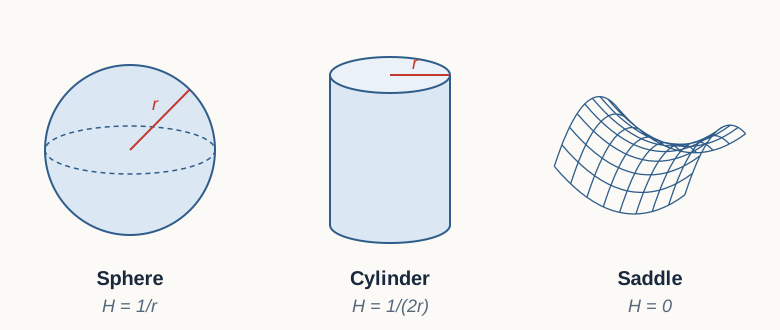
- Sphere of radius $r$: both curvatures are $\frac1r$, and $H=\frac1r$.
- Cylinder of radius $r$: one curvature is $\frac1r$ and the other is $0$, and $H=\frac1{2r}$.
- Saddle: the surface rises in one direction and falls in the other, the curvatures have opposite signs, and at the central point $H=0$.
Germain and Gauss: sum and product
In 1827 Gauss, Sophie’s correspondent, studied another combination of the same two curvatures: the product $K=\kappa_1\kappa_2$, now called Gaussian curvature. The two numbers say different things.
Gauss’s product measures what does not change when the surface is bent without stretching. A cylinder has $K=0$, like a sheet of paper, and indeed it rolls up from a sheet without crumpling. A sphere has $K=\frac1{r^2}$, and that is why no world map is perfect.
Germain’s sum measures what costs energy: how much the surface is curved, regardless of whether it could be unrolled. That is why it appears in elasticity and in films.
Soap bubbles
In 1805 Thomas Young and Pierre-Simon Laplace discovered that the pressure inside a surface under tension is greater than outside, by an amount proportional to the mean curvature. A soap bubble is round because, for a given volume, the sphere is the shape with the same mean curvature at every point.
And a soap film held on a wire, with air on both sides, has the same pressure on both faces. So its mean curvature is zero at every point: it curves one way in one direction and the other way in the perpendicular direction, like a saddle. The Belgian physicist Joseph Plateau studied these minimal surfaces with wire and soap in 1873, and they became one of the richest subjects in geometry.
Exercise: compute H and K for a cylinder of radius 2 and for a sphere of radius 2
Cylinder: $\kappa_1=\frac12$ and $\kappa_2=0$, so $H=\frac14$ and $K=0$. Sphere: $\kappa_1=\kappa_2=\frac12$, so $H=\frac12$ and $K=\frac14$. With the same radius, the sphere has twice the mean curvature of the cylinder.
Exercise: what is the excess pressure inside a soap bubble of radius 1 cm?
The soap film has two faces, inside and outside, and each contributes $\frac{2\gamma}{R}$, where $\gamma\approx0.025$ N/m is the surface tension of soapy water. So
$$\Delta p=\frac{4\gamma}{R}=\frac{4\cdot0.025}{0.01}=10\ \text{Pa}.$$That is about one ten-thousandth of atmospheric pressure. A smaller bubble has higher pressure: that is why, when two bubbles touch, the small one pushes into the large one.
Sources: Louis L. Bucciarelli and Nancy Dworsky, Sophie Germain: An Essay in the History of the Theory of Elasticity (1980) · Leonhard Euler, “Recherches sur la courbure des surfaces” (1760) · biography of Sophie Germain, MacTutor.
All Sophie Germain topics · ← Chladni figures and the prize for vibrating plates · Sophie Germain’s legacy →