
Euler's Eyes
2026-11-16
FUVEST 2027 – 1st phase: Mathematics solved
Source: FUVEST – test V1 and corrected answer key of the General Knowledge Test (1st phase), held on 01/11/2026 (1 November 2026).
The 1st phase of FUVEST 2027 had 80 multiple-choice questions covering all subjects (ten fewer than in 2026, with the same five hours). This post covers the mathematics questions, including the interdisciplinary ones in which mathematics does the main work. The numbering is that of Test V1; in versions V2, V3 and V4 the same questions appear in a different order (the official answer key includes a correspondence table).
The statements below are our English translation of the Portuguese originals.
Answer key
| Question | Topic | Answer |
|---|---|---|
| 13 | Reading a table: differences and ratios | D |
| 23 | Distance along a parallel; approximating the cosine | Annulled |
| 31 | Slope as a percentage and the tangent | C |
| 32 | Powers of 3 and a sum of points | C |
| 34 | An even function with exponentials | B |
| 35 | Linear circuit: combining experiments | A |
| 59 | Combinations: the spider and the vibrations | A |
| 67 | Counting up to a 120° rotation | A |
Question 13: Average income by sex and colour
Statement
The Ministry of Women is a body of the Federal Government responsible for coordinating and creating public policies to promote the rights, equality and protection of women, fighting violence and gender inequality. In 2025, the ministry released the Annual Socioeconomic Report on Women, which presents several analyses, including a comparison of the average incomes of people of different sexes, races or colours, as shown in the table below:
Real average monthly income usually received from all jobs, of people aged 14 or over employed in the reference week (R$, at average prices of the 2nd quarter of 2024)
| Sex and colour or race | Brazil | North | Northeast | Southeast | South | Centre-West |
|---|---|---|---|---|---|---|
| Total | 3,214 | 2,508 | 2,238 | 3,627 | 3,528 | 3,641 |
| White | 4,148 | 3,515 | 3,046 | 4,528 | 3,872 | 4,741 |
| Black or brown | 2,460 | 2,266 | 1,964 | 2,704 | 2,632 | 3,024 |
| Women | 2,790 | 2,313 | 2,081 | 3,080 | 2,981 | 3,025 |
| White | 3,529 | 3,073 | 2,758 | 3,828 | 3,245 | 3,914 |
| Black or brown | 2,146 | 2,111 | 1,845 | 2,262 | 2,230 | 2,498 |
| Men | 3,529 | 2,632 | 2,347 | 4,054 | 3,947 | 4,111 |
| White | 4,644 | 3,834 | 3,257 | 5,109 | 4,368 | 5,424 |
| Black or brown | 2,680 | 2,362 | 2,044 | 3,029 | 2,913 | 3,407 |
Source: IBGE, Continuous National Household Sample Survey. The rows “Total”, “Women” and “Men” include people who did not declare their colour or who declared themselves Indigenous or Asian.
Considering the data in the table, it is correct to state:
- A) The average income of women is lower than that of Black or brown men in every major region of Brazil.
- B) The ratio between the average income of Brazilian women and that of Brazilian men is 90%.
- C) In only two of the major regions is the average income of women higher than that of Brazilian women.
- D) The difference in average income between white Brazilian men and women is greater than the difference in this income between Black or brown Brazilian men and women.
- E) The average income of Black or brown women in the Southeast region is half that of white men in the same region.
Solution
Each option asks for a small calculation. The work is finding the right row and column.
A) Women vs. Black or brown men, region by region.
| North | Northeast | Southeast | South | Centre-West | |
|---|---|---|---|---|---|
| Women | 2,313 | 2,081 | 3,080 | 2,981 | 3,025 |
| Black or brown men | 2,362 | 2,044 | 3,029 | 2,913 | 3,407 |
In the Northeast (and also in the Southeast and South) women earn more. False.
B) Ratio women/men in Brazil.
$$\frac{2790}{3529} \approx 0.79 = 79\%$$not 90%. False.
C) Regions where women earn more than their national average (R$ 2,790). Southeast (3,080), South (2,981) and Centre-West (3,025): three regions, not two. False.
D) Difference between men and women, by colour, in Brazil.
$$\text{white: } 4644 - 3529 = 1115 \qquad \text{Black or brown: } 2680 - 2146 = 534$$The difference among white people is larger (more than double). True.
E) Southeast. Half the income of white men is $\frac{5109}{2} \approx 2555$, but Black or brown women earn 2,262. False.
Answer: option D.
Watch out: in option A, looking only at Brazil as a whole (2,790 vs. 2,680) already shows that women earn more on average than Black or brown men. A claim about “every region” falls with a single counterexample.
To review, see Percentage.
Question 23: From Porto de Galinhas to Luanda along the 9° S parallel
Question annulled by FUVEST. In an official note of 2 November 2026, FUVEST stated that, from a strictly mathematical point of view, the question “has a correct answer”, but that the error in the geographic coordinates on the map and in the names of the cities was sufficient reason to annul it.
Statement
The city of Luanda, capital of Angola, on the Atlantic Ocean, is located in the southern hemisphere and east of the Greenwich meridian. Its approximate coordinates are 9° South (latitude) and 13° East (longitude). Porto de Galinhas, in Pernambuco, is located at approximately 9° South (latitude) and 35° East (longitude). For historical reasons, the length of the Equator is very close to 40 thousand kilometres. We want to estimate the distance a ship must travel between Porto de Galinhas and Luanda if it moves along the 9° South parallel.
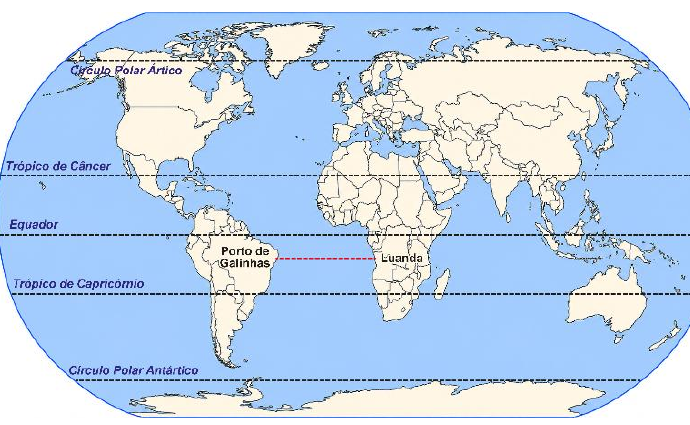
Assuming the Earth is perfectly spherical, the estimated distance, in kilometres, is approximately
- A) 2.4 thousand.
- B) 2.0 thousand.
- C) 1.5 thousand.
- D) 3.0 thousand.
- E) 2.7 thousand.
Note and use: $\pi^2 \approx 10$; $\cos(x) \approx 1 - \frac{x^2}{2}$, when $x$ is in radians and $|x| < 0.5$.
Comment
Where the error is. Porto de Galinhas is at about 35° West, not East: all of Brazil lies west of Greenwich. With the real coordinates, the difference in longitude would be $35° + 13° = 48°$, and the distance would be about 5.3 thousand km, which is not among the options. The calculation below follows the statement as written (both cities to the east), which is the reading that leads to option A.
1. The radius of the parallel. A parallel at latitude $\varphi$ is a circle of radius $R\cos\varphi$, where $R$ is the Earth’s radius. So the length of the parallel is that of the Equator multiplied by $\cos\varphi$:
$$C_{9°} = 40\,000 \cdot \cos 9°$$2. The cosine of 9° with the given approximation. In radians, $9° = \frac{\pi}{20}$. Then
$$\cos 9° \approx 1 - \frac{1}{2}\left(\frac{\pi}{20}\right)^2 = 1 - \frac{\pi^2}{800} \approx 1 - \frac{10}{800} = 0.9875$$3. The fraction of the parallel. According to the statement, the longitudes are 13° E and 35° E, and the difference is $22°$, that is, $\frac{22}{360}$ of a full turn:
$$d \approx \frac{22}{360} \cdot 40\,000 \cdot 0.9875 \approx 2\,444 \cdot 0.9875 \approx 2\,414 \text{ km}$$Expected answer: option A (about 2.4 thousand km).
The effect of the cosine is small here (near the Equator, $\cos 9°$ is almost 1): along the Equator alone it would already be 2.44 thousand km. The “Note and use” box lets the candidate confirm that the correction does not change the option.
To review, see Radians and the unit circle.
Question 31: How much must the ridge rise?
Statement
A symmetric gable roof was built on a house 12 m wide at the front and 20 m deep. The slope of the tiles relative to the line through the walls is 17.6%. Slope ($i\%$) as a percentage is common in civil construction and is calculated as follows: $i = \frac{x}{y}\cdot 100$, where $x$ is a vertical distance and $y$ the corresponding horizontal distance, as in the images below (cumeeira = ridge, visão frontal = front view):
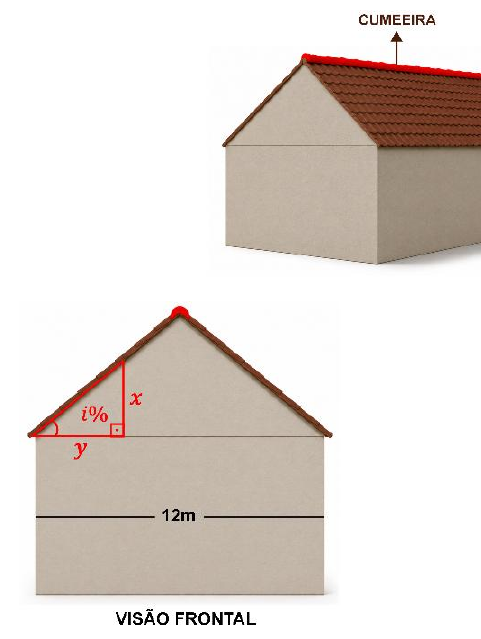
Over time, on days of heavy rain, the house began to show leaks in the roof. A technician was called to try to solve the problem and found that, for the specific type of tile used, the slope was wrong. So one way to stop the leaks is to increase the slope of the roof to 25°.
With this solution, by approximately how many metres must the ridge rise, relative to its previous height, with this change in the roof slope?
- A) 0.44
- B) 1.06
- C) 1.76
- D) 2.82
- E) 2.94
Note and use: $\sin 25° \cong 0.42$; $\cos 25° \cong 0.91$; $\tan 25° \cong 0.47$.
Solution
1. The horizontal distance. The roof is symmetric and the ridge runs along the depth, right in the middle of the 12 m front. Each slope covers, horizontally,
$$y = \frac{12}{2} = 6 \text{ m}$$(the 20 m depth plays no part in the calculation).
2. Current height. A slope of 17.6% means $\frac{x}{y} = 0.176$:
$$x_{\text{before}} = 0.176 \cdot 6 = 1.056 \text{ m}$$3. New height. With an angle of 25°, the ratio $\frac{x}{y}$ is the tangent:
$$x_{\text{after}} = 6 \cdot \tan 25° \approx 6 \cdot 0.47 = 2.82 \text{ m}$$4. How much it rises.
$$2.82 - 1.056 \approx 1.76 \text{ m}$$Answer: option C (1.76).
Watch out: options B (1.06) and D (2.82) are the heights before and after; the question asks for the difference. And a slope given as a percentage is the tangent times 100, not the angle: 17.6% corresponds to an angle of about 10°, not 17.6°.
To review, see Relations in the right triangle.
Question 32: 820 points in powers of 3
Statement
In a card tournament, the following scoring system was used: whoever wins the first round gets 1 point and, from the second round on, the score is triple that of the previous round. So the winner of the first round gets 1 point, the winner of the second gets 3 points, whoever wins the third gets 9, and so on until the end of the tournament. A player scores only by winning the round.
If a player accumulated 820 points over the whole tournament, how many rounds did they win?
- A) 2
- B) 3
- C) 4
- D) 5
- E) 6
Solution
Round $k$ is worth $3^{k-1}$ points: 1, 3, 9, 27, 81, 243, 729, … The player’s total is a sum of distinct powers of 3 (each round is won at most once).
1. Breaking 820 down, from the largest power to the smallest.
$$820 = 729 + 91, \qquad 91 = 81 + 10, \qquad 10 = 9 + 1$$So
$$820 = 729 + 81 + 9 + 1 = 3^6 + 3^4 + 3^2 + 3^0$$2. The decomposition is unique. Writing a number as a sum of distinct powers of 3 is writing it in base 3 using only the digits 0 and 1. Here, $820 = (1010101)_3$, with four digits equal to 1. So there is no other way to make 820: the answer does not depend on any choice.
One way to see that the largest term must be 729: all the smaller powers together add up to only $1 + 3 + 9 + 27 + 81 + 243 = 364 < 820$.
3. Counting. There are 4 terms, so the player won rounds 1, 3, 5 and 7.
Answer: option C (4).
To review, see Powers.
Question 34: An even function with exponentials
Statement
Consider the equation
$$f(x) = \frac{2e^{x^2} + C}{3Ce^{-x^2/2}}$$where $f$ is a real function for every real number $x$ and $C > 0$ is a constant. Based on the function $f$ and the constant $C$, one can state:
- A) $f(0) = 1$ and $f(x) = 0$, for some real number $x$ and for $C = 1$.
- B) $f(0) = 1$ and $f(x) = f(-x)$, for every real number $x$ and for some $C > 0$.
- C) $f(0) > 1$ and $f(x) < f(-x)$, for every real number $x$ and for every $C > 0$.
- D) $f(1) < 0$ and $f(x) = f(-x)$, for some real number $x$ and for $C = 1$.
- E) $f(1) = 0$ and $f(x) > f(-x)$, for every real number $x$ and for some $C > 0$.
Solution
Two observations settle the whole question.
1. $f$ is always positive. With $C > 0$, the numerator $2e^{x^2} + C$ and the denominator $3Ce^{-x^2/2}$ are positive for every $x$. So $f(x) > 0$ always. This already rules out A ($f(x) = 0$), D ($f(1) < 0$) and E ($f(1) = 0$).
2. $f$ is even. The variable only appears as $x^2$, and $(-x)^2 = x^2$. So $f(-x) = f(x)$ for every $x$, whatever $C$ is. This rules out C, which requires $f(x) < f(-x)$ (impossible: both sides are equal).
3. Checking B. At $x = 0$:
$$f(0) = \frac{2e^0 + C}{3Ce^0} = \frac{2 + C}{3C}$$$f(0) = 1 \iff 2 + C = 3C \iff C = 1$. So there is a $C > 0$ (namely $C = 1$) with $f(0) = 1$, and for it $f(x) = f(-x)$ for every $x$. B is true.
Answer: option B.
Read carefully: in C, “$f(0) > 1$ for every $C > 0$” is also false on its own: with $C = 2$, $f(0) = \frac{4}{6} < 1$.
To review, see The concept of function.
Question 35: Linear circuit and combining experiments
Statement
In a laboratory, a researcher carries out experiments on an electric circuit made of ideal wires and resistors, not necessarily equal, as in the image below:
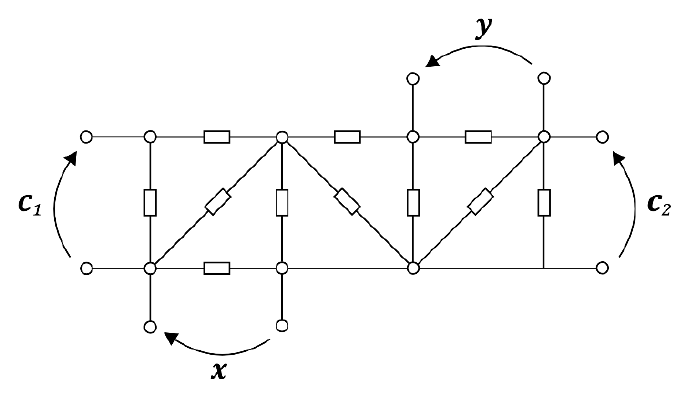
When voltage sources are set so that $(c_1, c_2) = (5, 10)$ volts, one finds $(x, y) = (5, 3)$ volts. The experiment is repeated with $(c_1, c_2) = (3, 3)$ volts, measuring $(x, y) = (1, 2)$ volts. When $(c_1, c_2) = (2, 1)$ volts is set, what must $5(x + y)$ be, in volts?
- A) 7
- B) 10
- C) 1
- D) 5
- E) 2
Solution
There is no need to analyse the circuit resistor by resistor.
1. The idea: the circuit is linear. A circuit made only of ideal wires and resistors obeys Ohm’s law, which is linear. By the superposition principle, the measured voltages $(x, y)$ depend linearly on the sources $(c_1, c_2)$: if the sources are $a(5, 10) + b(3, 3)$, the measurements are $a(5, 3) + b(1, 2)$.
2. Writing $(2, 1)$ as a combination of the two experiments.
$$a(5, 10) + b(3, 3) = (2, 1) \iff \begin{cases} 5a + 3b = 2 \\ 10a + 3b = 1 \end{cases}$$Subtracting the first equation from the second: $5a = -1$, so $a = -\frac{1}{5}$. In the first: $3b = 2 + 1 = 3$, so $b = 1$.
3. The measurements.
$$(x, y) = -\frac{1}{5}(5, 3) + 1\cdot(1, 2) = \left(-1 + 1,\; -\frac{3}{5} + 2\right) = \left(0,\; \frac{7}{5}\right)$$4. The requested quantity.
$$5(x + y) = 5\left(0 + \frac{7}{5}\right) = 7 \text{ V}$$Answer: option A (7).
The factor 5 in the statement is there only to make the answer an integer. Note that the coefficient $a$ is negative: by linearity, reversing the polarity of a source reverses the sign of its contribution.
Question 59: The spider and the web’s vibrations
Statement
It is known that spiders generally do not use sight, hearing or smell to detect when prey falls into their web. They use information gathered by their eight legs about the signal coming from the vibration produced by the prey.
Consider a simplified situation, illustrated below, with the spider’s legs evenly distributed, where a black dot indicates the direction and sense from which the signal caused by a prey comes. Assume also that the spider is always alert, waiting motionless at the centre of the web. When there are only two black dots, the spider sets off in the average direction and sense indicated by them, except when the two black dots are diametrically opposite (aranha se move = the spider moves; aranha não se move = the spider does not move):
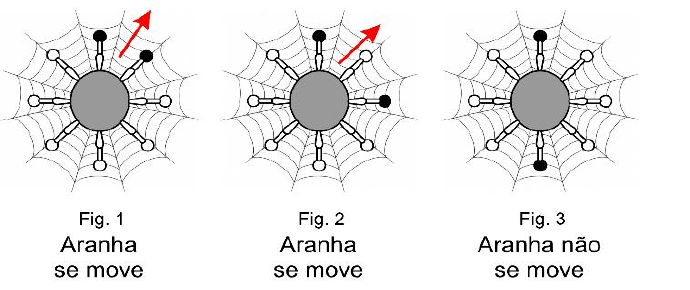
When there are exactly four black dots, the spider does not move only when they are opposite two by two, as if they were two pairs of opposite dots.
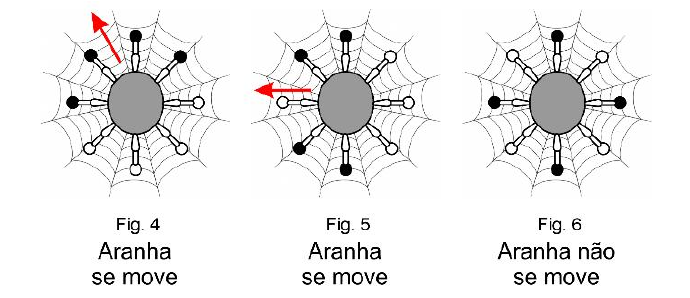
Considering the information and figures given, in the situation with only two or only four black dots, how many different combinations make the spider move?
- A) 88
- B) 85
- C) 82
- D) 58
- E) 63
Solution
The 8 legs point in 8 evenly spaced directions (every 45°), forming 4 pairs of opposite legs. We count all choices and remove the ones that leave the spider still.
1. Two dots. There are $\binom{8}{2} = 28$ choices. The spider stays still only when the two are opposite, and there are 4 opposite pairs:
$$28 - 4 = 24$$2. Four dots. There are $\binom{8}{4} = \frac{8\cdot7\cdot6\cdot5}{4!} = 70$ choices. The spider stays still when the four form two opposite pairs, that is, when we choose 2 of the 4 pairs:
$$\binom{4}{2} = 6 \quad\Rightarrow\quad 70 - 6 = 64$$3. Total.
$$24 + 64 = 88$$Answer: option A (88).
Why only these cases? The spider “sets off in the average direction”, so it stays still when the sum of the dots’ vectors is zero. With 8 evenly spaced directions, a sum of four of them vanishes only when they form two opposite pairs (the statement already says so, and a computer check of the 70 choices confirms it). A square, for example, is just two opposite pairs.
To review, see Combinations and the binomial theorem.
Question 67: Colourings of the triangular board
Statement
Two cells of a board shaped like an equilateral triangle, divided into 36 equilateral triangles, are painted yellow. Two colourings are considered equivalent if one can be obtained from the other by a 120° rotation about the point where the angle bisectors meet, as illustrated in the images below:
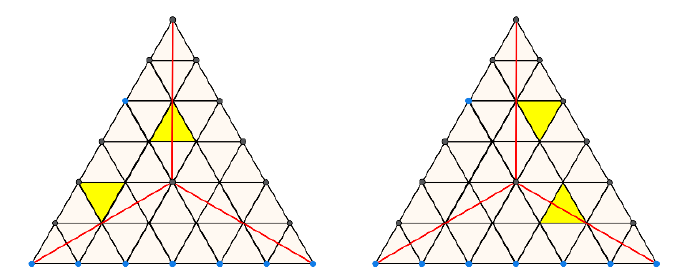
Considering the images shown, how many non-equivalent colourings are there?
- A) 210
- B) 315
- C) 420
- D) 630
- E) 1260
Solution
1. All colourings. Choose 2 of the 36 cells, order not mattering:
$$\binom{36}{2} = \frac{36\cdot 35}{2} = 630$$2. Grouping equivalent ones. Rotating the board by 120°, 240° and 360° about the centre, each colouring produces a group of equivalent colourings. The group has 3 different colourings, unless some rotation by 120° or 240° leaves the colouring unchanged.
3. No colouring stays fixed. For a colouring to stay the same after a 120° rotation, the set of the two yellow cells would have to be mapped onto itself. But the 120° rotation has order 3: it cannot swap two cells (doing that twice would put everything back after 240°, not after 360°). So it would have to fix each yellow cell, and no cell is fixed: the board has side 6, and the centre (where the bisectors meet) falls on a vertex of the grid, $\frac{6}{3} = 2$ rows above the base, as the red lines in the figures show. No small triangle has that point as its centre.
4. Dividing. The 630 colourings split into groups of exactly 3:
$$\frac{630}{3} = 210$$Answer: option A (210).
Watch out: dividing by 6 (also counting reflections) would give 105, which is not even among the options; the statement only identifies colourings up to rotation. And 630 (D) is the count without identifying anything. A computer count of the 630 colourings confirms the 210 groups.
To review, see Combinations and the binomial theorem.