
Euler's Eyes
2026-10-13
Zero and place value: numbers that calculate
Try multiplying $\text{XLVII}$ by $\text{XII}$. Without converting to our digits.
It is hard to know even where to start. The $\text{X}$ in $\text{XLVII}$ is worth ten, but it comes before the $\text{L}$, so it is subtracted: $\text{XL}=40$. The $\text{V}$ is worth five wherever it stands. There is no ones column and no tens column; each symbol carries its value hanging from its own shape. The same sum, written as $47\times 12$, is done in two lines:
$$47\times 12 = 47\times 10 + 47\times 2 = 470 + 94 = 564.$$And the result, in Roman numerals, is $\text{DLXIV}$. The Romans were not bad at arithmetic. They simply did not calculate with their numerals: they calculated with pebbles on an abacus or a ruled table, and used the numerals only to write down the result. A pebble, in Latin, was a calculus. That is where the word calculation comes from.
A digit is worth its place
The system we use is positional: the same shape changes value according to the place it occupies. In $205$, the $2$ is worth two hundred; in $25$, twenty; in $2$, two.
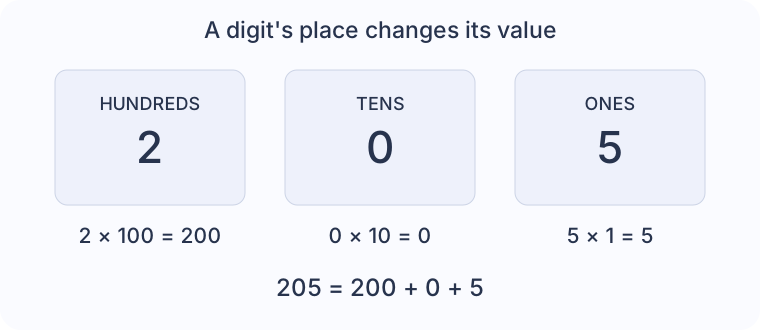
In semiotic terms, the digit $2$ on its own is an incomplete sign. What completes its meaning is its place, and what keeps the place, when a column is empty, is the zero. The value of an inscription like $205$ is not in any of its three shapes, but in the rule that organises them:
$$205 = 2\cdot 10^2 + 0\cdot 10^1 + 5\cdot 10^0.$$That is why place value is a perfect example of active notation. The rules for adding, subtracting, multiplying and dividing that we learn at school (“carry one”, “borrow one”) exist only because the writing puts ones under ones and tens under tens. The calculation is done on the paper itself, with no abacus.
A long journey to zero
The Babylonians were already writing numbers positionally around 1800 BC, in base 60 (which is why an hour has 60 minutes). But for many centuries they had no sign for the empty place: $1$ and $60$ could look the same, and the reader guessed from the context. Only around 300 BC does a separator sign appear on the tablets to mark the gap inside a number. The Maya, on the other side of the world, also arrived at a zero, drawn like a shell.
It was in India that zero stopped being only a placeholder and became a number. In 628 the astronomer Brahmagupta wrote rules for calculating with it: a number minus itself is zero; zero added to a number gives the number; zero times any number is zero. The mathematicians of Baghdad adopted the nine Indian digits and zero, and al-Khwarizmi wrote, around 825, a book on how to calculate with them. In its Latin translation the book began with Dixit Algorizmi, “al-Khwarizmi said”. The author’s name became the word algorithm.
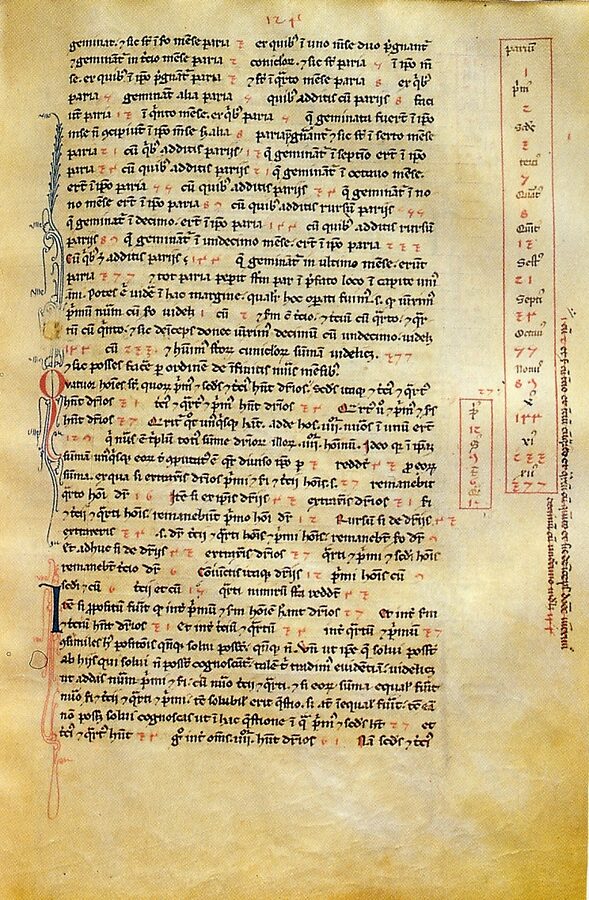
In Christian Europe the turning point has a date and an author. Leonardo of Pisa, better known as Fibonacci, grew up among merchants in North Africa, watched Arab traders calculating on paper and came back to Italy convinced. In 1202 he published the Liber abbaci, the “book of calculation”, which opens like this:
The nine Indian figures are these: 9 8 7 6 5 4 3 2 1. With these nine figures, and with this sign 0, which in Arabic is called zephirum, any number at all can be written.
— Leonardo of Pisa, Liber abbaci (1202)
The Arabic ṣifr (empty) gave, on one side, zephirum, zefiro and zero; on the other, cifra, which for a long time meant zero itself, then any digit, and finally a secret code: a cipher.
Patterns only place value shows
An active notation does not only make sums easier: it puts patterns in plain sight. Look at the nine times table:
$$9,\ 18,\ 27,\ 36,\ 45,\ 54,\ 63,\ 72,\ 81,\ 90.$$The tens go up from $0$ to $9$, the ones go down from $9$ to $0$, and the two digits always add up to $9$. To find $9\times 7$, just remember that the tens digit is one less than $7$ (that is, $6$) and that the ones digit makes up $9$ (that is, $3$): $63$. In Roman numerals the same table is $\text{IX}, \text{XVIII}, \text{XXVII}, \text{XXXVI}, \text{XLV}, \ldots$, and the pattern is simply not there. The pattern belongs to the numbers, but it only shows in a script that lets it show.
Exercise: why does the nine times table work?
For $k$ from $1$ to $10$ we can rewrite
$$9k = 10k - k = 10(k-1) + (10-k).$$The first term says the tens digit is $k-1$; the second, that the ones digit is $10-k$. The sum of the two digits is $(k-1)+(10-k)=9$. The proof uses exactly the place-value rule: “tens times 10, plus ones”.
Exercise: 2026 in Roman numerals
$2026 = 1000+1000+10+10+5+1$, written $\text{MMXXVI}$. There is no empty hundreds place to mark, because the Roman system has no places: it simply writes nothing for the hundreds. That works for reading, but it makes it impossible to line numbers up and add column by column. It is the difference between a script that records and one that calculates.
Chapter index · ← Radix quadrati: mathematics has a script too · Euclid: the figure and the proof →