
Euler's Eyes
2026-10-14
Colour: the spinning top and the tartan ribbon
The science of colour must therefore be regarded as essentially a mental science.
— James Clerk Maxwell, “Experiments on colour” (1855)
Since Newton it had been known that white light is a mixture of all the colours of the rainbow. But the colour we see is something else: it depends on the eye and the brain. The English physician Thomas Young had proposed, in 1802, that the eye has only three kinds of sensor, and that every colour we perceive is a combination of the responses of those three. It was a bold hypothesis without proof. Maxwell, aged 24, turned it into mathematics.
The colour top
Maxwell used a spinning top with discs of coloured paper slotted into one another, so that an adjustable fraction of each colour could be shown: so much red, so much green, so much blue. When the top spins fast, the eye cannot tell the slices apart and sees a single colour, the mixture. At the centre, a smaller disc of other colours spun as well.
By adjusting the fractions, Maxwell looked for the combination at which the outer ring and the inner disc looked the same. For example, certain proportions of red, green and blue gave the same grey as a mixture of white and black. Recording the angles of each slice, he obtained a colour equation, like an equation in algebra:
$$0.37\,\text{R}+0.27\,\text{G}+0.36\,\text{B}=0.28\,\text{W}+0.72\,\text{Bk}.$$The numbers in this example are illustrative, but the form is that of Maxwell’s tables. The great discovery was that these equations behaved like those of algebra: they could be added, multiplied by numbers and combined, and the predictions matched what the eye saw.
Colours are vectors
This means that a coloured light can be represented by three numbers, the amounts of three primary lights that, added together, imitate it:
$$\mathbf C=(R,G,B).$$Overlapping two lights means adding the vectors, component by component. Red plus green:
$$(1,0,0)+(0,1,0)=(1,1,0),$$which the eye sees as yellow, even though there is no yellow light in the mixture. Red plus green plus blue, $(1,1,1)$, gives white. Doubling the intensity means multiplying the vector by 2. Maxwell drew these colours in a triangle, with the three primaries at the vertices: each point of the triangle is a mixture, and the pure colours of the rainbow lie on a curve around it. It is the ancestor of the chromaticity diagram used today to calibrate screens and cameras.
The reason behind this is that each of the three kinds of cone in the retina responds to a broad band of wavelengths. The response of cone $i$ to a light with spectrum $I(\lambda)$ is
$$C_i=\int I(\lambda)\,s_i(\lambda)\,d\lambda,$$where $s_i(\lambda)$ is the sensitivity of the cone. Any light, with infinitely many frequencies, reaches the brain reduced to three numbers. Two lights with completely different spectra can give the same three numbers and look identical. They are called metamers, and it is thanks to them that a screen with only three kinds of pixel can show almost every colour.
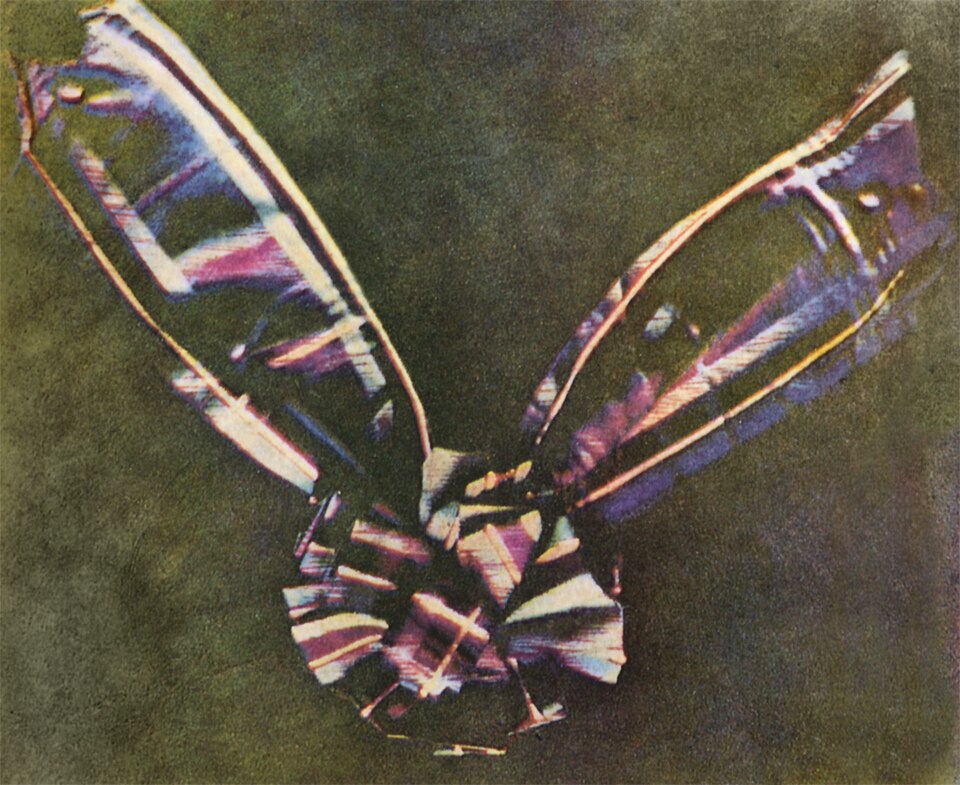
The first colour photograph
If three numbers are enough, then three photographs are enough too. On 17 May 1861, in a lecture at the Royal Institution in London, Maxwell demonstrated the idea. The photographer Thomas Sutton had photographed a ribbon of Scottish tartan cloth three times, each through a filter: red, green and blue. The three black-and-white plates were projected onto the screen by three lanterns, each with the matching filter, and superimposed. The audience saw the coloured ribbon.
It was the first colour photograph in history, and the principle is the same as in today’s digital cameras, whose sensors have red, green and blue filters.
Light is not paint
Adding lights is not the same as mixing paints. Two overlapping lights add their photons, so the mixture gets brighter: red plus green gives yellow. Two mixed paints subtract: each pigment absorbs part of the spectrum, and what is left is what both reflect. Blue paint with yellow paint gives green, and mixing many paints gives a dark brown. Printers use cyan, magenta and yellow precisely because they work by subtraction.
Exercise: what colour do you see when you add the lights (1, 0, 1) and (0, 1, 0)? And when you add (1, 0, 0) and (0, 0, 1)?
$(1,0,1)+(0,1,0)=(1,1,1)$: the three full primaries, which the eye sees as white. That is why magenta, $(1,0,1)$, and green are called complementary colours. And $(1,0,0)+(0,0,1)=(1,0,1)$ is magenta, a colour that does not exist in the rainbow: no single wavelength produces it.
Exercise: on a screen, each component goes from 0 to 255. How many different colours can it show?
Each component has 256 possible values, and the three are independent: $256^3=16{,}777{,}216$, about 16.7 million colours. Even so, there are very pure rainbow colours that lie outside the triangle of the screen’s three primaries and cannot be shown exactly.
Sources: James Clerk Maxwell, “Experiments on colour, as perceived by the eye”, Transactions of the Royal Society of Edinburgh 21 (1855) · Ralph M. Evans, “Maxwell’s color photography”, Scientific American 205 (1961) · Basil Mahon, The Man Who Changed Everything (Wiley, 2003), ch. 6.
All topics on James Clerk Maxwell · ← The life of James Clerk Maxwell · Saturn’s rings cannot be solid →