Euler's Eyes
2026-10-11
Point power
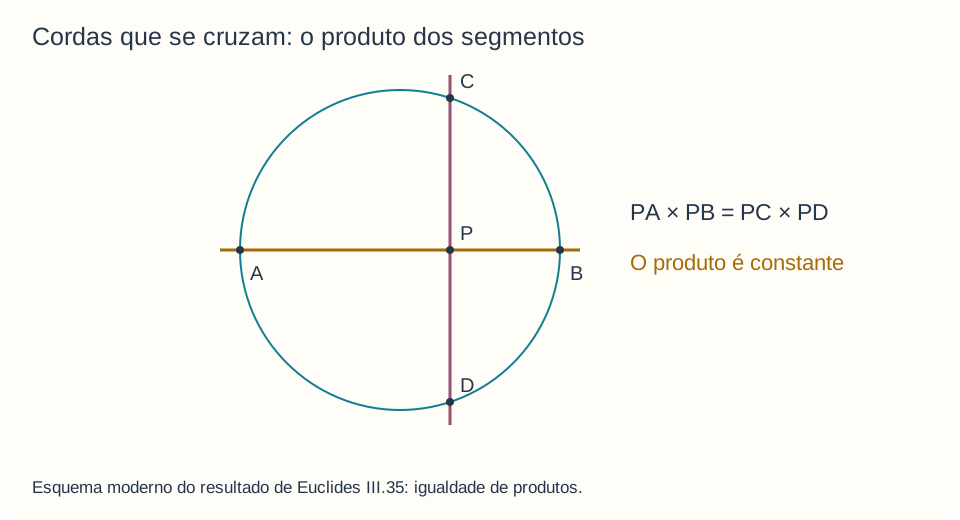
Two chords that intersect within a circle: the product of the parts of one is equal to the product of the parts of the other. With this idea, the distance to the horizon can be calculated.
Who discovered
The two classical forms are in The Elements of Euclid (c. 300 BC): the proposition III.35, about cords that cut each other, and the III.36, on a secant and a tangent drawn from the same exterior point. The name power of a point was created much later, in 1826, by the Swiss Jakob Steiner, who realized that the product is always the same, whatever the straight line drawn by the point.

The story
Steiner was one of the great names in synthetic geometry in the 19th century. Son of peasants, he only learned to write when he was 14 years old and ended up a professor at the University of Berlin. For him, the power of a point was a way of bringing together several of Euclid’s theorems into a single idea.
The concept leads to others: the radical axis of two circles is the place of points with the same power in relation to both, a tool used to this day in tangency problems.
In everyday life
- Distance from the horizon. From a height $h$ above the sea, the tangent to the horizon measures $d$, with $d^2 = h(2R + h)$, where $R$ is the radius of the Earth (III.36). At 1,7 m height, the horizon is about 4,7 km away.
- Radius of a bow. Measuring the string $c$ and the arrow $s$ (the height of the bow), the radius is $r = \tfrac{c^2/4 + s^2}{2s}$. Restorers use it to reconstruct old arches and windows.
- Road curves. Surveyors calculate the radius of a curve in the same way, with a chord and arrow measured on the asphalt.
- Lenses and mirrors. The radius of curvature of a lens is obtained by measuring the depth of a section of known diameter.
Sources: Elements, proposition III.35 · Elements, proposition III.36 · Steiner (MacTutor).
Theory and constructions
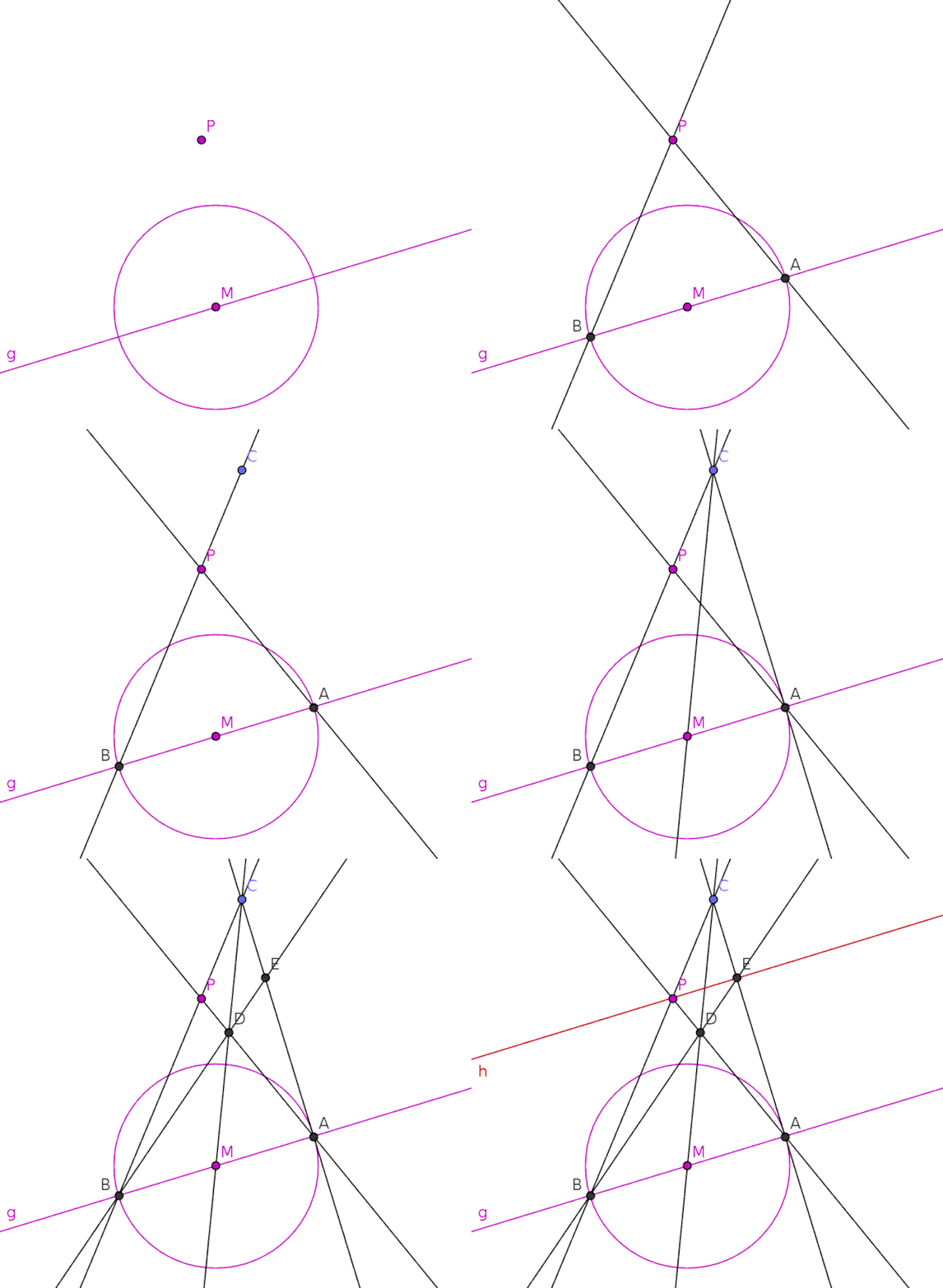
Through a point $P$ two straight lines pass through a circle $\lambda$ in $A$, $B$ and in $C$, $D$. There are two cases: $P$ interior (the straight lines form chords that cut at $P$) or $P$ exterior (we have “secant segments” $\overline{PA}$ and $\overline{PC}$, with exterior parts $\overline{PB}$ and $\overline{PD}$).
TeoremaStrings and secants
In both cases,
$$PA \cdot PB = PC \cdot PD.$$- Ropes: if two ropes cut each other, the product of the parts of one is equal to the product of the parts of the other.
- Secants: if from an exterior point we conduct two secant segments, the product of each one by its exterior part is the same.
Demonstration. In the triangles $PAD$ and $PCB$, the angle in $P$ is common (or o.p.v.) and $\hat{A} \equiv \hat{C}$ (inscriptions that see the same arc $\overset{\frown}{BD}$). In the AA case, $\triangle PAD \sim \triangle PCB$, therefore $\dfrac{PA}{PC} = \dfrac{PD}{PB}$, that is, $PA \cdot PB = PC \cdot PD$.
DefiniçãoPower of a point
Once $P$ and the circumference are fixed, the product $PA \cdot PB$ is the same for any chord (or secant) that passes through $P$. This number is the power of $P$ in relation to the circumference. If $P$ is exterior and $\overline{PT}$ is tangent (triangles $PAT$ and $PTB$ are similar):
$$PA \cdot PB = PC \cdot PD = \cdots = PT^2.$$In terms of the radius $r$ and the distance $d = PO$: the power is worth $|d^2 - r^2|$ (exercise 499).