
Euler's Eyes
2026-10-29
Time, clocks and relativity
At the end of the nineteenth century physics had a problem. Light was a wave, and waves were thought to need a medium to travel through, the ether. The Earth moves through the ether at 30 km/s around the Sun, and this should have been detectable: light should seem faster in one direction than in the other. But every experiment, above all Michelson and Morley’s of 1887, gave a null result.
What is simultaneity?
Poincaré knew well the practical problem of comparing distant clocks. He was a member of the Bureau des Longitudes, responsible for determining longitudes, which required synchronising clocks in different places by telegraph signals. In 1898, in a philosophical article called “The measure of time”, he asked a question no one had asked clearly: what does it mean for two events in different places to happen at the same time?
We have no direct intuition of simultaneity, any more than of the equality of two durations. … The simultaneity of two events, or the order of their succession, and the equality of two durations, must be defined in such a way that the statement of the natural laws is as simple as possible.
— Henri Poincaré, The measure of time (1898)
In 1900 he went further: he showed that the “local time” the Dutchman Hendrik Lorentz had introduced as a mathematical device is exactly the time that two moving observers would read if they synchronised their clocks by exchanging light signals and assuming that light takes the same time to go and to come back.
The principle of relativity
In 1904, in a lecture in St Louis, in the United States, Poincaré stated what he called the principle of relativity: the laws of physics must be the same for an observer at rest and for one in uniform motion, so that no experiment can tell whether or not we are moving with respect to the ether. He also predicted that a new mechanics would be needed, in which no velocity could exceed that of light.
The Lorentz group
On 5 June 1905 Poincaré presented to the Academy a short note, “On the dynamics of the electron”, followed by a long version published in 1906. There he gave Lorentz’s formulas their exact form and the name Lorentz transformations:
$$x' = \gamma\,(x - vt), \qquad t' = \gamma\left(t - \frac{v x}{c^2}\right), \qquad \gamma = \frac{1}{\sqrt{1 - v^2/c^2}}.$$He showed that they form a group: two transformations in succession are equivalent to a third of the same kind. From this follows the rule for composing velocities,
$$u \oplus v = \frac{u + v}{1 + uv/c^2},$$which never gives a result greater than $c$. And he observed that, using the coordinate $ict$, the transformations are rotations in a four-dimensional space that preserve $x^2 + y^2 + z^2 - c^2 t^2$: the seed of the spacetime that Hermann Minkowski would develop in 1908.
Poincaré and Einstein
On 30 June 1905, less than a month after Poincaré’s note, the journal Annalen der Physik received the paper of a clerk at the Bern patent office, Albert Einstein, “On the electrodynamics of moving bodies”. The mathematics was essentially the same. The difference lay in the interpretation: Einstein abandoned the ether for good and took the principle of relativity and the constancy of the speed of light as postulates from which everything follows; the time measured by moving clocks was not apparent, it was the true time. Poincaré, to the end, went on speaking of the ether and regarding the choice between the two descriptions as a matter of convenience.
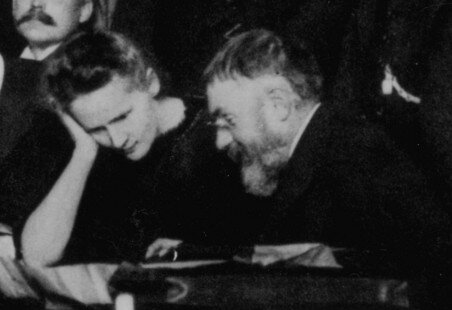
The two met only once, at the 1911 Solvay Conference. Poincaré never cited Einstein in his work on relativity, and Einstein only publicly acknowledged Poincaré’s contribution many years later.
Exercise: the muon that reaches the ground
Muons are particles created in the upper atmosphere that live on average $2.2$ microseconds. Travelling at $0.995c$, without relativity they would cover only about 660 m. How far do they actually travel?
With $\beta = 0.995$, $\gamma = \frac{1}{\sqrt{1 - 0.990025}} = \frac{1}{\sqrt{0.009975}} \approx 10.0$. For us, the muon’s life stretches to $22$ microseconds, and it travels $0.995 \cdot 3 \cdot 10^8 \cdot 22 \cdot 10^{-6} \approx 6.6$ km. That is why so many muons reach sea level.
Exercise: adding velocities
A spaceship moves away from Earth at $0.9c$ and launches a probe forwards at $0.9c$ relative to itself. What is the probe’s velocity relative to Earth?
By Poincaré’s rule, $\frac{0.9 + 0.9}{1 + 0.81}\,c = \frac{1.8}{1.81}\,c \approx 0.9945\,c$, not $1.8\,c$. Composing velocities smaller than $c$, the result is always smaller than $c$: the speed of light is a limit that cannot be exceeded by adding.
Sources: Henri Poincaré, “La mesure du temps”, Revue de métaphysique et de morale 6 (1898) · Henri Poincaré, “Sur la dynamique de l’électron”, Comptes rendus 140 (1905) and Rendiconti del Circolo matematico di Palermo 21 (1906) · Peter Galison, Einstein’s Clocks, Poincaré’s Maps (2003) · Olivier Darrigol, “The mystery of the Einstein–Poincaré connection”, Isis 95 (2004).
All topics on Henri Poincaré · ← The Poincaré conjecture · Probability in the Dreyfus affair →