
Euler's Eyes
2026-10-11
Segment and ray
A straight line has no beginning or end. In practice, we almost always work with pieces of it: segments and rays.
Who discovered
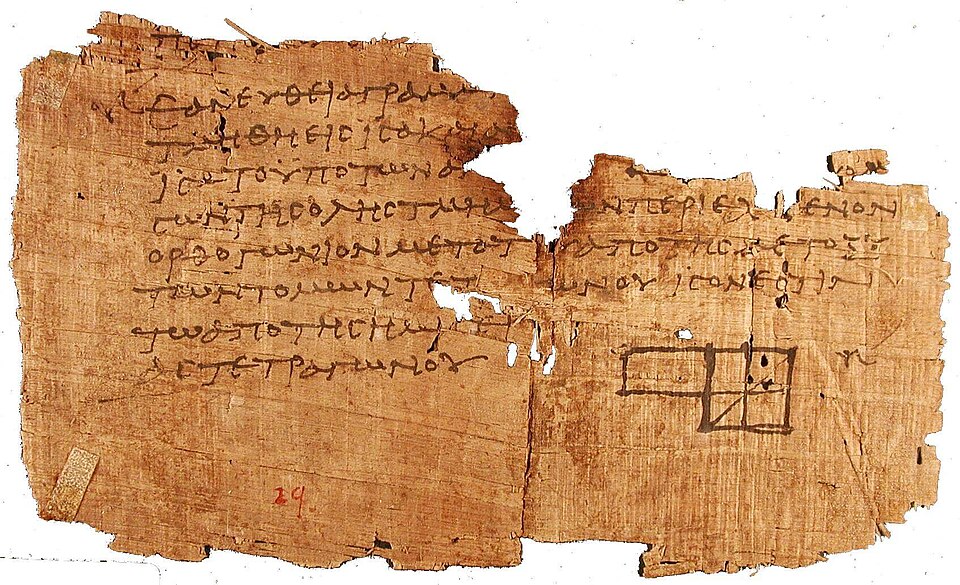
The Greeks thought of the piece first. In The Elements (c. 300 BC), Euclid speaks of “finite straight lines” — our segments — and his second postulate allows a finite straight line to be extended continuously. In other words, for him, the unlimited straight line was something that was obtained by extending a segment as much as necessary. The names “segment” and “ray”, with the definitions used in school, are from modern vocabulary, established by geometry books from the 19th and 20th centuries.

The story
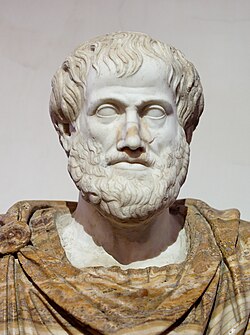
The Greeks’ caution with the infinite has a philosophical origin. Aristotle distinguished the infinite “in potential” — which can always grow one step further — from the infinite “in act”, taken as something complete. Euclid’s postulates respect this distinction: they speak of prolonging, never of a ready-made infinite straight line.
The ray gained importance with modern geometry, because it is the right type of object to define angles: two sides that start from the same vertex and continue indefinitely in one direction.
In everyday life
- Ray of light. A laser or the beam of a flashlight starts from a point and follows in one direction: they are semi-straight models.
- Ruler, tape measure and tape measure. Measure segments — there is always a beginning and an end.
- Pedestrian crossings and parking spaces. The markings painted on the asphalt are aligned segments.
- Vision in games. In electronic games, the “aim radius” that detects whether a target has been hit is calculated as a ray coming out of the camera.
Sources: Elements, postulate 2 (D. Joyce) · Euclid (MacTutor).
Theory and constructions
Definiçãostraight segment
Given two distinct points $A$ and $B$, the straight segment $\overline{AB}$ is the meeting of the set $\lbrace A, B \rbrace$ with the set of points that are between $A$ and $B$:
$$\overline{AB} = \lbrace A, B \rbrace \cup \lbrace X \mid X \text{ está entre } A \text{ e } B \rbrace$$$A$ and $B$ are the ends of the segment; the points between them are the internal points. If $A = B$, we say that $\overline{AB}$ is the null segment.
DefiniçãoSemi-straight
Given two distinct points $A$ and $B$, the ray $\overrightarrow{AB}$ is the meeting of the segment $\overline{AB}$ with the set of points $X$ such that $B$ is between $A$ and $X$:
$$\overrightarrow{AB} = \overline{AB} \cup \lbrace X \mid B \text{ está entre } A \text{ e } X \rbrace$$The point $A$ is the origin of the ray. If $A$ is between $B$ and $C$, the rays $\overrightarrow{AB}$ and $\overrightarrow{AC}$ are opposite.
Use the buttons to compare the entities that two points determine. The last button shows an important equality: the segment is the common part of the two rays.
ResumoTwo distinct points A and B determine
| entity | Notation | Start | Ends |
|---|---|---|---|
| straight | $\overleftrightarrow{AB}$ | has no beginning | there is no end |
| segment | $\overline{AB}$ | in $A$ | in $B$ |
| semi-straight | $\overrightarrow{AB}$ | at $A$, passing through $B$ | there is no end |
| semi-straight | $\overrightarrow{BA}$ | at $B$, passing through $A$ | there is no end |
Also, $\overline{AB} = \overrightarrow{AB} \cap \overrightarrow{BA}$.