Mathematicians value money in proportion to its quantity, and people of good sense in proportion to the use they can make of it.
— Gabriel Cramer, letter to Nicolaus Bernoulli (1728)
Gabriel Cramer (1704–1752) is a name almost every student knows and almost nobody can place. Cramer’s rule, which solves a system of linear equations as a fraction of determinants, appears in every algebra textbook, at school and at university. But who was Cramer?
He was a professor of mathematics and of philosophy in Geneva, at a time when the city was a small independent republic. He became a doctor at eighteen, shared a chair with his friend Calandrini for ten years, travelled across Europe to meet Johann Bernoulli, de Moivre and Maupertuis, and spent much of his life editing other people’s works: those of Johann and Jakob Bernoulli, the correspondence of Leibniz, the books of Christian Wolff.
His own most important work is a book of almost seven hundred pages on algebraic curves, published in 1750. The rule that bears his name sits in a three-page appendix. The same book contains Cramer’s paradox, about the points that determine a curve, and in a letter written as a young man he gave one of the first answers to the St Petersburg paradox.
In this series we tell the story of Cramer’s life and rework, with the calculations in full view, six of his ideas.
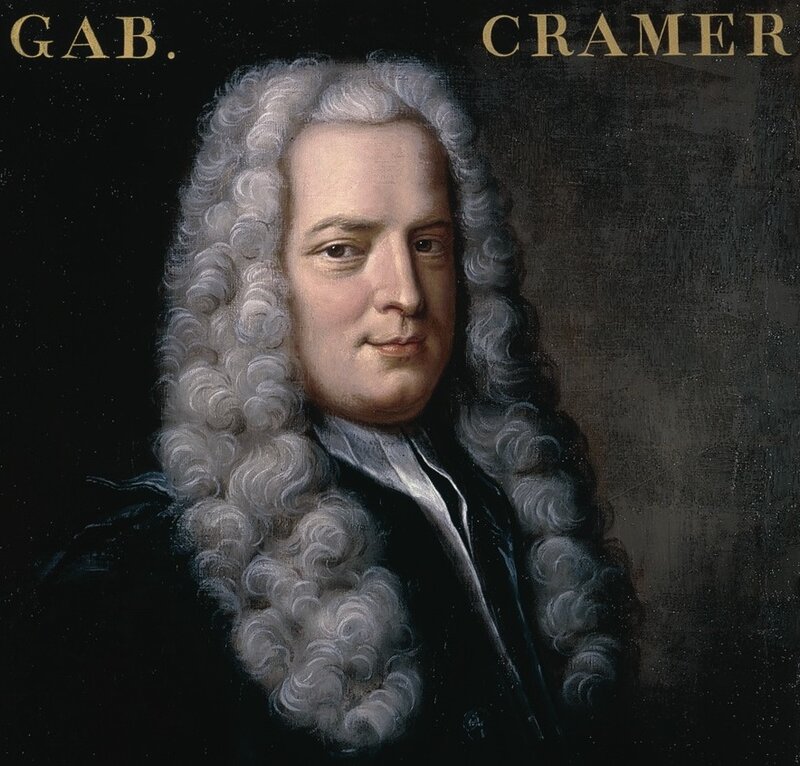
Who he was
Gabriel Cramer
- Nascimento
- 31 July 1704, Geneva, Republic of Geneva
- Morte
- 4 January 1752, Bagnols-sur-Cèze, France
- Origem
- Republic of Geneva (now Switzerland)
- Áreas
- Algebra, geometry of curves, probability, editing of scientific works
Reading guide
Biography
Discoveries and proofs
- Cramer’s rule
- Seki, Leibniz and Maclaurin: determinants before Cramer
- How many points determine a curve
- Cramer’s paradox
- Newton’s parallelogram and the branches of curves
- The St Petersburg paradox