
Euler's Eyes
2026-10-27
矩阵代数
数表在数学里早就出现了。关孝和、莱布尼茨和克莱姆用它们解方程组;高斯和柯西发展了行列式理论。但在所有这些工作中,数表只是一种手段:要紧的是由它算出来的那个数。1850 年,西尔维斯特给数表起了个名字——矩阵(matrix,原意为"母体"),子行列式就是从它里面生出来的。还差下一步,迈出这一步的是凯莱。
1858 年的长文
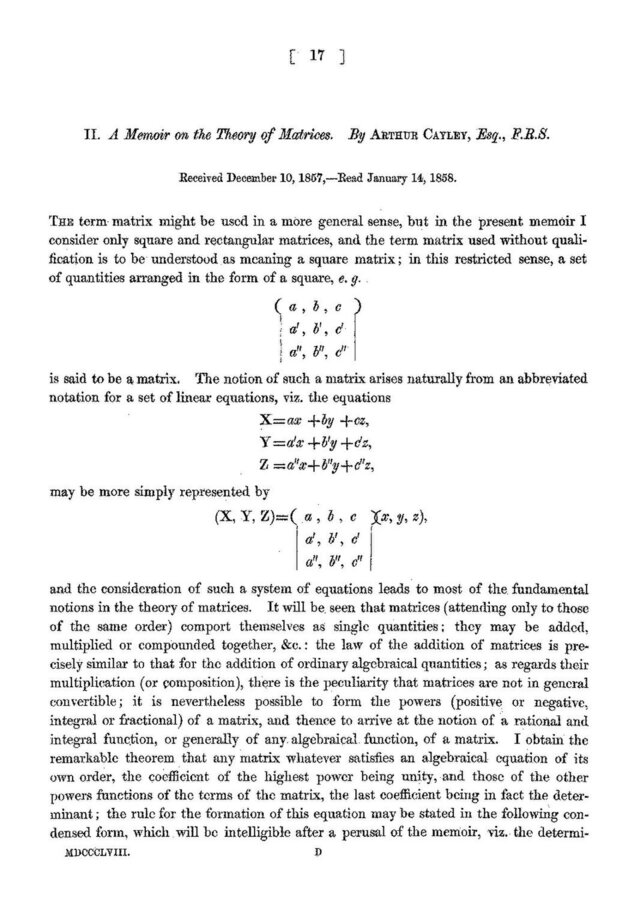
1857 年 12 月 10 日,凯莱向皇家学会提交了《矩阵理论研究报告》(A memoir on the theory of matrices),次年发表在《哲学汇刊》上。第一页就提出了这个想法:像
$$X = ax + by + cz, \quad Y = a'x + b'y + c'z, \quad Z = a''x + b''y + c''z$$这样的线性方程组,可以写成一种简写形式,其中系数表单独出现,作为作用在 $(x, y, z)$ 上的一个整体的量。凯莱接着问:对这些数表可以做哪些运算?
加法是显而易见的,逐项相加。数乘也是。两个矩阵的乘积,凯莱用复合来定义:如果矩阵 $B$ 把 $(x, y)$ 变成 $(x', y')$,矩阵 $A$ 把 $(x', y')$ 变成 $(x'', y'')$,那么 $AB$ 就是把 $(x, y)$ 直接变成 $(x'', y'')$ 的矩阵。算出来,就得到"行乘列"的规则:
$$\begin{pmatrix} a & b \\ c & d \end{pmatrix}\begin{pmatrix} e & f \\ g & h \end{pmatrix} = \begin{pmatrix} ae + bg & af + bh \\ ce + dg & cf + dh \end{pmatrix}.$$顺序很重要
取 $A = \begin{pmatrix} 1 & 2 \\ 3 & 4 \end{pmatrix}$,$B = \begin{pmatrix} 0 & 1 \\ 1 & 0 \end{pmatrix}$,
$$AB = \begin{pmatrix} 2 & 1 \\ 4 & 3 \end{pmatrix}, \qquad BA = \begin{pmatrix} 3 & 4 \\ 1 & 2 \end{pmatrix}.$$$B$ 右乘 $A$ 交换 $A$ 的两列;左乘则交换两行。结果不同。凯莱平静地记下了这一点:矩阵像普通代数量一样相加,但就乘法而言,“有一个特点,即矩阵一般不可交换”。十五年前,哈密顿的四元数已经表明,一种自洽的代数可以有 $ij \ne ji$。矩阵给了这个现象一个具体的、几何的形式。
在下图中选两个平面变换,比较先做一个再做另一个时字母 F 的变化:
逆矩阵
凯莱还定义了让一切保持原位的单位矩阵 $I$,以及逆矩阵:满足 $AA^{-1} = A^{-1}A = I$ 的矩阵 $A^{-1}$。对 $2 \times 2$ 矩阵,
$$\begin{pmatrix} a & b \\ c & d \end{pmatrix}^{-1} = \frac{1}{ad - bc}\begin{pmatrix} d & -b \\ -c & a \end{pmatrix},$$它恰好在行列式 $ad - bc$ 不为零时存在。这样一来,解线性方程组 $AX = Y$ 就成了一次除法:$X = A^{-1}Y$。克莱姆法则把每个未知数写成行列式之比,原来正是这个乘积的书面形式。
在同一篇长文里,凯莱走得更远:他定义了矩阵的幂和多项式,陈述了今天以他和哈密顿命名的定理,甚至研究了 $2 \times 2$ 矩阵的平方根,指出一般有四个,但有些矩阵有无穷多个,有些则一个也没有。
练习:一个逆矩阵
求 $A = \begin{pmatrix} 2 & 1 \\ 5 & 3 \end{pmatrix}$ 的逆矩阵,并验证 $AA^{-1} = I$。
行列式为 $2 \cdot 3 - 1 \cdot 5 = 1$,所以
$$A^{-1} = \begin{pmatrix} 3 & -1 \\ -5 & 2 \end{pmatrix}.$$验证:$\begin{pmatrix} 2 & 1 \\ 5 & 3 \end{pmatrix}\begin{pmatrix} 3 & -1 \\ -5 & 2 \end{pmatrix} = \begin{pmatrix} 6 - 5 & -2 + 2 \\ 15 - 15 & -5 + 6 \end{pmatrix} = \begin{pmatrix} 1 & 0 \\ 0 & 1 \end{pmatrix}$。
练习:哪些矩阵与剪切可交换?
求所有与 $S = \begin{pmatrix} 1 & 1 \\ 0 & 1 \end{pmatrix}$ 可交换的矩阵 $X = \begin{pmatrix} a & b \\ c & d \end{pmatrix}$。
$SX = \begin{pmatrix} a + c & b + d \\ c & d \end{pmatrix}$,$XS = \begin{pmatrix} a & a + b \\ c & c + d \end{pmatrix}$。令对应元素相等:$a + c = a$ 得 $c = 0$,$b + d = a + b$ 得 $d = a$。与 $S$ 可交换的矩阵就是形如 $\begin{pmatrix} a & b \\ 0 & a \end{pmatrix}$ 的矩阵,在四个可能的元素中只有两个参数。
来源: Arthur Cayley,“A memoir on the theory of matrices”,Philosophical Transactions of the Royal Society 148(1858) · Thomas Hawkins,“Another look at Cayley and the theory of matrices”,Archives internationales d’histoire des sciences 26(1977) · Tony Crilly,Arthur Cayley: Mathematician Laureate of the Victorian Age(2006)。
凯莱的全部主题 · ← 凯莱的一生 · 凯莱–哈密顿定理 →
图片来源.