
Euler's Eyes
2026-10-11
Central angle
The central angle has the apex at the center of the circle and measures the same as the arc it sees. With this idea, the size of the Earth was measured.
Who discovered
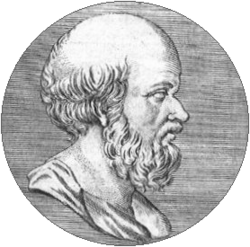
The relationship between central angle and arc is the basis of the proposition III.26 of The Elements of Euclid: in equal circles, equal central angles correspond to equal arcs. The most famous use of it is by Eratosthenes of Cyrene (c. 276–194 BC), director of the Library of Alexandria, who calculated the circumference of the Earth from a central angle.

The story
Eratosthenes knew that, at noon on the summer solstice, the Sun illuminated the bottom of the wells of Siena, in southern Egypt. At the same moment, in Alexandria, the shadow of a gnomon showed that the sun’s rays arrived at an angle from 1/50 back (7,2°). As the Sun’s rays are practically parallel, this angle is equal to the central angle of the Earth between the two cities. Simply multiply the Siena–Alexandria distance by 50.
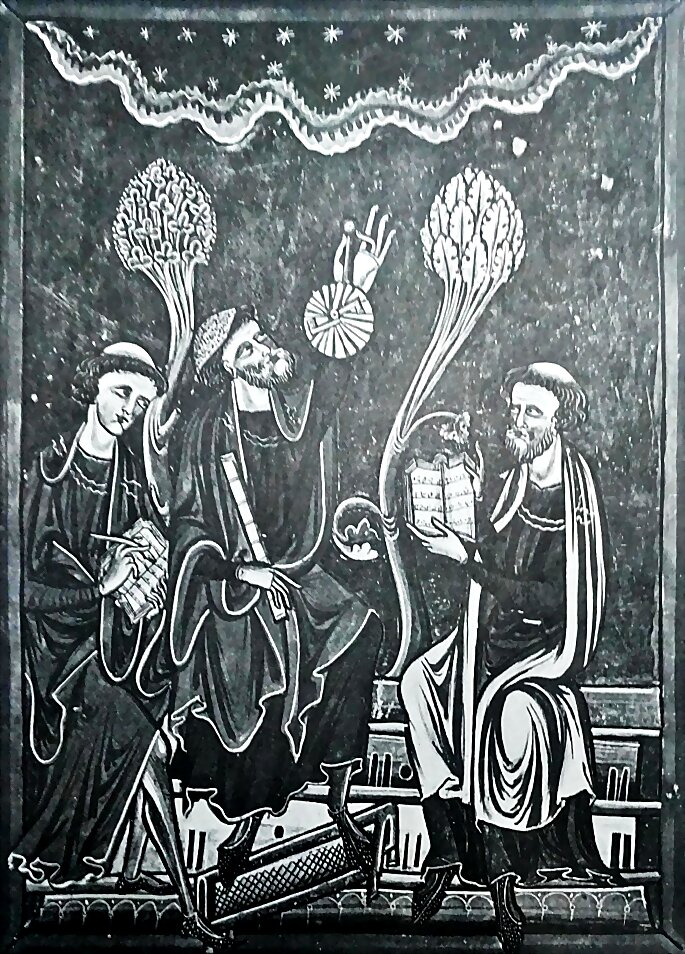
The result, around 250 000 stadiums, is close to the real value, although it is not known exactly how long the stadium he used was. It was the first measurement of the Earth based on geometric reasoning.
In everyday life
- Pie chart. Invented by William Playfair in 1801, it represents each part of a total by a central angle: 25% are 90°.
- Clock hands. The angle between the hands is central; at 2h, it measures 60°.
- Ferris Wheel. With 12 cabins equally spaced, each cabin is 30° from the next, measured from the axis.
- Speedometers and pressure gauges. The pointer rotates around the center, and the central angle indicates the value on the scale.
Sources: Eratosthenes (MacTutor) · Elements, proposition III.26 · William Playfair (Wikipedia).
Theory and constructions
DefiniçãoCentral angle and measure of an arc
Central angle is an angle with a vertex at the center of the circle. The arc $\overset{\frown}{AB}$ determined by him is the corresponding arc (or implied) to the central angle $A\hat{O}B$.
The measure of an arc is the measure of the corresponding central angle: if $m(A\hat{O}B) = 60^{\circ}$, then $m(\overset{\frown}{AB}) = 60^{\circ}$, and vice versa. For simplicity, we use the same symbol $\overset{\frown}{AB}$ for the arc and its measurement.