
Euler's Eyes
2026-10-11
Inscribed angle
The inscribed angle measures half the arc that he sees. A special case — the angle inscribed in the semicircle is right — is attributed to Thales.
Who discovered
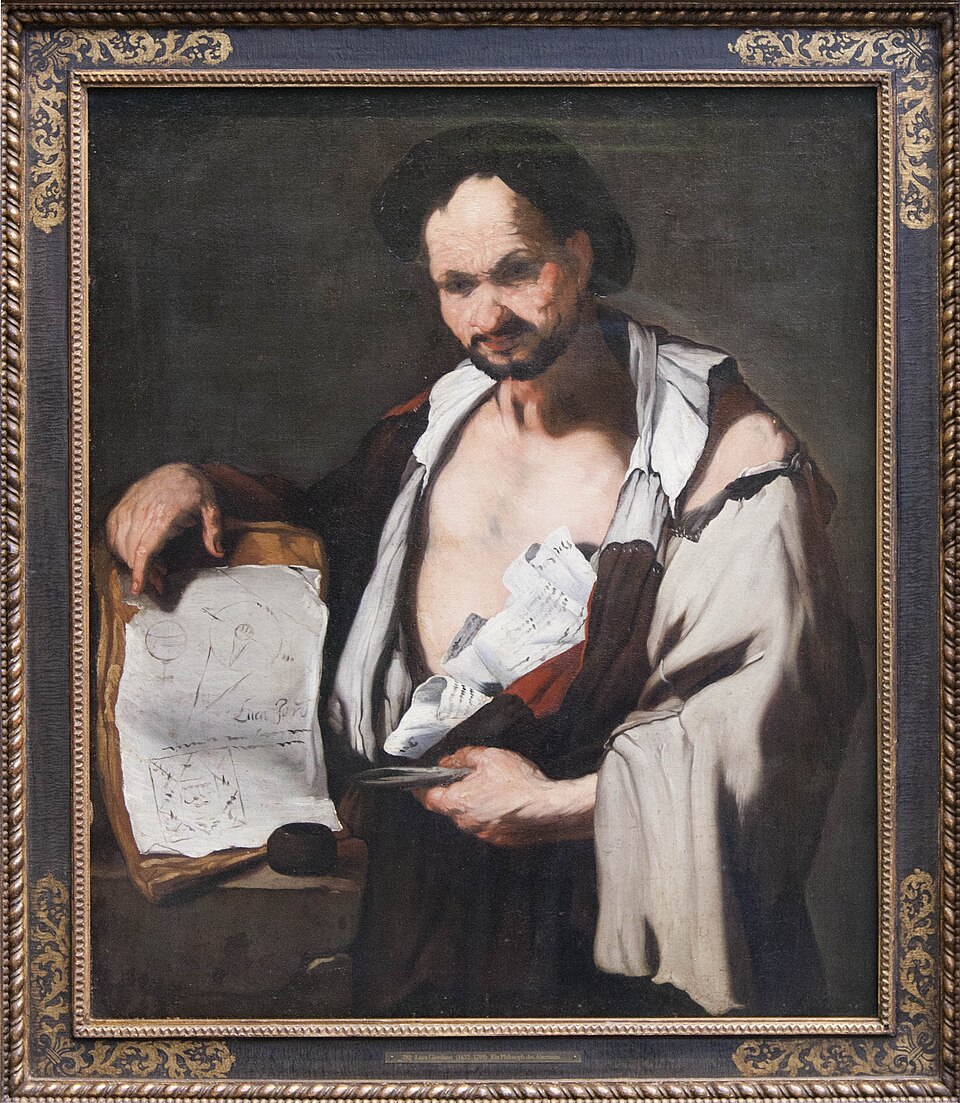
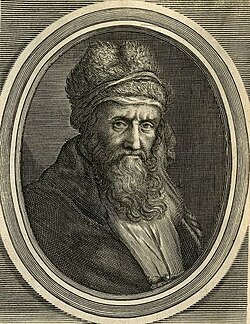
Greek tradition attributes to Tales of Miletus (6th century BC) the discovery that every angle inscribed in a semicircle is right. Diógenes Laércio says, citing the writer Pânfila, that Thales sacrificed an ox to celebrate the result. The general relationship — the central angle is twice that inscribed on the same arc — is the proposition III.20 of the The Elements of Euclid, and the case of the semicircle is the III.31.

The story
In German and English, “Thales’ theorem” (Satz des Thales) is precisely that of the angle in the semicircle, not that of the parallels that we will study in chapter 12. The story of the ox comes from an author who lived eight centuries after Thales, but it shows that the Greeks saw the result as a remarkable achievement.
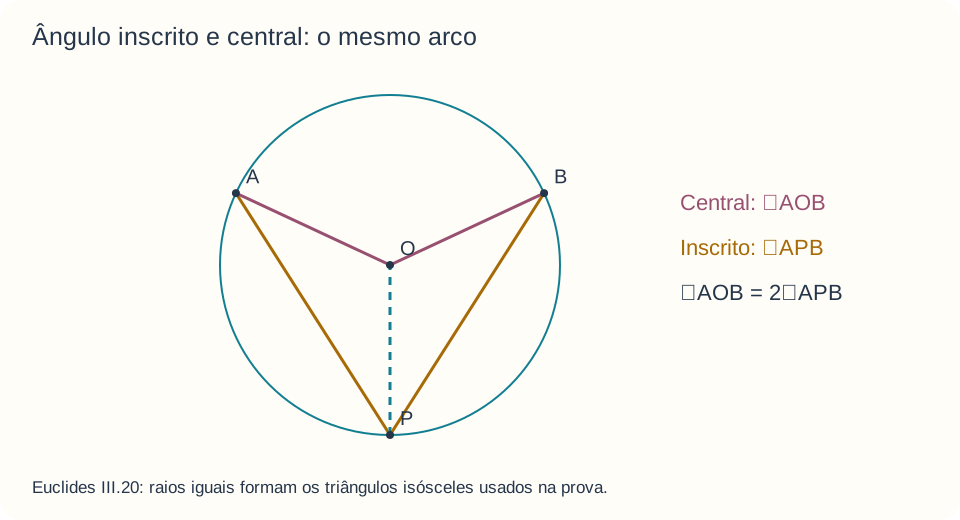
Euclid’s proof traces the diameter through the vertex of the inscribed angle and uses isosceles triangles formed by radii. The same reasoning leads to proposition III.22: in an inscribed quadrilateral, the opposite angles add up to 180°.
In everyday life
- Find the center of a disc. Place the corner of a square against the edge and mark where the sides cut the circle: this segment is a diameter. Repeat elsewhere; the intersection of the two diameters is the center.
- Theatre and cinema. Seats on the same circular arc view the stage from the same angle.
- Photography. To make two buildings appear from the same angle, the photographer can move along an arc that passes through them.
- Football. The points from which the opening of the goal is seen from the same angle are on an arc of circumference.
Sources: Tales (MacTutor) · Elements, proposition III.20 · Elements, proposition III.31.
Theory and constructions
DefiniçãoInscribed angle
Inscribed angle is an angle with the vertex on the circle and the sides secant to it. In $A\hat{V}B$, the arc $\overset{\frown}{AB}$ is the corresponding arc, and $A\hat{O}B$ is the corresponding central angle.
TeoremaMeasure of the inscribed angle
An inscribed angle measures half of the corresponding central angle, that is, half of the corresponding arc:
$$\alpha = \frac{\beta}{2} = \frac{\overset{\frown}{AB}}{2}.$$Demonstration (three cases)
- 1st case — $O$ is on one side of the angle. $OV = OA$ (rays), so $\triangle OVA$ is isosceles and $\hat{V} = \hat{A} = \alpha$. As $\beta$ is the external angle of this triangle, $\beta = \hat{A} + \hat{V} = 2\alpha$.
- 2nd case — $O$ is internal to the angle. Let $C$ be the other extreme of the diameter by $V$. For the 1st case, $\beta_1 = 2\alpha_1$ (in $A\hat{V}C$) and $\beta_2 = 2\alpha_2$ (in $C\hat{V}B$). Adding: $\beta = 2\alpha$.
- 3rd case — $O$ is external to the angle. With the same diameter $\overline{VC}$, in the 1st case, $\beta_1 = 2\alpha_1$ and $\beta_2 = 2\alpha_2$; subtracting: $\beta = \beta_1 - \beta_2 = 2(\alpha_1 - \alpha_2) = 2\alpha$.
- In all cases, $\alpha = \dfrac{\beta}{2}$, and like $\beta = \overset{\frown}{AB}$, we have $\alpha = \dfrac{\overset{\frown}{AB}}{2}$.
TeoremaAngle inscribed in a semicircle
Every right angle is inscribed in a semicircle and, conversely, every angle inscribed in a semicircle, with the sides passing through the ends, is right. In particular, a triangle inscribed in a semicircle, with one side equal to the diameter, is rectangle.
In fact, if $A\hat{V}B = 90^{\circ}$, the corresponding arc measures $180^{\circ}$; and if $\overline{AB}$ is diameter, $\overset{\frown}{AB} = 180^{\circ}$ gives $A\hat{V}B = 90^{\circ}$. Use the “AB diameter” button in the figure above.
Inscribable quadrilateral
TeoremaInscribed quadrilateral
A quadrilateral that has vertices in a circle is inscribed in it.
a) If a convex quadrilateral is inscribed in a circle, its opposite angles are supplementary: $\hat{A} + \hat{C} = \hat{B} + \hat{D} = 180^{\circ}$.
b) Reciprocal: if a convex quadrilateral has supplementary opposite angles, it is inscribable.
Thus, having supplementary opposite angles is a necessary and sufficient condition for a convex quadrilateral to be inscribable.
View the demos
a) $\hat{A}$ is enrolled and sees the arc $\overset{\frown}{BCD}$: $\hat{A} = \dfrac{\overset{\frown}{BCD}}{2}$. Likewise, $\hat{C} = \dfrac{\overset{\frown}{DAB}}{2}$. Adding, $\hat{A} + \hat{C} = \dfrac{360^{\circ}}{2} = 180^{\circ}$. As the sum of the four angles is $360^{\circ}$, also $\hat{B} + \hat{D} = 180^{\circ}$.
b) If $ABCD$ were not inscribable, the circle $\lambda$ through $A$, $B$ and $C$ would not pass through $D$. Let $E$ be the meeting of the straight line $CD$ with $\lambda$; then $ABCE$ is entered and $\hat{B} + \hat{E} = 180^{\circ}$. With the $\hat{B} + \hat{D} = 180^{\circ}$ hypothesis, $\hat{D} = \hat{E}$ would come — absurd by the external angle theorem in $\triangle ADE$.