
Euler's Eyes
2026-10-10
Why does the rainbow appear at 42°
In The Meteors, Descartes explained the rainbow using the law of refraction, which he published in The Dioptric. When light passes from air to water, it bends
where $i$ is the entry angle, $r$ the angle into the water and $n \approx \frac{4}{3}$ for the water. (The Dutchman Willebrord Snell had found the same law before, but did not publish it. That is why it is called Snell-Descartes law.)
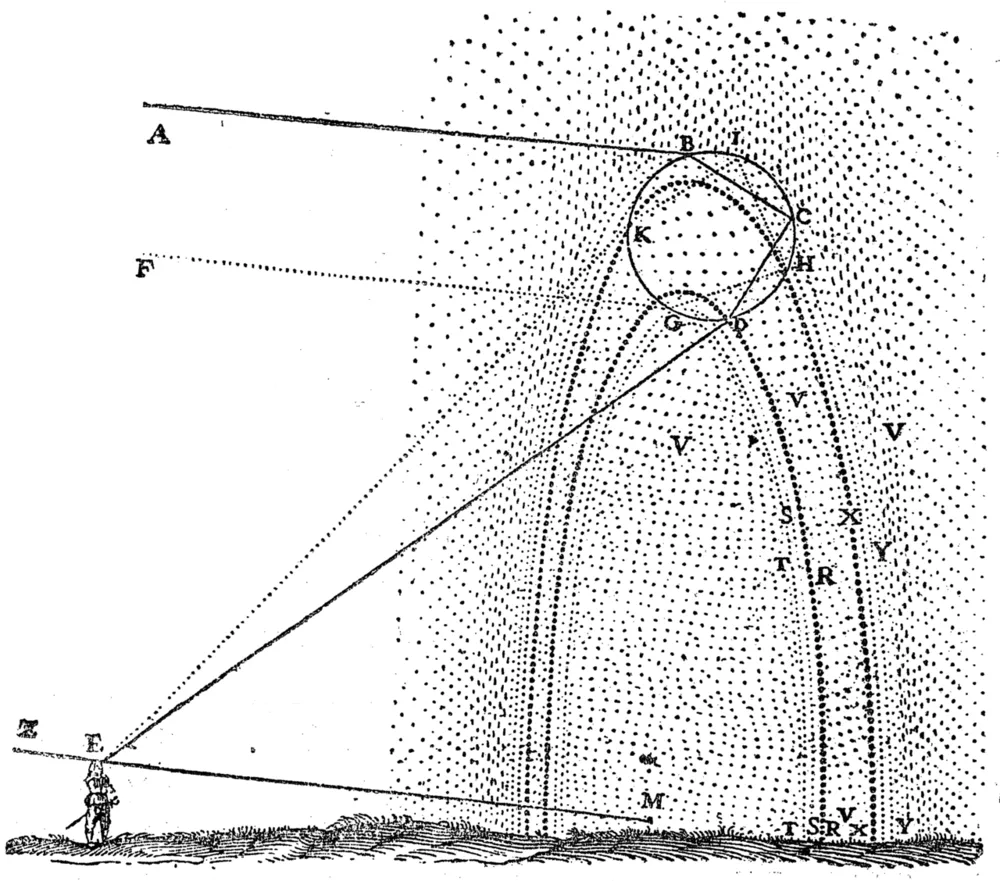
Descartes imagined a ray of sunlight entering a spherical drop, reflecting once inside and exiting. Following the angles, the ray leaves, making an angle of
He calculated this angle by hand for rays entering various positions of the droplet. Redoing the account with $n = \frac{4}{3}$:
| Entry angle $i$ | $r$ | Exit angle $\theta = 4r - 2i$ |
|---|---|---|
| 10° | 7,5° | 9,9° |
| 20° | 14,9° | 19,5° |
| 30° | 22,0° | 28,1° |
| 40° | 28,8° | 35,3° |
| 50° | 35,1° | 40,3° |
| 55° | 37,9° | 41,6° |
| 60° | 40,5° | 42,0° |
| 65° | 42,8° | 41,3° |
| 70° | 44,8° | 39,2° |
| 80° | 47,6° | 30,5° |
Notice the column on the right: it rises, reaches a maximum of around 42° and falls again. Near the maximum, rays that enter at very different positions (from 50° to 70°) exit at almost the same angle. Light accumulates there, and so we see a bright arc at 42° from the point opposite the Sun.
Now do Descartes’ experiment. Move the entry point and follow the chart to the right, then turn on “Many rays” to see red and violet accumulating at slightly different angles:
As $n$ varies slightly with color (red light deviates less than violet), each color has its own maximum at a slightly different angle: red is on the outside and violet is on the inside. It was the first mathematical explanation of the rainbow.
All topics by René Descartes · ← The kissing circles theorem · Descartes and the idea of function →