
Euler's Eyes
2026-09-26
FUVEST 2025 – 2nd phase: Mathematics solved
Source: FUVEST – 2nd phase test, 2nd day (questions M01 to M06), available in the FUVEST collection 2025.
The 2nd phase of FUVEST 2025 had, on the 2nd day, specific discursive questions for career; The Mathematics test has six questions, M01 to M06. Each candidate solved only the subjects of your career (the six questions, or just the four or first three). The 2nd phase does not have a multiple choice answer sheet: FUVEST published a Answer Guide with the answers expected by the panel. The resolutions below are ours, and each The result was checked with this guide and through a second path.
Template
| Question | Subject | Answers |
|---|---|---|
| M01 | Linear systems: stationery promotions | b) R$ 32,00; c) promotions I and III |
| M02 | Conditional probability and relative risk | a) 0,025; b) ≈ 0,833; c) 145 |
| M03 | Number patterns in a table | a) $46 + 40n$; b) 10; c) $n$ |
| M04 | Financing in the Price system (sum of PG) | a) 38; b) R$ 19.294,05; c) $-\log_{1{,}01} 0{,}62$ |
| M05 | Progressions and decimal places | a) PA ratio 1/8; b) 2; c) $2^{b+1} - 1$ |
| M06 | Trigonometry in a sculpture | a) 45°; b) $k = 2\tan\alpha$; c) 2,5 m |
Question M01: Promotions from a stationery store (linear systems)
Statement
A stationery store offers three different promotions:
| Composition | Total value (R$) | |
|---|---|---|
| Promotion I | 2 Hardcover notebooks + 1 Colored pencil box + 1 Pen set | 86,00 |
| Promotion II | 3 Hardcover notebooks + 3 Colored pencil boxes + 3 Pen sets | 174,00 |
| Promotion III | 3 Hardcover notebooks + 2 Colored pencil boxes + 2 Pen sets | 142,00 |
Based on this information, answer:
a) Write a system of three equations whose unknowns C, L and N represent, respectively, the prices of the hardcover notebook, the box of colored pencils and the set of pens.
b) Considering only promotions II and III, what is the sum of the prices of the pencil box color and pen set?
c) The sum of the prices of the box of colored pencils and the set of pens is the same in three promotions and the value of this sum depends on the price of the hardcover notebook. Suppose that, in only two of the promotions, the price of the hardcover notebook is the same, being this price is greater than the sum of the prices of the box of colored pencils and the set of pens. Under these conditions, which promotions have the same price for the cover notebook? Does it last?
Resolution
a) Each promotion gives an equation (quantity × price, added together, equal to the total value):
Answer (a): the system above.
b) With the equations for promotions II and III (even $C$ in both), we subtract the second from the first:
$$(3C + 3L + 3N) - (3C + 2L + 2N) = 174 - 142 \quad\Rightarrow\quad L + N = 32$$The notebook disappears in the subtraction, because it appears 3 times in both promotions.
Answer (b): R$ 32,00.
c) 1. Why does the price of the notebook change. Call $K = L + N$. If the notebook had the same price in the three promotions, II would give $C + K = 58$ and I would give $2C + K = 86$, then $C = 28$ and $K = 30$. But then III would give $3 \cdot 28 + 2 \cdot 30 = 144 \ne 142$. The system for item (a) is impossible: the price of the notebook cannot be the same in all three.
Then we write $C_{\text{I}}$, $C_{\text{II}}$ and $C_{\text{III}}$ for the price of the notebook in each promotion:
2. Testing the three possible pairs.
- I and II equal ($C$): $2C + K = 86$ and $C + K = 58$. Subtracting, $C = 28$ and $K = 30$. Here $C = 28 < 30 = K$: doesn’t work (the notebook would have to be more expensive than $K$).
- I and III equal ($C$): from $2C + K = 86$ comes $K = 86 - 2C$. In the third: $3C + 2(86 - 2C) = 142 \Rightarrow 172 - C = 142 \Rightarrow C = 30$, e $K = 26$. Here $C = 30 > 26 = K$: serves. (In promotion II, $3C_{\text{II}} + 78 = 174$, then $C_{\text{II}} = 32$.)
- II and III equal ($C$): is item (b): $K = 32$ and $3C + 64 = 142$, therefore $C = 26$. Here $C = 26 < 32 = K$: doesn’t work.
Answer (c): the promotions I and III (notebook at R$ 30,00 in both; pencil + pens to R$ 26,00).
Conference: promotion I: $2 \cdot 30 + 26 = 86$ ✔; promotion III: $3 \cdot 30 + 2 \cdot 26 = 142$ ✔; promotion II: $3 \cdot 32 + 3 \cdot 26 = 174$ ✔.
To review, see First Degree Equations.
Question M02: Relative risk (conditional probability)
Statement
Relative risk (RR) is a statistical term used to compare the probabilities conditions of a certain event occurring, given that a group is exposed to certain phenomenon, while another is not exposed to that same phenomenon. In terms mathematicians, we have:
$$RR = \frac{P(\text{evento} \mid \text{exposto})}{P(\text{evento} \mid \text{não exposto})}$$A group of people were exposed, over a long period of time, to a certain chemical agent that may represent a risk factor for a certain disease. Another group of people did not suffer this exposure. In both groups, there were individuals who developed this disease and others who did not, as shown in the following table.
| People | With the disease | Without the disease | Total |
|---|---|---|---|
| Exposed | 500 | 300 | 800 |
| Not exposed | 100 | 23.100 | 23.200 |
| Total | 600 | 23.400 | 24.000 |
Based on this data, what is the estimate for
a) the probability that any individual will develop the disease?
b) the probability that an individual was exposed given that they developed the disease?
c) the relative risk that an individual will develop the disease, given that they have been exposed to the chemical agent?
Resolution
a) Of the 24 000 individuals, 600 have the disease:
$$P(\text{doença}) = \frac{600}{24\thinspace 000} = \frac{1}{40} = 0{,}025$$Response (a): 0,025 (2,5%).
b) “Given that you developed the disease” restricts the universe to 600 sick people. Of them, 500 were exposed:
$$P(\text{exposto} \mid \text{doença}) = \frac{500}{600} = \frac{5}{6} \approx 0{,}833$$Answer (b): $\frac{5}{6} \approx 0{,}833$ (about 83,3%).
c) 1. Among those exposed(800 people), 500 became ill:
$$P(\text{doença} \mid \text{exposto}) = \frac{500}{800} = 0{,}625$$2. Among the unexposed(23 200 people), 100 became ill:
$$P(\text{doença} \mid \text{não exposto}) = \frac{100}{23\thinspace 200} = \frac{1}{232}$$3. Relative risk:
$$RR = \frac{500/800}{100/23\thinspace 200} = \frac{500}{800} \cdot \frac{23\thinspace 200}{100} = 0{,}625 \cdot 232 = 145$$Answer (c): $RR = 145$: those who were exposed have a 145 times greater risk of developing the disease.
Caution: in item (b) the condition is “developed the disease”, so the denominator is 600 (total number of patients), not 800 (total number of exposed patients). Swapping the two gives $500/800 = 0{,}625$, which is the probability used in item (c), not that in item (b).
To review, see Introduction to Probability.
Question M03: Rectangles in a numerical table
Statement
After an activity proposal from a teacher who encouraged students from her class to explore, in a numerical table, mathematical thinking through investigative activities, the class noticed several interesting patterns.
Consider a table with 10 columns, in which the natural numbers are arranged sequentially from the first line. In this table, the teacher highlighted a rectangle, as shown in the figure:

Subsequently, he defined the sum of the rectangle’s elements as $S$ and the modulus as $D$. of the difference in the product of the elements of the diagonals. For the highlighted rectangle, we have:
$$S = 6 + 7 + 16 + 17 = 46.$$$$D = |7 \times 16 - 6 \times 17| = |112 - 102| = 10.$$If this rectangle is moved one column to the right, we will have $S = 50$, and if is moved one line down, we will have $S = 86$.
Based on the information presented, answer:
a) If the table’s highlighted rectangle is moved $n$ rows down, what will be the value of $S$?
b) If the table’s highlighted rectangle is moved $n$ rows down, what will be the value of $D$?
c) Consider now that the table was built with $n$ columns, being $n \ge 2$. What it is the value of $D$ for a rectangle whose smallest element is $k$, with $k \ne pn$ ($p \in \mathbb{N}$)?
Resolution
a) Going down a row in a table of 10 columns adds 10 to each number. Descending $n$ lines, each of the 4 rectangle numbers increases $10n$:
$$S = (6 + 10n) + (7 + 10n) + (16 + 10n) + (17 + 10n) = 46 + 40n$$Checking with the statement: for $n = 1$, $S = 86$ ✔.
Response (a): $S = 46 + 40n$.
b) The elements become $6 + 10n$, $7 + 10n$, $16 + 10n$ and $17 + 10n$. Call $m = 10n$:
$$(7 + m)(16 + m) - (6 + m)(17 + m) = (112 + 23m + m^2) - (102 + 23m + m^2) = 10$$Terms with $m$ cancel each other out.
Answer (b): $D = 10$, for any $n$.
Numerical check: for $n = 2$, the rectangle is 26, 27, 36, 37 and $|27 \cdot 36 - 26 \cdot 37| = |972 - 962| = 10$ ✔.
c) 1. The rectangle. With $n$ columns, the number just below $x$ is $x + n$. If the smallest element is $k$, the rectangle is
| $k$ | $k + 1$ |
| $k + n$ | $k + n + 1$ |
The condition $k \ne pn$ guarantees that $k$ is not in the last column, so $k + 1$ is right next to $k$ (on the same line).
2. The difference between the products of the diagonals.
$$(k + 1)(k + n) - k(k + n + 1) = (k^2 + kn + k + n) - (k^2 + kn + k) = n$$Answer (c): $D = n$ (the number of columns).
Conference: with $n = 10$ and $k = 6$, the formula gives $D = 10$, the value of the statement ✔.
Question M04: Financing in the Price system
Statement
The Price system, also known as the French Amortization System, is a model widely used for financing, such as cell phones and vehicles. The main characteristic of this system is that the installments are fixed throughout the period of the financing, that is, the amount paid periodically is the same from beginning to end. The financing portion in the Price system is made up of two parts: amortization and interest. In this system, over time, the amount paid as interest decreases as As the amount paid as amortization increases, maintaining the total value of the constant portion, according to the mathematical model:
$$V = \frac{P}{(1+j)} + \frac{P}{(1+j)^2} + \frac{P}{(1+j)^3} + \cdots + \frac{P}{(1+j)^n} = \frac{P}{(1+j)}\left[1 + \frac{1}{(1+j)} + \frac{1}{(1+j)^2} + \cdots + \frac{1}{(1+j)^{n-1}}\right]$$where $V$ corresponds to the total amount financed, $j$ represents the interest rate charged monthly, $n$ is the number of monthly installments to be paid and $P$ is the value of each of the installments.
The value of $n$ is an integer, as it is the number of financing installments. However, when mathematically modeling such a problem, one may come across values that are not integers. There are calculators that, for example, even if the modeled value mathematically for $n$ not to be an integer, they present as a standard answer $n$ as the smallest integer being greater than the value obtained with the mathematical model. For example, considering a financed amount of R$19.000,00, which will be charged at an interest rate of 1% per month, with fixed installments of R$500,00, the calculator presents as a solution $n = 49$.
a) Assuming the absence of interest, that is, an interest rate of 0% per month, in how many installments of R$500,00 could the financing of R$19.000,00 be paid off?
b) Considering an interest rate of 1% per month, fixed installments of R$500,00 and $n = 49$, calculate the financed amount $V$ obtained using the mathematical model presented.
c) Assuming that $n$ does not need to be an integer in the mathematical model presented, find $n$ for a financed amount of R$19.000,00 which will be paid in fixed installments of R$500,00 at an interest rate of 1% per month.
Note and adopt:
- In item (b), use, if necessary: $(1{,}01)^{-48} = 0{,}620260$; $(1{,}01)^{-49} = 0{,}614119$; $(1{,}01)^{-50} = 0{,}608039$.
- In item (c), the answer can be presented as a logarithm function.
Resolution
a) With $j = 0$, all denominators are worth 1 and the model becomes $V = P + P + \cdots + P = nP$:
$$19\thinspace 000 = 500n \quad\Rightarrow\quad n = 38$$Answer (a): 38 installments.
b) 1. Closed formula. Inside the brackets there is a GP of $n$ terms, first term 1 and ratio $q = \frac{1}{1+j}$. The sum is $\dfrac{1 - q^n}{1 - q}$. How $1 - q = \dfrac{j}{1+j}$, it becomes
$$V = \frac{P}{1+j} \cdot \frac{1 - (1+j)^{-n}}{\frac{j}{1+j}} = \frac{P}{j}\left[1 - (1+j)^{-n}\right]$$2. Replacing$P = 500$, $j = 0{,}01$ and $n = 49$, with $(1{,}01)^{-49} = 0{,}614119$:
$$V = \frac{500}{0{,}01}\left(1 - 0{,}614119\right) = 50\thinspace 000 \cdot 0{,}385881 = 19\thinspace 294{,}05$$Response (b): $V \approx$ R$ 19.294,05.
(It makes sense: with 49 installments you can finance a little more than R$ 19.000,00, and with 48 installments, $50\thinspace 000 \cdot (1 - 0{,}620260) = 18\thinspace 987$, a little less. Therefore the calculator responds $n = 49$.)
c) Using the same formula with $V = 19\thinspace 000$:
$$19\thinspace 000 = 50\thinspace 000\left[1 - (1{,}01)^{-n}\right] \quad\Rightarrow\quad 1 - (1{,}01)^{-n} = 0{,}38 \quad\Rightarrow\quad (1{,}01)^{-n} = 0{,}62$$Applying the logarithm to the base 1,01:
$$-n = \log_{1{,}01} 0{,}62 \quad\Rightarrow\quad n = -\log_{1{,}01} 0{,}62 = \frac{\log 0{,}62}{\log(1{,}01)^{-1}}$$Response (c): $n = -\log_{1{,}01} 0{,}62 \approx 48{,}04$.
Conference: $n \approx 48{,}04$ is between 48 and 49, consistent with item (b) and with the answer $n = 49$ from the calculator (smallest integer greater than 48,04).
To review, see Compound Interest and the Euler number and Properties of Logarithms.
Question M05: Quotients by powers of 2
Statement
Consider the quotient $(k_n) = \dfrac{n}{2^b}$, where $n, b \in \mathbb{N}^*$.
a) For $b = 3$, $(k_n)$ forms a progression. Indicate whether the progression formed is arithmetic or geometric and provide the value of the ratio.
b) If $n$ is an even number and $b \le 3$, what is the maximum number of decimal places in $k_n$?
c) What is the smallest $n$, in terms of $b$, such that $k_1 + k_2 + \cdots + k_n$ is an integer?
Resolution
a) For $b = 3$, $k_n = \dfrac{n}{8}$:
$$(k_n) = \left(\frac{1}{8}, \frac{2}{8}, \frac{3}{8}, \ldots\right)$$The difference between consecutive terms is always $\frac{n+1}{8} - \frac{n}{8} = \frac{1}{8}$. (Not PG: $\frac{2/8}{1/8} = 2$, but $\frac{3/8}{2/8} = 1{,}5$.)
Answer (a): arithmetic progression of ratio $\frac{1}{8}$.
b) Write the $n$ pair as $n = 2a$, with $a \in \mathbb{N}^*$.
- $b = 1$: $k_n = \dfrac{2a}{2} = a$, integer: none decimal place.
- $b = 2$: $k_n = \dfrac{2a}{4} = \dfrac{a}{2}$: integer or ends in ,5: at most 1 place.
- $b = 3$: $k_n = \dfrac{2a}{8} = \dfrac{a}{4}$: the possible remainders when dividing by 4 give endings ,00, ,25, ,5 or ,75: at most 2 places (for example, $n = 2$ gives $k_2 = 0{,}25$).
Answer (b): 2 decimal places.
c) 1. The sum. By the sum of the $n$ first naturals:
$$k_1 + k_2 + \cdots + k_n = \frac{1 + 2 + \cdots + n}{2^b} = \frac{n(n+1)}{2} \cdot \frac{1}{2^b} = \frac{n(n+1)}{2^{b+1}}$$2. When it is integer. We need $2^{b+1}$ to divide $n(n+1)$. Like $n$ and $n+1$ are consecutive, one of them is odd and has no factor 2. Then all the factor $2^{b+1}$ must be in the even number, which must be a multiple of $2^{b+1}$.
3. The smallest $n$. The smallest positive multiple of $2^{b+1}$ is $2^{b+1}$ itself. It can be $n$ or $n + 1$; the smallest $n$ comes from $n + 1 = 2^{b+1}$:
$$n = 2^{b+1} - 1$$Response (c): $n = 2^{b+1} - 1$.
Conference: for $b = 1$, the formula gives $n = 3$: $\frac{1}{2} + \frac{2}{2} + \frac{3}{2} = 3$ (integer), while $n = 1$ and $n = 2$ give $0{,}5$ and $1{,}5$. For $b = 2$, gives $n = 7$: $\frac{7 \cdot 8}{8} = 7$, and none of $n$ from 1 to 6 work (checked numerically).
To review, see Arithmetic Progression.
Question M06: Geometry in a sculpture
Statement
From the cutting of a square whose side measures 10 m, a plastic artist created a metal work represented in Figure 1, whose planning is shown in Figure 2.
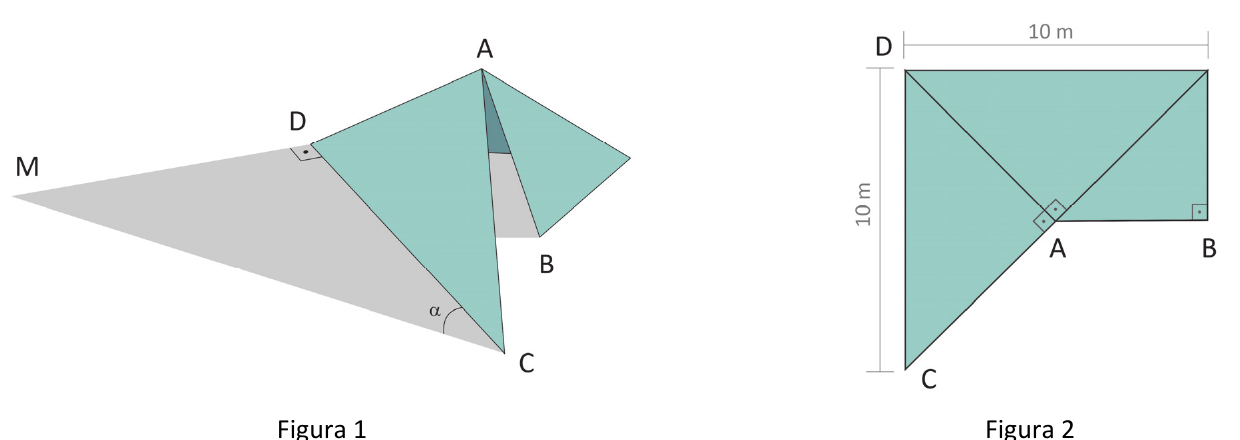
Observe Figures 1 and 2 to answer:
a) Assuming that the measurement of the area of the sculpture’s external shadow, represented by triangle DMC, be twice the measure of the area of triangle DAC, what is the measure of the angle α, indicated in Figure 1?
b) Assuming that the measurement of the area of the DMC triangle is $k$ times the measurement of the area of the triangle DAC, determine the value of $k$ as a function of α.
c) What is the measure of the orthogonal projection of the segment AB on the ground, assuming that the angle of this segment in relation to the ground is 60°?
Note and adopt:
- $\text{sen}(60°) = \frac{\sqrt{3}}{2}$
- $\cos(60°) = \frac{1}{2}$
Resolution
Reading the plan (Figure 2). The square has side 10 m. D and C are two vertices on the same side, then $DC = 10$ m. Point A is the center of the square (meeting of the diagonals, which are perpendicular), and B is the midpoint of the side opposite DC, then $AB = 5$ m.
Area of triangle DAC. The diagonals divide the square into 4 equal triangles, so
$$\text{Área}(DAC) = \frac{10^2}{4} = 25 \text{ m}^2$$(Or: base $DC = 10$ and height equal to the distance from A to DC, which is 5: $\frac{10 \cdot 5}{2} = 25$.)
The DMC triangle (Figure 1). It is on the ground and has a right angle in D, with legs $MD$ and $DC = 10$. Logo
$$\text{Área}(DMC) = \frac{MD \cdot 10}{2} = 5 \cdot MD \qquad \text{e} \qquad \tan\alpha = \frac{MD}{DC} = \frac{MD}{10}$$a) The DMC area is twice 25, that is, 50:
$$5 \cdot MD = 50 \quad\Rightarrow\quad MD = 10$$$$\tan\alpha = \frac{10}{10} = 1 \quad\Rightarrow\quad \alpha = 45°$$(The DMC triangle is an isosceles rectangle, with legs equal to 10.)
Answer (a): α = 45°.
b) Now $5 \cdot MD = 25k$, then $MD = 5k$. Hence
$$\tan\alpha = \frac{5k}{10} = \frac{k}{2} \quad\Rightarrow\quad k = 2\tan\alpha$$Response (b): $k = 2\tan\alpha$.
Conference: with $\alpha = 45°$, $k = 2 \cdot 1 = 2$, twice as much as item (a) ✔.
c) The segment AB measures 5 m and makes 60° with the ground. The orthogonal projection $p$ is the side adjacent to the angle of 60° in the right triangle formed by AB, its projection and the vertical:
$$p = AB \cdot \cos 60° = 5 \cdot \frac{1}{2} = 2{,}5 \text{ m}$$Response (c): 2,5 m.
Caution: using sine in item (c) gives $5 \cdot \frac{\sqrt{3}}{2} \approx 4{,}33$ m, which is the height of the highest point of AB relative to the lowest point, not the projection on the ground.
To review, see Right Triangles.