Hero Image
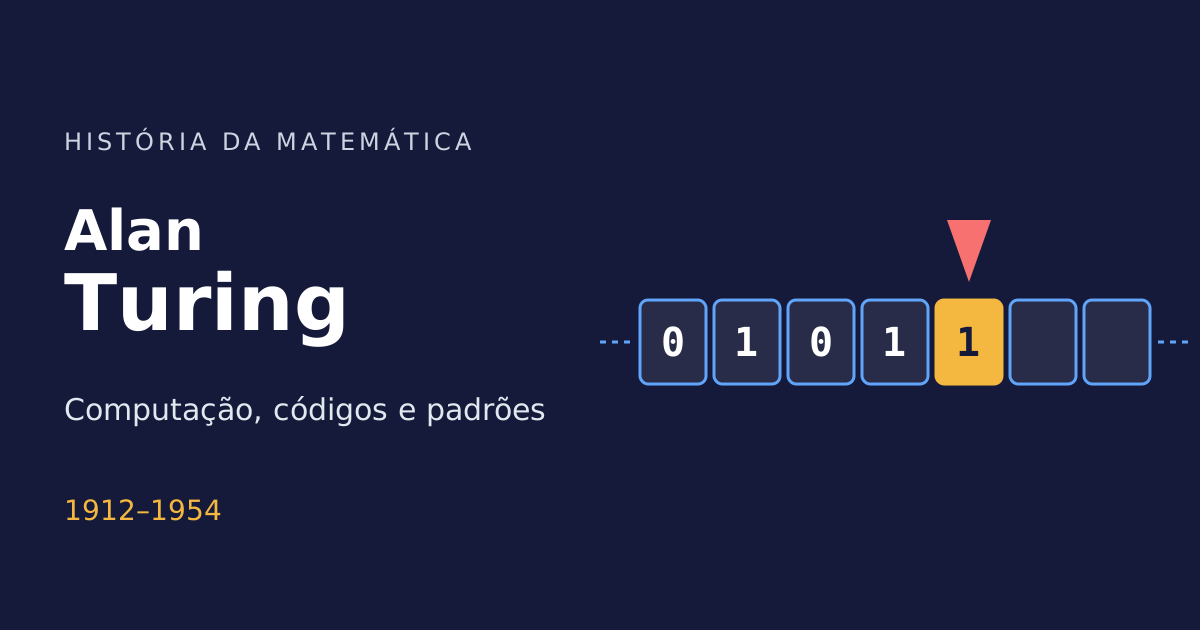
The life of Alan Turing

Timeline 1912Born on 23 June in London. His parents live in India. 1926Starts at Sherborne boarding school. 1930Christopher Morcom, his best friend, dies. 1931Enters King’s College, Cambridge. 1935Elected a fellow of King’s, aged 22. 1936Writes “On computable numbers”. Goes to Princeton. 1938Doctorate at Princeton. Returns to Cambridge. 1939Starts work at Bletchley Park, on breaking the Enigma. 1940The first electromechanical bombe comes into operation. 1945Moves to the National Physical Laboratory, where he designs the ACE. 1948Moves to the University of Manchester. 1950Publishes the paper on the imitation game. 1952Publishes the theory of morphogenesis. Convicted for homosexuality. 1954Dies on 7 June, in Wilmslow, aged 41. ◀ Previous Follow the journey Next ▶ 1912 LondonHe is born on 23 June in Maida Vale. His parents live in India, and he is brought up by a foster family in the south of England. 1926–1931 SherborneAt boarding school he meets Christopher Morcom, the friend whose death in 1930 leads him to think about the relation between mind and matter. 1931–1936 CambridgeHe studies at King’s College, becomes a fellow at 22 and writes “On computable numbers”. 1936–1938 PrincetonHe does his doctorate with Alonzo Church, who had reached the same result by another route. 1939–1945 Bletchley ParkDuring the war he heads the section that breaks the German naval Enigma and designs the electromechanical bombe. 1945–1947 TeddingtonAt the National Physical Laboratory he designs the ACE, a stored-program computer. 1948–1954 ManchesterHe programs one of the first computers, proposes the imitation game and studies morphogenesis. He dies in Wilmslow, near the city, on 7 June 1954. Enable JavaScript to see the map. The stages are listed below. From London to Manchester, by way of Princeton and Bletchley Park. Map: © OpenStreetMap contributors

Hero Image
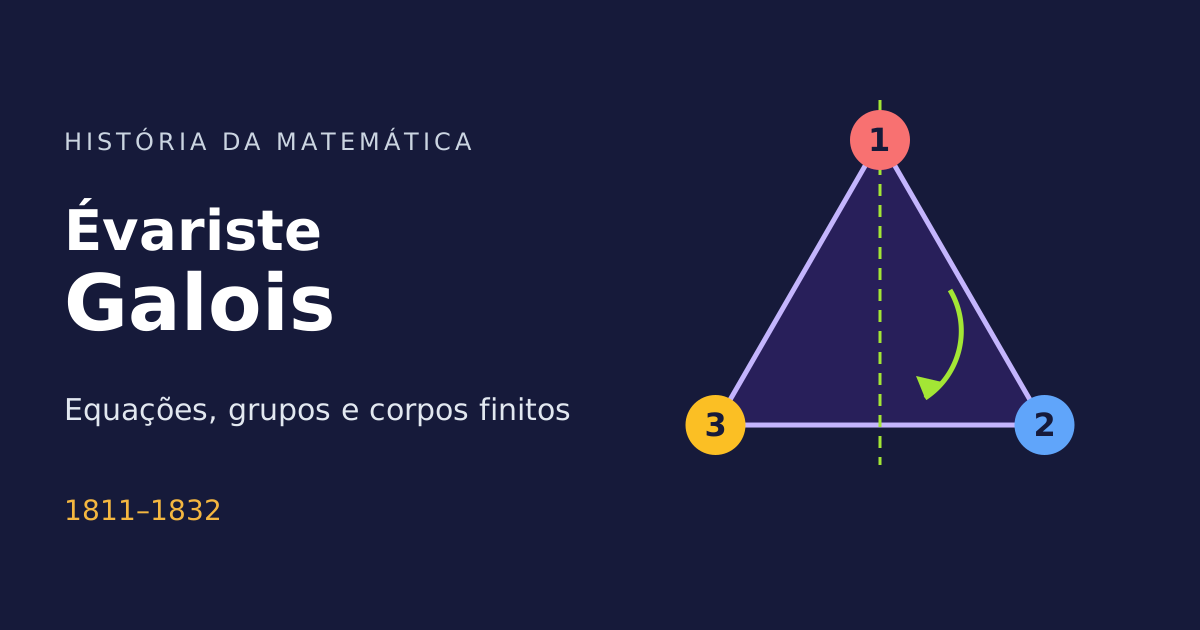
The life of Évariste Galois

Timeline 1811Born on 25 October in Bourg-la-Reine, near Paris. 1823Enters the Louis-le-Grand college in Paris. 1827Discovers mathematics and abandons everything else. 1828Fails the École Polytechnique entrance examination for the first time. 1829Publishes his first paper. Sends work to the Academy. His father commits suicide. Second failure at the Polytechnique. Enters the École Normale. 1830The paper entered for the Grand Prize is lost when Fourier dies. July Revolution. 1831Expelled from the École Normale. Poisson rejects his memoir. Arrested twice. 1832Dies on 31 May, aged 20, after being wounded in a duel. 1846Joseph Liouville publishes his works. ◀ Previous Follow the journey Next ▶ 1811–1823 Bourg-la-ReineHe is born in the town where his father will be mayor. His mother teaches him at home until he is 12. 1823–1829 Louis-le-GrandAt school he discovers mathematics at 15, “the frenzy of mathematics dominates him”. Having failed the Polytechnique twice, he enters the École Normale in 1829 and is expelled in 1831. 1831 Pont NeufOn 14 July he is arrested on the bridge, wearing the uniform of the disbanded artillery and armed. 1831–1832 Sainte-Pélagie prisonHe spends eight months in prison. In July 1831 he receives Poisson’s rejection. 1832 Cochin hospitalWounded in the duel of 30 May, he is taken to the hospital, where he dies on the morning of 31 May, aged 20. Enable JavaScript to see the map. The stages are listed below. Galois’s Paris, from school to prison and hospital, within a few kilometres. Map: © OpenStreetMap contributors

Hero Image
The life of Niels Henrik Abel

Timeline 1802Born on 5 August near Stavanger, on the west coast of Norway. 1804The family moves to Gjerstad, where his father is the pastor. 1815Enters the Cathedral School of Christiania, today’s Oslo. 1818Bernt Holmboe becomes his mathematics teacher. 1820His father dies. Abel begins to support part of the family. 1821Enters the university. Believes he has solved the quintic and finds the mistake. 1824Publishes, at his own expense, the proof that there is no formula for the fifth degree. 1825Travels to Berlin, where he meets August Leopold Crelle. 1826In Paris, hands the Academy his great memoir on integrals. Cauchy loses it. 1827Returns to Norway, jobless and in debt. Publishes elliptic functions. 1829Dies of tuberculosis at Froland on 6 April, aged 26. 1830Receives, posthumously, the Grand Prize of the Paris Academy, with Jacobi. ◀ Previous Follow the journey Next ▶ 1802 near StavangerHe is born on the west coast of Norway, the second of seven children of a pastor. 1804–1815 GjerstadHe grows up in his father’s parish in the south of the country. 1815–1825 ChristianiaAt the Cathedral School his teacher Holmboe discovers his talent. In 1824 he publishes the six-page pamphlet on the quintic. 1825–1826 BerlinHe meets August Leopold Crelle, who publishes seven of his papers in the first volume of his journal. 1826 ParisHe hands the Academy his great memoir on integrals. Nobody pays attention to him, and Cauchy loses the manuscript. 1827–1828 ChristianiaHe returns jobless and in debt. He publishes elliptic functions and races Jacobi. 1828–1829 FrolandHe travels by sleigh at Christmas to see his fiancée, falls ill and dies of tuberculosis on 6 April. Two days later the appointment from Berlin arrives. Enable JavaScript to see the map. The stages are listed below. Abel’s great journey, from Norway to Berlin and Paris, and the return to die at Froland. Map: © OpenStreetMap contributors

Hero Image
Euclid of Alexandria: the author without a face

Timeline c. 530 BCPythagoras and his followers study numbers and figures in southern Italy. c. 387 BCPlato founds the Academy in Athens. Over the door, according to tradition: “Let no one ignorant of geometry enter”. 331 BCAlexander the Great founds Alexandria, in the Nile delta. c. 300 BCEuclid teaches in Alexandria, in the time of King Ptolemy I, and writes the Elements. c. 250 BCArchimedes, in Syracuse, cites the Elements. c. AD 100A papyrus found at Oxyrhynchus, in Egypt, preserves a passage from Book II. c. 370Theon of Alexandria prepares the edition that will be copied over the following centuries. c. 450Proclus writes his commentary on Book I, with the little news we have of Euclid. c. 800The Elements are translated into Arabic in Baghdad. c. 1120Adelard of Bath translates the Arabic text into Latin. 1482First printed edition, in Venice, by Erhard Ratdolt. ◀ Previous Follow the journey Next ▶ c. 387 a.C. AthensPlato founds the Academy. The geometry Euclid will organise grows up in the Greek schools. c. 300 a.C. AlexandriaEuclid teaches in the time of Ptolemy I and writes the thirteen books of the Elements. c. 250 a.C. SyracuseArchimedes already cites the Elements in his works. c. 100 OxyrhynchusA papyrus found in the town’s rubbish heaps preserves a passage from Book II, with a figure. c. 370 AlexandriaTheon of Alexandria prepares the edition that will be copied for a thousand years. c. 450 AthensProclus writes his commentary on Book I, with the little news we have about Euclid. c. 800 BaghdadIn the House of Wisdom the Elements are translated into Arabic. c. 1120 BathAdelard of Bath translates the Arabic text into Latin, and the book returns to Europe. 1482 VeniceErhard Ratdolt prints the first edition, with the figures in the margins. More than a thousand editions followed. Enable JavaScript to see the map. The stages are listed below. The journey of the Elements, from Athens and Alexandria to the first printed edition in Venice. Map: © OpenStreetMap contributors

Hero Image
The life of Albert Einstein

Timeline 1879Born on 14 March in Ulm, in southern Germany. The family soon moves to Munich. 1891At 12, receives a book of Euclidean geometry, which he would call the “holy little book”. 1895Fails the entrance exam of the Zurich Polytechnic, despite high marks in mathematics and physics. 1900Graduates in Zurich. Spends two years without a steady job. 1902Starts work at the patent office in Bern, as a “technical expert, third class”. 1905The miraculous year: four papers that change physics and a doctoral thesis. 1909Leaves the patent office and becomes a professor in Zurich. 1914Moves to Berlin, as a member of the Prussian Academy of Sciences. 1915Presents the equations of general relativity. 1919The eclipse of 29 May, observed in Sobral and on the island of Príncipe, confirms the theory. Einstein becomes world-famous. 1922His Nobel Prize in Physics for 1921 is announced, for the photoelectric effect. 1925Visits Rio de Janeiro, from 4 to 12 May. 1933With the Nazis in power, leaves Germany for good. Settles in Princeton, in the United States. 1939Signs a letter to President Roosevelt about the possibility of an atomic bomb. 1955Dies on 18 April in Princeton. ◀ Previous Follow the journey Next ▶ 1879 UlmBorn on 14 March. The family soon moves away. 1880–1894 MunichHe receives the “holy little book” of geometry and hates his school, where everything is learned by heart. 1894–1895 ItalyAt 15 he leaves school and follows his family, which has moved to Italy. 1895–1896 AarauHaving failed the Zurich exam, he finishes secondary school at a freer Swiss school. 1896–1902 ZurichHe studies at the Polytechnic and graduates in 1900. He spends two years without a steady job. 1902–1909 BernTechnical expert third class at the patent office. In 1905, the miracle year, he writes four papers that change physics. 1911–1912 PragueProfessor at the University of Prague, between two periods in Zurich. 1914–1932 BerlinA member of the Prussian Academy. He presents general relativity (1915) and becomes famous after the 1919 eclipse. 1925 Rio de JaneiroHe spends eight days in Rio, from 4 to 12 May, and is enchanted by the Botanical Garden. 1933–1955 PrincetonWith the Nazis in power, he leaves Germany. He works at the Institute for Advanced Study until his death in 1955. Enable JavaScript to see the map. The stages are listed below. From Ulm to Princeton, with a stop in Rio de Janeiro. Map: © OpenStreetMap contributors
Hero Image
The life of James Bernoulli

Timeline 1655Born on 6 January in Basel, into a family of spice merchants. 1671Receives his master’s degree in philosophy. Goes on studying theology, as his father wishes. 1676Finishes theology and sets off on his travels. In Geneva he teaches mathematics to a blind girl. 1681Visits England, where he meets Robert Boyle and Robert Hooke. Writes about the great comet of 1680. 1683Back in Basel, lectures on experimental physics and studies the problem of compound interest. 1684Marries Judith Stupanus. Begins reading Leibniz’s papers on the calculus. 1687Becomes professor of mathematics at the University of Basel, a post he holds until his death. 1689Publishes the first of his dissertations on infinite series, with the harmonic series. 1690Solves the isochrone problem and uses the word integral for the first time. 1694Describes the lemniscate. 1697Breaks publicly with his brother Johann over the brachistochrone. 1705Dies on 16 August in Basel, leaving the Ars conjectandi unfinished. 1713The Ars conjectandi is published by his nephew Nicolaus. ◀ Previous Follow the journey Next ▶ 1655–1676 BaselHe is born into a family of spice merchants. At his father’s wish he studies theology; on his own, mathematics. 1676 GenevaHe tutors Elisabeth von Waldkirch, a blind girl, teaching her to read, write and a little mathematics. 1677–1680 FranceHe studies the philosophy of Descartes and Malebranche. 1681 HollandHe meets the scientists of the new experimental philosophy. 1681 EnglandHe meets Robert Boyle and Robert Hooke and writes about the great comet of 1680. 1683–1705 BaselHe returns home, teaches himself Leibniz’s calculus and is a professor at the university until his death in 1705. Enable JavaScript to see the map. The stages are listed below. Jakob Bernoulli’s years of travel, from Basel to England and back. Map: © OpenStreetMap contributors
Hero Image
The life of James Clerk Maxwell

Timeline 1831Born on 13 June in Edinburgh, Scotland. Spends his childhood on the family estate, Glenlair. 1839His mother dies of cancer, when he is 8. 1846At 14, a paper of his on oval curves is read at the Royal Society of Edinburgh. 1850Enters the University of Cambridge. 1855Presents his theory of colour and the paper “On Faraday’s lines of force”. 1856Becomes a professor in Aberdeen, aged 25. 1859Publishes the essay on Saturn’s rings, which won the Adams Prize. Presents the distribution of molecular speeds. 1860Loses his job when two colleges merge. Moves to King’s College, London. 1861Shows the first colour photograph at the Royal Institution. 1862Calculates that electromagnetic waves travel at the speed of light. 1865Publishes “A dynamical theory of the electromagnetic field” and returns to Glenlair. 1871Becomes the first Cavendish Professor of Experimental Physics, in Cambridge. 1873Publishes the Treatise on Electricity and Magnetism. 1879Dies on 5 November in Cambridge, aged 48. ◀ Previous Follow the journey Next ▶ 1831 EdinburghBorn on 13 June. Later he studies at the Edinburgh Academy and University; at 14 a paper of his on ovals is read at the Royal Society of Edinburgh. 1831–1841 GlenlairHe spends his childhood on the family estate, asking “what’s the go of that?”. His mother dies when he is eight. 1850–1856 CambridgeHe studies at Trinity College. He presents his theory of colours and his paper on Faraday’s lines of force. 1856–1860 AberdeenA professor at 25. He wins the Adams Prize with his essay on Saturn’s rings and loses his job when the colleges merge. 1860–1865 LondonAt King’s College he shows the first colour photograph and discovers that light is an electromagnetic wave. 1865–1871 GlenlairHe returns to the country and writes the Treatise on Electricity and Magnetism. 1871–1879 CambridgeThe first Cavendish Professor, he founds the Cavendish Laboratory. He dies in 1879, aged 48. Enable JavaScript to see the map. The stages are listed below. Maxwell between Scotland and England, always returning to Glenlair. Map: © OpenStreetMap contributors
Hero Image
The life of Johann Bernoulli

Timeline 1667Born on 27 July in Basel, the tenth child of Nicolaus Bernoulli. 1682Sent to Neuchâtel to learn the trade. He has no talent for it. 1683Enters the University of Basel. Studies medicine and, with his brother Jakob, mathematics. 1691Solves the catenary problem. Travels to Geneva and then to Paris. 1692Begins teaching the calculus to the Marquis de l’Hôpital. 1694Takes his doctorate in medicine. Signs a contract with l’Hôpital and marries Dorothea Falkner. 1695Becomes professor of mathematics in Groningen, in Holland. 1696Issues the challenge of the brachistochrone. L’Hôpital’s book, made from his lessons, comes out. 1705Returns to Basel. Jakob dies, and Johann inherits his chair. 1717States the principle of virtual work in a letter to Varignon. 1720Begins guiding the young Leonhard Euler. 1734Shares a Paris Academy prize with his son Daniel and throws him out of the house. 1748Dies on 1 January in Basel, aged 80. ◀ Previous Follow the journey Next ▶ 1667–1682 BaselHe is born, the tenth child of Nicolaus Bernoulli, who wants to make him a merchant. 1682 NeuchâtelHe is sent to learn trade. He has no talent for it. 1683–1691 BaselHe studies medicine and, with his brother Jakob, Leibniz’s calculus. He solves the problem of the catenary. 1691 GenevaHe passes through Geneva on his way to Paris. 1691–1692 ParisHe meets Malebranche’s circle and starts teaching calculus to the Marquis de l’Hôpital, also at the château of Oucques. 1695–1705 GroningenProfessor of mathematics in Holland. In 1696 he issues the brachistochrone challenge. 1705–1748 BaselHe returns home, inherits Jakob’s chair, guides the young Euler and quarrels with his son Daniel. He dies in 1748, aged 80. Enable JavaScript to see the map. The stages are listed below. Johann Bernoulli between Basel, Paris and Groningen. Map: © OpenStreetMap contributors

Hero Image
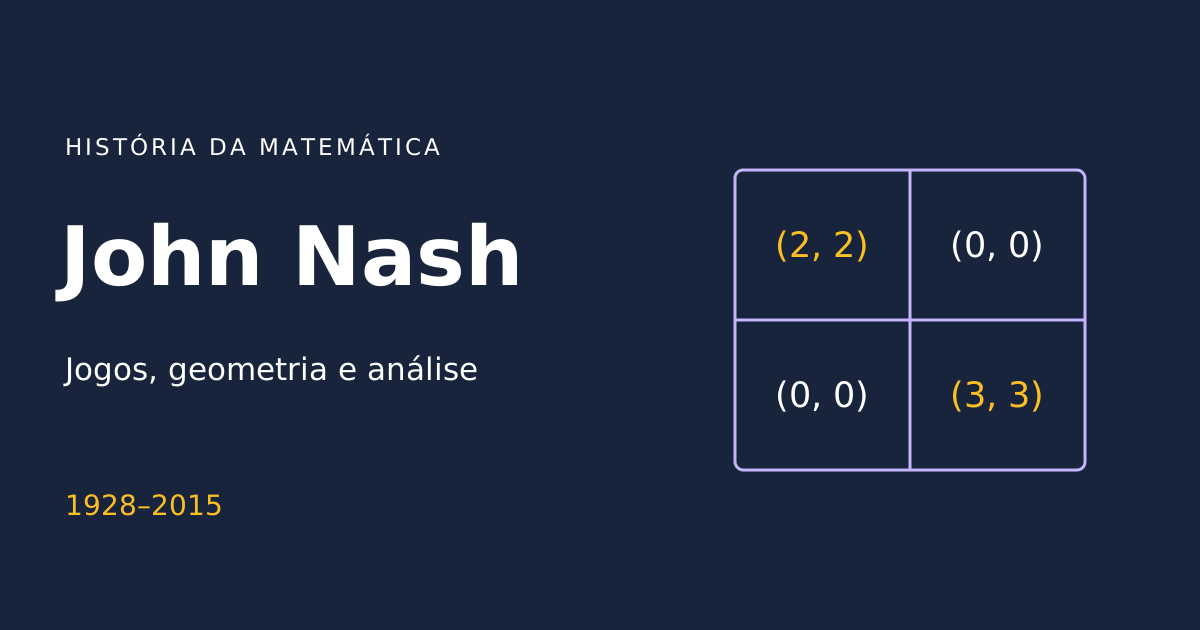
The life of John Nash

Timeline 1928Born on 13 June in Bluefield, West Virginia, in the United States. 1945Enters the Carnegie Institute of Technology, in Pittsburgh, to study chemical engineering. Switches to mathematics. 1948Arrives at Princeton. Invents the game his colleagues call “Nash”, known today as Hex. 1950Defends the thesis “Non-cooperative games”, with the Nash equilibrium. Publishes “The bargaining problem”. 1951Becomes an instructor at MIT. 1956Publishes the isometric embedding theorem. 1957Marries Alicia Lardé, a physics student at MIT. 1958Publishes the result on the regularity of parabolic equations. 1959First psychiatric hospitalisation. Three decades of illness begin. 1994Receives the Nobel Prize in Economics, with John Harsanyi and Reinhard Selten. 2001Remarries Alicia. The film A Beautiful Mind is released. 2015Receives the Abel Prize, with Louis Nirenberg. Dies in a car crash on 23 May, together with Alicia. ◀ Previous Follow the journey Next ▶ 1928–1945 BluefieldHe grows up in a railway and coal town. He reads Men of Mathematics and proves Fermat’s little theorem by himself. 1945–1948 PittsburghAt the Carnegie Institute of Technology he swaps chemical engineering for mathematics and has the bargaining idea. 1948–1951 PrincetonHe invents Hex and defends his 28-page thesis with the Nash equilibrium. 1951–1959 MITA professor at MIT. He proves the embedding theorem and the result on parabolic equations. In 1959 his illness begins. 1970–2015 PrincetonHe wanders the corridors as “the phantom of Fine Hall” and recovers at the end of the 1980s. 1994 StockholmHe receives the Nobel Prize in Economics, with John Harsanyi and Reinhard Selten. 2015 OsloHe receives the Abel Prize, with Louis Nirenberg. On the way home, on 23 May, he and Alicia die in a taxi crash in New Jersey. Enable JavaScript to see the map. The stages are listed below. John Nash’s places, from Bluefield to Princeton, and the journeys to receive the Nobel and the Abel. Map: © OpenStreetMap contributors

Hero Image
The life of Joseph-Louis Lagrange

Timeline 1736Born on 25 January in Turin, capital of the Kingdom of Sardinia, as Giuseppe Lodovico Lagrangia. 1753At 17, reads an essay by Edmond Halley and decides to devote himself to mathematics. 1755Writes to Euler with the method that will give rise to the calculus of variations. In September he is appointed professor at the Artillery School in Turin, aged 19. 1757Helps found the scientific society that will become the Turin Academy of Sciences. 1764Wins the Paris Academy prize by explaining why the Moon always shows the same face. 1766Moves to Berlin to take Euler’s place at the Academy of Frederick the Great. 1770Proves that every whole number is a sum of four squares and begins studying the permutations of the roots of an equation. 1772Shares the Paris prize with Euler for the three-body problem, where the Lagrange points appear. 1787After Frederick’s death, moves to Paris, where he lives in the Louvre. 1788Publishes the Analytical Mechanics. 1790Joins the commission that will create the metric system. 1794Lavoisier is guillotined. Lagrange becomes a professor at the new École Polytechnique. 1797Publishes the Theory of Analytic Functions, with the notation $f'(x)$. 1808Napoleon makes him a count of the Empire. 1813Dies on 10 April in Paris and is buried in the Panthéon. ◀ Previous Follow the journey Next ▶ 1736–1766 TurinAt 19 he is a professor at the Artillery School. He writes to Euler the method that will give rise to the calculus of variations. 1766–1787 BerlinHe takes Euler’s place at the Academy of Frederick the Great. He proves the four-square theorem and finds the Lagrange points. 1787–1813 ParisHe lives in the Louvre, publishes the Analytical mechanics, helps create the metric system and teaches at the École Polytechnique. He is buried in the Panthéon. Enable JavaScript to see the map. The stages are listed below. Lagrange in three capitals, Turin, Berlin and Paris. Map: © OpenStreetMap contributors
Hero Image
The life of Sophie Germain

Timeline 1776Born on 1 April in Paris, the daughter of a wealthy silk merchant. 1789At 13, during the Revolution, she reads the story of Archimedes’ death and decides to study mathematics. 1794The École Polytechnique is founded and does not admit women. Sophie obtains the lecture notes and sends Lagrange a paper under the name Monsieur Le Blanc. 1801Gauss publishes the Disquisitiones Arithmeticae. 1804She begins writing to Gauss, again as Monsieur Le Blanc. 1806French troops occupy Braunschweig. Sophie asks a general who is a friend of the family to protect Gauss, who thus discovers who she is. 1809The Academy of Sciences announces a prize for the mathematical theory of vibrating plates. 1816On her third attempt, she wins the prize. She is the first woman to receive a prize from the Academy. 1823Legendre makes public her theorem on Fermat’s Last Theorem. 1829She learns she has breast cancer. 1831Dies on 27 June in Paris, aged 55. ◀ Previous Follow the journey Next ▶ 1776–1794 Rue Saint-DenisShe grows up in the house of her father, a rich silk merchant. At 13, during the Revolution, she decides to study mathematics. 1794 École PolytechniqueThe school does not admit women. She obtains the lecture notes and sends a paper to Lagrange as Monsieur Le Blanc. 1804–1806 BrunswickShe writes to Gauss about number theory. In 1806, with the city occupied, she asks a French general to protect Gauss, who thus learns who she is. 1816 Institut de FranceAt the third attempt she wins the Academy’s prize on vibrating plates, the first woman to receive a prize from the Academy. 1831 Père-Lachaise cemeteryShe dies on 27 June, aged 55. It is said that her death certificate recorded her as a rentière, a person of private means, and not as a mathematician. Enable JavaScript to see the map. The stages are listed below. Sophie Germain’s Paris, with a line for the letters sent to Gauss in Brunswick. Map: © OpenStreetMap contributors