
Euler's Eyes
2026-10-10
The spring and differential equations
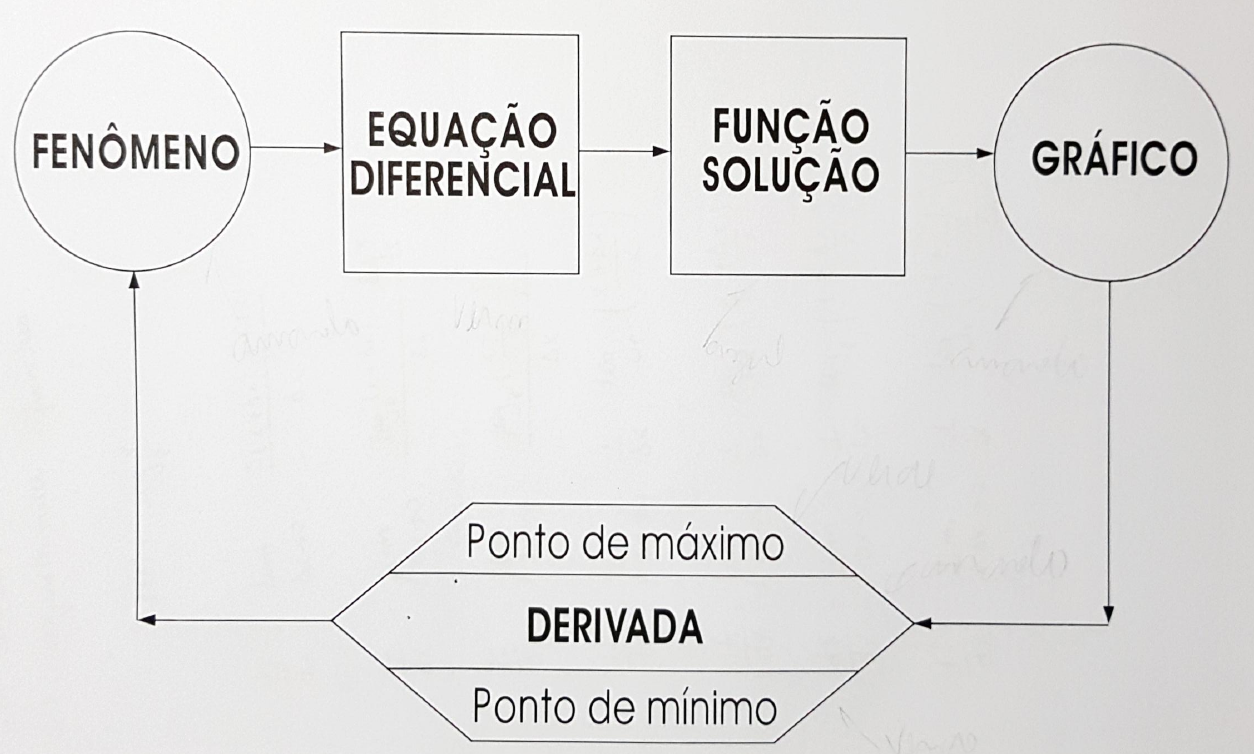
A differential equation is an equation in which the unknown is a function, and the equation speaks of its derivatives. Euler organized this path into a scheme that we still use today: observe a phenomenon, write the equation, find the function that solves it and draw the graph.
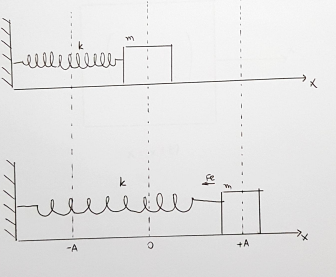
The phenomenon. In 1678, Robert Hooke summarized the behavior of a spring in Latin: ut tensio, sic vis, “as extension, so strength.” A spring of constant $k$, stretched by $x$, pulls back with strength $F = -kx$.
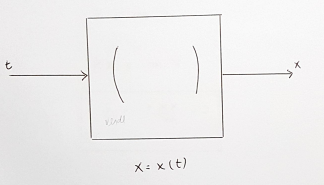
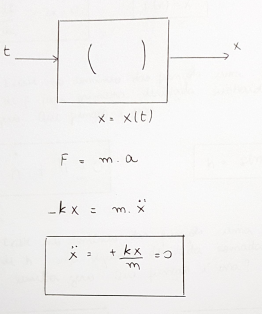
The equation. By Newton’s second law, $F = m \cdot a$, and acceleration is the second derivative of position, $x''$. Then
The solution function. We look for a function whose second derivative is itself multiplied by a negative number. Euler’s trick (1743) was to try $x = e^{rt}$, since differentiating $e^{rt}$ only does the factor $r$ appears:
An imaginary number appeared! This is where Euler’s formula comes in: $e^{i\omega t} = \cos(\omega t) + i\sin(\omega t)$. Putting the real parts together, the solutions are
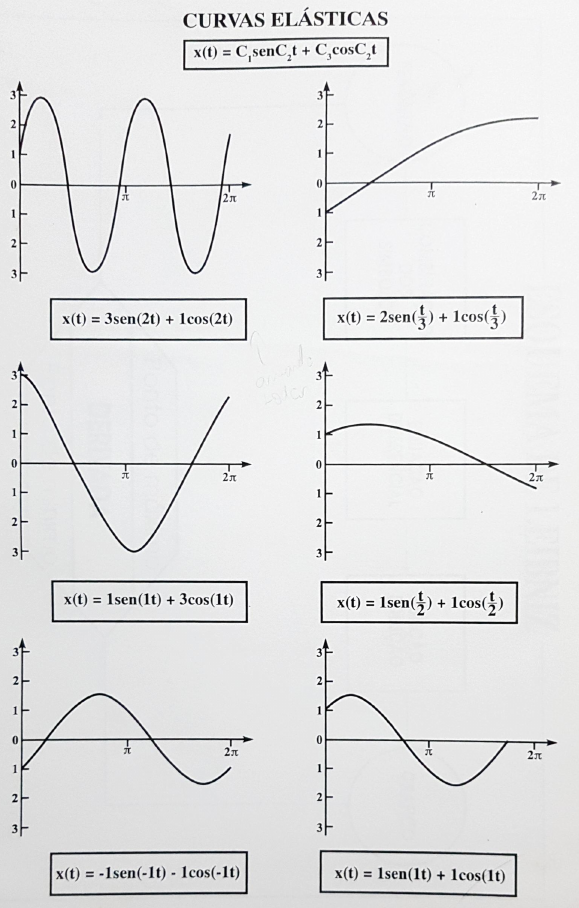
The graph. The mass goes back and forth forever, drawing a sinusoid. Change the spring and mass and see what period $T = 2\pi/\omega$ change: harder spring oscillates faster, larger mass oscillates slower.
What function is this? (click to see the next puzzle)
- There is a function $f$ whose derivative, minus $2x$, gives zero: $f' - 2x = 0$. Response: $f(x) = x^2$ (plus any constant).
- There is a function $h$ whose second derivative, added to the function itself, gives zero: $h'' + h = 0$. Response: $h(x) = \sin x$, and also $\cos x$. It is the spring equation with $k = m$.
- There is a function $g$ whose fourth derivative, minus the function itself, gives zero: $g'''' - g = 0$. Response: $g(x) = \cos x$, and also $\sin x$, $e^x$ and $e^{-x}$.
All topics by Leonhard Euler · ← Euler’s formula and the “most beautiful equation” · The Königsberg bridges and the birth of graphs →