
Euler's Eyes
2026-10-11
The cycloid: the toothache curve
Paint a dot on a bicycle tyre and push the bike in a straight line. The dot rises, makes an arch and comes back down to touch the ground, once for every turn of the wheel. The curve it traces is called the cycloid.
In the 17th century it was the fashionable curve. The French called it the roulette. So many mathematicians quarrelled over discoveries about it that it earned a nickname: the Helen of geometers, after Helen of Troy, who started a war.
The equation of the wheel
A wheel of radius $r$ rolls without slipping along a straight line. When it turns through an angle $t$, measured in radians, its centre moves forward the distance $rt$, the length of rim that has touched the ground. The painted dot, which started at the bottom, is at
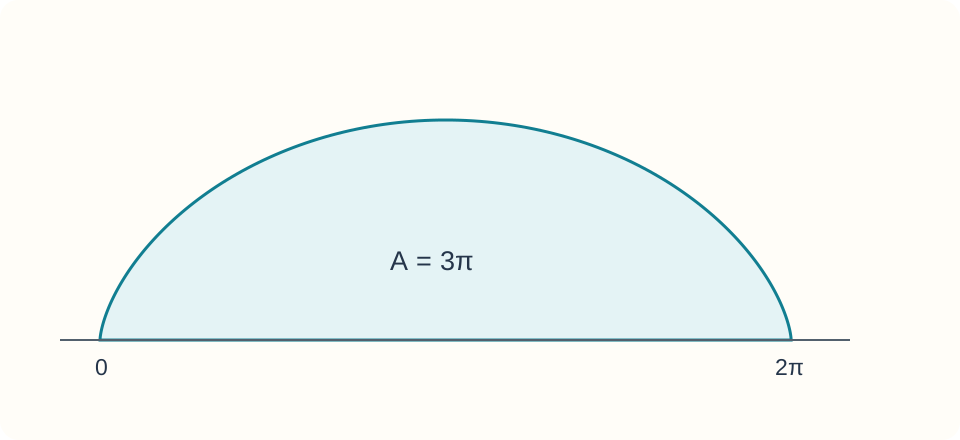
$$x=r(t-\sin t),\qquad y=r(1-\cos t).$$From $t=0$ to $t=2\pi$ the wheel makes one full turn. The arch is $2\pi r$ wide, equal to the wheel’s circumference, and $2r$ high at most, the diameter.
Galileo weighs the curve
Galileo gave the curve its name around 1599 and wanted to know the area under one arch. Unable to calculate it, he cut the cycloid and the generating circle out of sheets of the same material and weighed them. The cycloid weighed almost three times as much as the circle. Galileo suspected the ratio was not exactly 3 and gave up.
It was exactly 3. Gilles de Roberval proved it in 1634, and today the calculation takes just a few lines.
The area, with calculus
The area under the curve is the sum of thin strips of height $y$ and width $dx$. Since $dx=r(1-\cos t)\,dt$,
$$A=\int_0^{2\pi}y\,\frac{dx}{dt}\,dt=r^2\int_0^{2\pi}(1-\cos t)^2\,dt.$$Expanding the square leaves three parts:
$$\int_0^{2\pi}1\,dt=2\pi,\qquad \int_0^{2\pi}-2\cos t\,dt=0,\qquad \int_0^{2\pi}\cos^2t\,dt=\pi.$$The last one comes from $\cos^2t=\frac{1+\cos2t}{2}$. Adding up,
$$A=r^2(2\pi+0+\pi)=3\pi r^2.$$The area under one arch of a cycloid is three times the area of the wheel that drew it. Galileo’s cut-outs were right.
The night of 1658
By 1658 Pascal had given up mathematics for four years. According to his sister Gilberte, one night he could not sleep because of a bad toothache. To forget the pain he began thinking about the cycloid. The pain went away. Pascal took this as permission to carry on and, in eight days, solved problems nobody had solved: the areas of pieces of the curve, their centres of gravity and the volumes of the solids it generates when it spins around an axis.
Then he issued a public challenge to all of Europe, signed with a pseudonym, Amos Dettonville. He offered 40 gold pistoles for first place and 20 for second, with a deadline of 1 October 1658.
Two mathematicians sent solutions: the Englishman John Wallis and the Jesuit Antoine de Lalouvère. The jury found errors in both, and nobody won the prize. Pascal published his own results in the Letters of A. Dettonville. One of them, on the sines of a quarter circle, was read years later by a young Leibniz, who said he saw in it a light that led him to the calculus.
The fastest curve
The cycloid still had surprises in store. In 1659 Christiaan Huygens discovered that a ball sliding inside an upturned cycloid takes the same time to reach the bottom, whatever height it starts from. He used this to build more accurate pendulum clocks. In 1696 Johann Bernoulli proved that it is also the curve of fastest descent between two points: faster even than the straight line.
Exercise: what is the area under an arch traced by a wheel of radius 2?
$A=3\pi\cdot2^2=12\pi\approx37.7$. Doubling the radius multiplies the area by four.
Exercise: show that the length of one arch of a cycloid is 8r
The length is $\int_0^{2\pi}\sqrt{x'(t)^2+y'(t)^2}\,dt$. Since $x'=r(1-\cos t)$ and $y'=r\sin t$, the square root equals $r\sqrt{2-2\cos t}=2r\sin\frac t2$. So the length is $\int_0^{2\pi}2r\sin\frac t2\,dt=2r\Big[-2\cos\frac t2\Big]_0^{2\pi}=8r$. The man who found this result, in 1658, was the Englishman Christopher Wren, the architect of St Paul’s Cathedral in London.
Sources: Pascal biography, MacTutor · Gilberte Périer, Life of Pascal, on Wikisource (French).
All Pascal topics · ← The mystic hexagram: six points on a conic · Pascal’s principle: multiplying forces with water →