
Euler's Eyes
2026-10-13
The equals sign is a balance, not an arrow
What number goes in the box?
$$8+4=\square+5$$In the late 1990s the American researchers Karen Falkner, Linda Levi and Thomas Carpenter asked this question of pupils from first to sixth grade. In every grade, fewer than one in ten answered $7$. The commonest answers were $12$ and $17$.
Those who answered $12$ did the sum $8+4$ and wrote the result after the $=$, as they always did. Those who answered $17$ added up all the numbers they could see. Neither group got the sum wrong. Both got the reading of the equals sign wrong.
An arrow or a balance?
For many pupils, $=$ means “and the answer is”. It is the reading the calculator teaches: you key in $8$, $+$, $4$ and press the $=$ key, which does the sum and shows the answer. In this reading equals is an arrow: on the left the question, on the right the answer, and the calculation only goes one way.
But that is not what Recorde drew in 1557. Two parallels of the same length say that the two things are worth the same. Equals is a balance: the pans are level, and it does not matter which side is on the left.
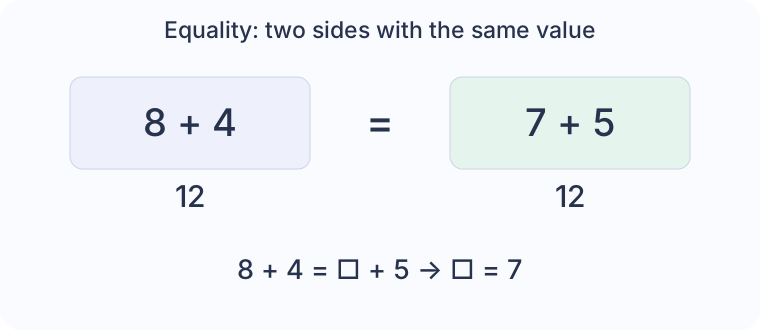
In the balance reading the answer is immediate: the left pan weighs $12$, so the right one must weigh $12$ too, and it is $7$ short of that. Writing $12$ in the box would give $8+4=12+5$, that is, $12=17$, a balance out of level.
The balance reading also explains why $7=3+4$ is just as true as $3+4=7$, and why $3+4=5+2$ is a perfectly correct sentence, although it has no “answer” at all. In mathematical language, equality is a symmetric relation: if $A=B$, then $B=A$.
An equation read sign by sign
The balance reading is what makes algebra possible. Go back to the equation from chapter 1, “a quantity added to its half gives five”:
$$x+\frac{x}{2}=5.$$A hasty reading says “add $x$ to its half and get five”. A semiotic reading looks at each sign:
- The $x$ is not just any number: it is an unknown, a place reserved for a value the equality will select.
- The fraction bar in $\frac x2$ groups without needing brackets: the half is of the whole of $x$.
- The $+$ joins two quantities: the whole $x$ and its half.
- The $=$ does not tell you to calculate anything. It states that the two pans weigh the same, and it is a condition that only one value of $x$ satisfies.
Solving the equation means doing, on both pans, operations that keep the balance level:
$$x+\frac x2=5 \iff \frac{3x}{2}=5 \iff 3x=10 \iff x=\frac{10}{3}.$$The sign $\iff$ says that each step is reversible: multiplying both sides by $2$ and then dividing by $3$ neither loses nor invents solutions, because $2$ and $3$ are not zero. Checking closes the circle and reconnects the writing to the problem:
$$\frac{10}3+\frac12\cdot\frac{10}3=\frac{10}3+\frac53=\frac{15}3=5.$$The same condition in another drawing
The sentence can also be translated into a drawing of segments. Half of $x$ is one part; the whole $x$ is two parts equal to it. Together, $x$ and its half are three equal parts, and the three measure $5$:
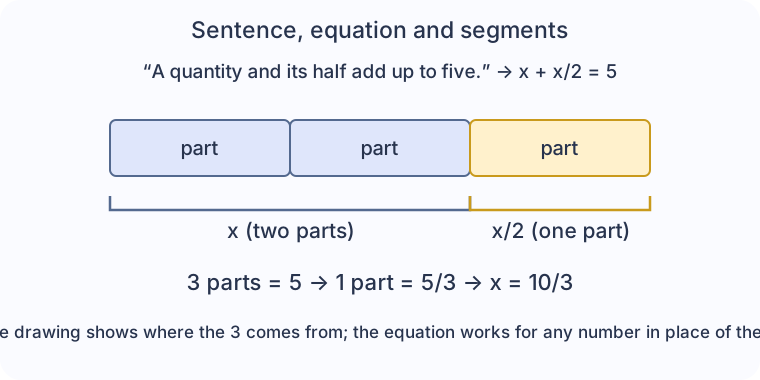
Each part measures $\frac53$, and $x$, which is two parts, measures $\frac{10}3$. The drawing shows at once where the $3$ comes from; the equation hides it inside a sum of fractions, but in return it works for any number in place of the $5$. The sentence shows neither, but it is the only one that says what we are talking about. Each representation lights up a part of the same problem.
Exercise: what number goes in the box?
The left side is worth $8$. For the right side to be worth $8$, the box must be $11$, because $11-3=8$. Whoever reads equals as an arrow writes $8$, and the balance becomes $8=5$.
Exercise: fix the chain
Correct the writing $5\cdot3=15+2=17$ without changing the idea of the calculation. Two correct forms:
$$5\cdot3+2=15+2=17,$$where every equals sign joins expressions that really are worth the same, or in two separate lines: $5\cdot3=15$ and $15+2=17$.
Chapter index · ← When place is the algorithm: multiplication and the rule of three · Square root: the side of the square and the sign that forgot →