
Euler's Eyes
2026-10-13
Peirce: icon, index and symbol
Charles Sanders Peirce (1839–1914) was at once a chemist, astronomer, geodesist, logician and philosopher. He spent thirty years measuring the Earth’s gravity for the United States Coast Survey, created, independently of Frege, a notation for the quantifiers of logic and, in whatever hours were left, built the most influential theory of signs of the twentieth century. He died poor, in a house in Pennsylvania, leaving tens of thousands of manuscript pages that are still being edited today.
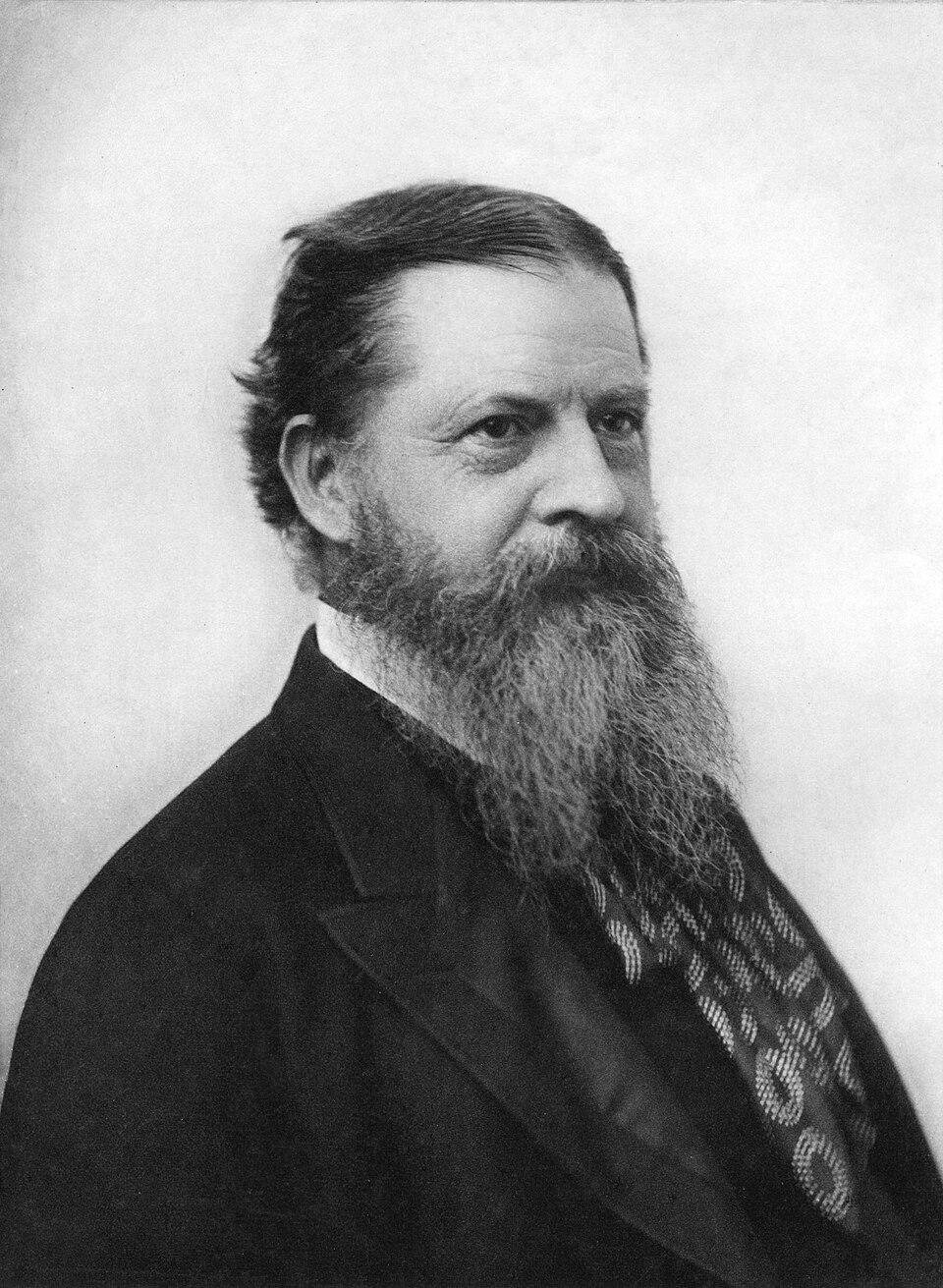
Peirce was a logician and thought like one. For him semiotics was “logic in the broad sense”, and his ideas fit mathematics like a glove.
Three, not two
Saussure saw the sign as having two faces: signifier and signified. Peirce saw three elements:
- the sign (or representamen): what is perceived, such as the mark $\pi$ on paper;
- the object: what the sign refers to, the ratio of circumference to diameter;
- the interpretant: the effect the sign produces in whoever reads it, the understanding it awakens.
The interpretant is not the person reading. It is the thought the sign provokes, and that thought is in turn a new sign, which can provoke another, and so on. On seeing $2+3=5$, a reader may recognise an equality, use it to check a calculation or fit it into a proof. The sign is the same; the interpretant depends on what is being done. Peirce called this endless process semiosis.
Icon, index and symbol
Peirce’s most famous classification separates signs by the way they connect to their object:
- An icon represents by resemblance: a portrait, a map, a diagram. The drawing of a triangle is an icon of the triangle.
- An index represents by a factual connection: smoke indicates fire, a footprint indicates who passed, an arrow points to a spot. In a figure, the letter $A$ next to a vertex is an index: it points “this one here”.
- A symbol represents by convention or habit: words, digits, $+$. It only works for those who have learned the rule.
Almost every mathematical sign is, at first sight, a symbol in Peirce’s sense, and this is where the surprise comes.
Every equation is an icon
Peirce realised that the classification does not apply sign by sign, but to the whole expression. The signs of an equation are symbols, but the equation as a whole is an icon: its shape reproduces the shape of the relations between the quantities. He wrote:
For a great distinguishing property of the icon is that by the direct observation of it other truths concerning its object can be discovered than those which suffice to determine its construction. […] Every algebraical equation is an icon, in so far as it exhibits, by means of the algebraical signs (which are not themselves icons), the relations of the quantities concerned.
— Charles S. Peirce, Collected Papers, 2.279 and 2.282 (c. 1893–1903)
The first sentence is the best definition there is of what this book calls active notation. A script is active when, by looking at it, we discover things we did not deliberately put there. Leibniz’s chain rule is the perfect example: nobody drew $\frac{dz}{dy}\cdot\frac{dy}{dx}$ so that the $dy$ would cancel, but the shape is there, and whoever looks at it discovers the rule.
Here is another, much older example. Draw a square of side $a+b$ and divide each side into two pieces, $a$ and $b$:
$$(a+b)^2 \;=\; \underbrace{a^2}_{\text{big square}} + \underbrace{ab+ab}_{\text{two rectangles}} + \underbrace{b^2}_{\text{small square}} \;=\; a^2+2ab+b^2.$$The figure is an icon of the identity: by looking at it we see there are two rectangles, and that is where the $2ab$ that so many pupils forget comes from. The formula is also an icon, in another way: its shape lets you see that replacing $b$ by $-b$ gives $(a-b)^2=a^2-2ab+b^2$, with no need to draw anything.
The three modes together
In practice the three modes mix. A Cartesian graph is iconic (the curve has the shape of the function’s behaviour), indexical (each marked point points to a pair of values) and symbolic (the axes, the scale and the labels are conventions). That is why a graph can mislead: its iconic shape seems to say more than the conventions guarantee. A curve that seems to touch the axis may pass just above it; a stretched scale can turn a small rise into a climb.
Peirce did not give a table for classifying signs; he gave questions for reading them. Faced with a representation, it is worth asking: what does it preserve of the object? What does it leave out? Which conventions do you need to know? And above all: what new truths can be discovered by looking at it?
Exercise: icon, index or symbol?
In a graph of $y=x^2$ with the point $P=(2,4)$ marked and an arrow pointing to it:
- the drawn parabola is an icon (it has the shape of the relation: symmetric, with a minimum at the origin);
- the arrow and the letter $P$ are indices (they point to a particular point);
- the numbers on the scale and the expression $y=x^2$ written beside it are symbols (they depend on conventions).
The expression $y=x^2$ itself, read as a whole, is also iconic in Peirce’s sense: its shape shows that replacing $x$ by $-x$ does not change $y$, which is exactly the parabola’s symmetry.
Exercise: discover a truth in the icon
Using the figure of the square of side $a+b$, compute $11^2$ without multiplying. With $a=10$ and $b=1$: $11^2=100+2\cdot10+1=121$. And $21^2$? $a=20$, $b=1$: $400+40+1=441$. The identity, which was just a figure, has become a method of mental arithmetic, a truth that was not “written” in the drawing but is discovered by looking at it.
Chapter index · ← What is a sign? Saussure, Morris and the minus sign · The object and its representations: the case of fractions →