
Euler's Eyes
2026-10-14
The Nash bargaining solution
A new treatment is presented of a classical economic problem, one which occurs in many forms, as bargaining, bilateral monopoly, etc.
— John Nash, The Bargaining Problem (1950)
In 1948, still an undergraduate at the Carnegie Institute of Technology, Nash took a course in international economics, the only economics course of his life. He came out of it with a question: when two people negotiate, how do they share the gains from a deal? Economists thought the answer depended on each side’s psychology, skill and bluffing, and that there was nothing to say in general. Nash showed that, if the deal must satisfy a few reasonable requirements, there is only one possible answer. The paper, written before he arrived at Princeton, was published in 1950 in the journal Econometrica.
The problem
Two people, 1 and 2, can make a deal. Each possible deal gives each of them a gain, measured as utility: $u_1$ and $u_2$. If there is no deal, each keeps what they already had, the disagreement point $(d_1,d_2)$. A deal is only of interest if it gives each person at least what they would have without it.
The four requirements
Nash asked the solution to have four properties:
- Efficiency. There must be no other deal that is better for both at the same time.
- Symmetry. If the situation is symmetric, with the same possibilities and the same disagreement point for both, both gain the same.
- Invariance. The solution does not change if one person’s utility is measured on another scale, as one swaps degrees Celsius for Fahrenheit.
- Independence of irrelevant alternatives. If the solution of a problem is still possible in a smaller problem, it is still the solution. Removing options nobody would choose does not change the deal.
Nash’s theorem says that there is a single rule with the four properties: choose the deal that maximises the product of the gains over the disagreement point,
$$\boxed{(u_1-d_1)\cdot(u_2-d_2).}$$Sharing 10 dollars
Two people are going to share 10 dollars. If there is no deal, nobody gets anything: $d=(0,0)$. Suppose, for simplicity, that utility is the money itself. If person 1 receives $x$, person 2 receives $10-x$, and the product is
$$P(x)=x(10-x)=25-(x-5)^2.$$The maximum is at $x=5$: each takes 5 dollars. No surprise, in a symmetric case.
Whoever has a good alternative gets more
Now suppose person 1 has an alternative: without a deal, she can get 4 dollars elsewhere, and person 2 still gets nothing. The disagreement point is $(4,0)$. The gains over the disagreement point are $x-4$ and $10-x$, and the product is
$$P(x)=(x-4)(10-x)=9-(x-7)^2,\qquad4\leq x\leq10.$$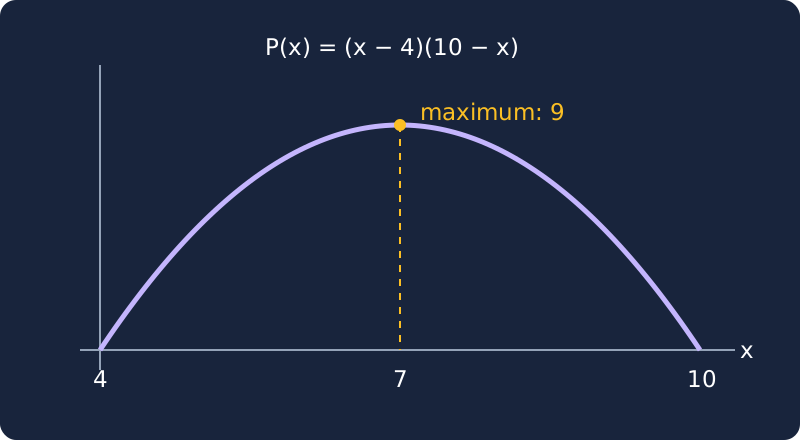
The maximum is at $x=7$: the split is 7 for person 1 and 3 for person 2. Each gains 3 dollars more than they would have without a deal. The Nash solution splits the surplus equally, the value the deal creates beyond what each had already secured. That is why whoever has a good alternative gets more: it is not handed over as a gift, it is the starting point of the negotiation.
A calculation with different utilities
Money is not always worth the same to both. Suppose that, for person 2, who is poorer, the utility of $y$ dollars is $\sqrt y$: the first dollars are worth a lot, the following ones less and less. With disagreement point $(0,0)$, we maximise $x\sqrt{10-x}$. Differentiating,
$$\sqrt{10-x}-\frac{x}{2\sqrt{10-x}}=0\quad\Longrightarrow\quad2(10-x)=x\quad\Longrightarrow\quad x=\frac{20}3\approx6.67.$$Person 1 takes 6.67 dollars and person 2 takes 3.33. Whoever is more eager for any deal, because each dollar matters more to them, ends up with less. Nash’s mathematics does not say whether this is fair: it says what follows from the four requirements.
Exercise: with a total of 12 and disagreement point (2, 0), what is the Nash split, with utility equal to money?
We maximise $(x-2)(12-x)=-x^2+14x-24=25-(x-7)^2$. The maximum is at $x=7$: the split is (7, 5). The surplus is $12-2=10$, and each gains 5 over the disagreement point.
Exercise: show that, with utilities equal to money, total T and disagreement point (d₁, d₂), person 1 receives d₁ + (T − d₁ − d₂)/2.
The product is $(x-d_1)(T-x-d_2)$. It is a parabola in $x$ with roots at $x=d_1$ and $x=T-d_2$, and the maximum lies halfway between them: $x=\frac{d_1+T-d_2}2=d_1+\frac{T-d_1-d_2}2$. Each receives their disagreement payoff plus half of the surplus $T-d_1-d_2$.
Sources: John F. Nash, “The bargaining problem”, Econometrica 18 (1950) · Ken Binmore, Game Theory: A Very Short Introduction (Oxford, 2007) · 1994 Nobel Prize in Economics, Nobel Foundation.
All topics on John Nash · ← Mixed strategies: the penalty kick and odds and evens · Crumpling without stretching: the embedding theorem →