
Euler's Eyes
2026-10-10
Square root with ruler and compass
Geometry begins by showing that arithmetic operations can be done with segments. The most beautiful is the square root. To find $\sqrt{a}$:
- Draw on a straight line a segment $AB$ of length 1 and then a segment $BC$ of length $a$.
- Draw a semicircle with diameter $AC$.
- Lift a perpendicular through $B$ until you find the semicircle at point $D$.
Then $BD = \sqrt{a}$.
Why? Every triangle inscribed in a semicircle, with one side in diameter, is a right angle. So $ADC$ is rectangle in $D$, and $DB$ is the height relative to the hypotenuse. The triangles $ABD$ and $DBC$ are similar, which gives
In the drawing, $a = 4$: height $BD$ measures exactly 2 units.
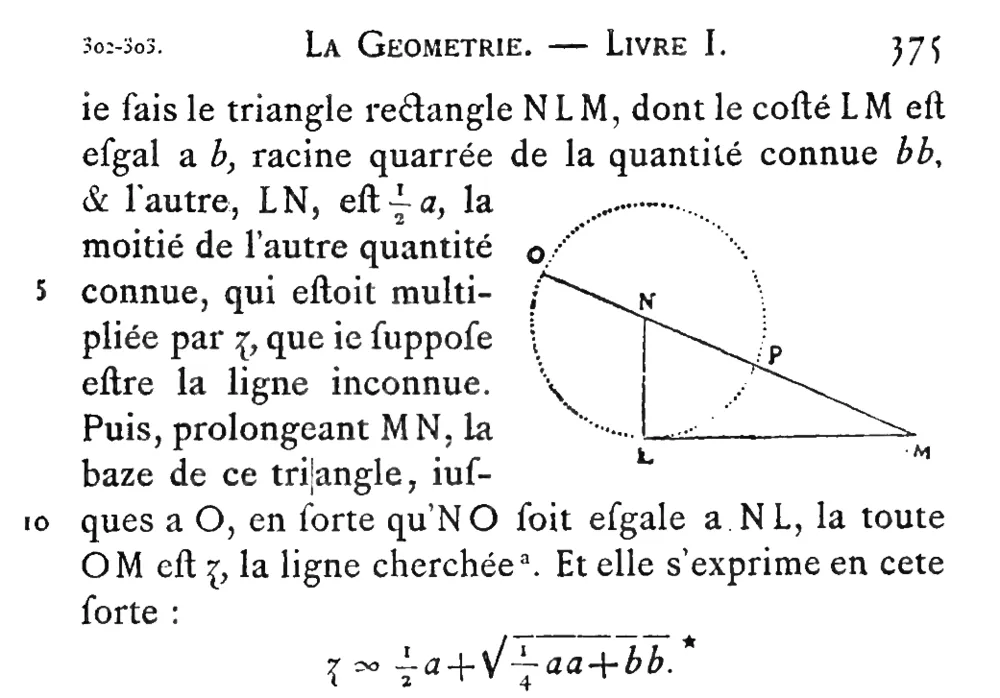
It was also in Geometry that Descartes established conventions that we still use today: the last letters of the alphabet ($x$, $y$, $z$) for the unknowns, the first ($a$, $b$, $c$) for the values known, and the exponents written at the top, as in $x^3$.
All topics by René Descartes · ← Coordinates: geometry becomes algebra · The rule of signs →