
Euler's Eyes
2026-09-26
FUVEST 2026 – 2nd phase: Mathematics solved
Source: FUVEST – test on the 2nd day of the 2nd phase (specific tests; Mathematics has questions M01 to M06) and expected Mathematics answers. Files in the FUVEST collection 2026.
In the 2nd phase of FUVEST 2026, the 2nd day consisted of specific essay tests for each area; The Mathematics test has six questions, M01 to M06, each with items a), b) and c). For this test, FUVEST published the expected answers; the resolutions below are ours, we checked each one in a second way and all match the official expected answers.
Template
| Question | Subject | Answers |
|---|---|---|
| M01 | Probability: draw of ARARA letters | a) $\frac{3}{10}$; b) $\frac{1}{10}$; c) $\frac{1}{120}$ |
| M02 | Linear systems: selling bottles of alcohol | a) 45 and 5; b) R$ 7,80; c) impossible |
| M03 | Trigonometry: submarine sonar | a) 3 m; b) $120 - 5\sqrt{2} \approx 112{,}93$ m; c) 100 m |
| M04 | Percentage: increase followed by discount | a) $33{,}\overline{3}\%$; b) $y = \frac{100x}{100 + x}$; c) $m = 25$ |
| M05 | Spatial geometry: pyramid inscribed in the cube | a) 1 m; b) 4 m; c) $2\sqrt{3}$ m |
| M06 | Modular function and areas | a) $(1,1)$ e $(-1,1)$; b) 4; c) $d^3$ |
Question M01: Drawing the letters of ARARA (probability)
Statement
The word ARARA, in addition to the beauty of the bird and being a palindrome, is commonly used in combinatorial analysis and probability exercises, as it is formed by five letters, with only two distinct letters. Assuming that the letters of this word are in an urn in which the removal of each letter is equally likely, answer:
a) What is the probability of drawing two letters, without replacement, forming the word AR, that is, draw the first letter A and, without replacement, draw the second letter R?
b) What is the probability of drawing 5 letters, without replacement, and forming the word ARARA?
c) Assuming now that the letters placed in the ballot box are colored, that is, ARARA, What is the probability of drawing again, without replacement, 5 letters that form the word ARARA with the same initial color?
Resolution
In the ballot box there are 5 letters: 3 letters A and 2 letters R.
a) In the first removal, 3 of the 5 letters are A. If one A is removed, 4 letters remain, of which 2 are R:
$$P(\text{AR}) = \frac{3}{5}\cdot\frac{2}{4} = \frac{6}{20} = \frac{3}{10} = 30\%$$b) We followed the word letter by letter, always looking at what was left in the urn:
| Withdrawal | Desired letter | Leftovers in the ballot box | Probability |
|---|---|---|---|
| 1ª | A | 3 A, 2 R | $\frac{3}{5}$ |
| 2ª | R | 2 A, 2 R | $\frac{2}{4}$ |
| 3ª | A | 2 A, 1 R | $\frac{2}{3}$ |
| 4ª | R | 1 A, 1 R | $\frac{1}{2}$ |
| 5ª | A | 1 A | $\frac{1}{1}$ |
Second way: letters can come out in $\frac{5!}{3! \cdot 2!} = 10$ “words” distinct (anagrams of ARARA), all equally likely. Only one of them is ARARA, then the probability is $\frac{1}{10}$.
c) Now the 5 letters are all different (each has its own color). In each withdrawal there is only one correct letter:
$$P = \frac{1}{5}\cdot\frac{1}{4}\cdot\frac{1}{3}\cdot\frac{1}{2}\cdot\frac{1}{1} = \frac{1}{120} \approx 0{,}83\%$$Second way: there are $5! = 120$ possible orders for 5 different letters, and only one is the original color sequence.
Response (a): $\frac{3}{10} = 30\%$. Response (b): $\frac{1}{10} = 10\%$. Response (c): $\frac{1}{120} \approx 0{,}83\%$.
To review, see Equiprobable Events.
Question M02: Alcohol bottles of 1 and 2 liters (linear systems)
Statement
A supermarket chain sells two types of bottles of a certain alcohol, one with a capacity of 1 liters and another of 2 liters. On a certain day of the month, one of the chain supermarkets sold a total of 50 bottles and, on that day, the value collected from the sales of these bottles was R$ 320,00.
a) If the price of a 1 liter bottle of alcohol is R$ 6,00 and 2 liters is R$ 10,00, how many bottles of each type were sold that day?
b) Now suppose that on that day the supermarket sold 25 1 liter bottles for total value of R$ 125,00. What was the value of the 2 liter bottle?
c) Now imagine that the 2 liter bottle is about to expire and that the supermarket announced a promotion in which the value of a 2 liter bottle will be the same as the 1 liter bottle, that is, R$ 6,00. It is possible that, at the end of the promotion, the manager sells the same number of bottles (50 bottles) collecting the same value (R$ 320,00)? If possible, how many bottles of each type were sold?
Resolution
Call $x$ the number of 1 liter bottles and $y$ the number of 2 liter bottles.
a) Total bottles and total collected:
From the first equation, $x = 50 - y$. Replacing in the second:
$$6(50 - y) + 10y = 320 \quad\Rightarrow\quad 300 + 4y = 320 \quad\Rightarrow\quad y = 5$$e $x = 50 - 5 = 45$.
Checking: $45 \cdot 6 + 5 \cdot 10 = 270 + 50 = 320$. ✔
b) If 25 bottles were 1 liter, the other $50 - 25 = 25$ were 2 liter. The 1 liter ones yielded R$ 125,00, so the 2 liter ones yielded $320 - 125 = 195$ real. With price $p$ for the 2 liter bottle:
$$25p = 195 \quad\Rightarrow\quad p = \frac{195}{25} = 7{,}80$$Checking: $125 + 25 \cdot 7{,}80 = 125 + 195 = 320$. ✔
c) With the two bottles at R$ 6,00, the system is
Multiplying the first equation by 6: $6x + 6y = 300$. But the second says that $6x + 6y = 320$. 300 and 320 cannot be valid at the same time: the system is impossible.
Another way of looking at it: if every bottle costs R$ 6,00, 50 bottles always yield $50 \cdot 6 = 300$ reals, whatever the division between types.
Answer (a): 45 1 liter bottles and 5 2 liter bottles. Response (b): R$ 7,80. Answer (c): it is not possible: 50 bottles at R$ 6,00 always yield R$ 300,00 (the system is impossible).
To review, see First Degree Equations.
Question M03: The submarine’s sonar (trigonometry)
Statement
A spherical beam sonar is located on the front of the hull of a submarine. 3 m to detect objects around you. Sonar emits waves that propagate throughout directions, forming spheres with a radius equal to the distance between the center of the sonar and the surface of the detected object. The center of the sonar is at a depth of 120 m in relation to the water surface.
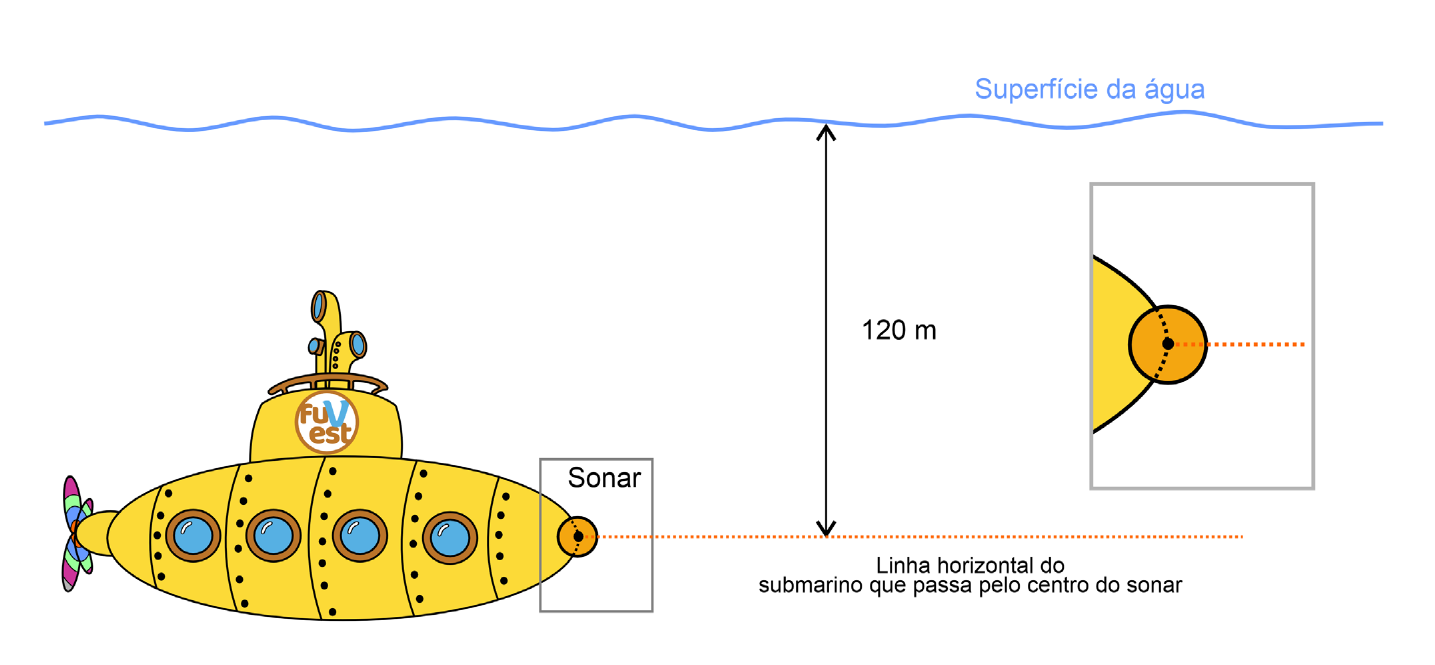
a) What is the minimum distance from the center of the sonar to the surface of the object so that is it detected?
b) If the sonar detects an object at a distance of 10 m from its center, at a point located at 45º above the horizontal line passing through the center of the sonar, what is the depth of the object in relation to the water surface?
c) If the sonar detects an object at a depth of 170 m below the surface of the water and at 30° below the horizontal line, which passes through the center of the sonar, what is the distance from the object to the center of the sonar?
Resolution
a) The sonar is a sphere of radius 3 m; waves leave its surface. An object can only be outside the sonar, so the distance from the center to the object is at least the radius itself: 3 m.
b) Connect the sonar center to the object (10 m segment, the hypotenuse) and trace the vertical line from the object to the horizontal line. A right-angled triangle is formed in which the height $d_v$ of the object above the horizontal line is the opposite side of the angle 45°:
$$d_v = 10 \cdot \operatorname{sen} 45° = 10 \cdot \frac{\sqrt{2}}{2} = 5\sqrt{2} \approx 7{,}07 \text{ m}$$The object is above the center, which is 120 m deep:
$$\text{profundidade} = 120 - 5\sqrt{2} \approx 120 - 7{,}07 = 112{,}93 \text{ m}$$Checking: at the angle of 45° the two sides are equal; by the theorem of Pythagoras, $2d_v^2 = 10^2$, then $d_v = \sqrt{50} = 5\sqrt{2}$. ✔
c) The object is 170 m deep, that is, $170 - 120 = 50$ m below of the sonar horizontal line. This difference is the side opposite to the angle of 30°, and the distance $d$ sought is the hypotenuse:
$$\operatorname{sen} 30° = \frac{50}{d} \quad\Rightarrow\quad d = \frac{50}{1/2} = 100 \text{ m}$$Checking: in a right-angled triangle with an angle of 30°, the side opposite to it is half of the hypotenuse; $50 = \frac{100}{2}$. ✔
Answer (a): 3 m (the sonar radius). Answer (b): $120 - 5\sqrt{2} \approx 112{,}93$ m deep. Response (c): 100 m.
To review, see Right Triangles.
Question M04: “Everything for 50% double” (increases and discounts)
Statement
“All for 50% double” is a well-known phrase about misleading offers, which became a meme. This is basically because a product, after suffering an increase of 100%, now costing twice as much, it needs a discount of 50% to return to its value initial value, that is, remaining with the value unchanged after the readjustment followed by the discount. Based on this idea, answer:
a) What percentage discount would be necessary for a product that was readjusted by 50% return to the original value?
b) Assume that a product that costs P is readjusted at $x\%$ and, subsequently, with a discount of $y\%$, it will cost the same amount again P. Explain $y$ based on of $x$ in the presented model, that is, display the discount $y$ depending on the adjustment $x$.
c) Suppose a product has an adjustment of $m\%$ and then a discount of $n\%$, returning to the initial price. Consider that $m$ and $n$ are larger integers than zero. What would be the smallest value of $m$ so that $n$ is also an integer?
Resolution
Increasing $x\%$ is multiplying by $\left(1 + \frac{x}{100}\right)$; give a discount $y\%$ is to multiply by $\left(1 - \frac{y}{100}\right)$.
a) After 50% increase, the price is $1{,}5P$. We want a factor $k$ such that $1{,}5P \cdot k = P$:
$$k = \frac{1}{1{,}5} = \frac{2}{3} \approx 0{,}6667$$The price is multiplied by $\frac{2}{3}$, that is, it loses $\frac{1}{3}$ of the value: discount from $\frac{1}{3} \approx 33{,}33\%$.
Checking with numbers: R$ 100,00 + 50% = R$ 150,00; R$ 150,00 − 33,33% of 150 = 150 − 50 = R$ 100,00. ✔
b) The condition is
$$P\left(1 + \frac{x}{100}\right)\left(1 - \frac{y}{100}\right) = P \quad\Rightarrow\quad (100 + x)(100 - y) = 10\thinspace 000$$Isolating $y$:
$$100 - y = \frac{10\thinspace 000}{100 + x} \quad\Rightarrow\quad y = 100 - \frac{10\thinspace 000}{100 + x} = \frac{100x}{100 + x}$$Checking: $x = 100$ gives $y = \frac{10\thinspace 000}{200} = 50$ (the meme) and $x = 50$ gives $y = \frac{5000}{150} = 33{,}\overline{3}$ (item a). ✔
c) For item b, $n = \frac{100m}{100 + m}$. Rewriting,
$$n = 100 - \frac{10\thinspace 000}{100 + m}$$So $n$ is integer exactly when $100 + m$ divides $10\thinspace 000 = 2^4 \cdot 5^4$. Like $m > 0$, we look for the smallest divisor of 10 000 that is greater than 100. The divisors of 10 000 close to 100 are $\dots, 80, 100, 125, 200, \dots$ (there is no none between 101 and 124, as every divisor is of the form $2^a 5^b$). The smallest is 125:
$$100 + m = 125 \quad\Rightarrow\quad m = 25, \qquad n = 100 - \frac{10\thinspace 000}{125} = 100 - 80 = 20$$Checking: increase of 25% and discount of 20%: $1{,}25 \cdot 0{,}80 = 1$. ✔ (Testing $m = 1, 2, \dots, 24$ one by one, none gives $n$ integer.)
Answer (a): discount of $\frac{1}{3} \approx 33{,}33\%$. Response (b): $y = \frac{100x}{100 + x}$. Response (c): $m = 25$ (with $n = 20$).
To review, see Increases and Discounts.
Question M05: Lamp at the apex of the pyramid inside the cube
Statement
You want to install a luminaire at a certain height from the ceiling. The lamp is positioned at the vertex P of a regular pyramid with a square base which, in turn, is inscribed in a cube with side 4 m, as shown in the following image. The projections of the luminaire on the ceiling and floor plane are represented, respectively, by the points R and Q, which coincide with the intersection of the diagonals of squares DCGH and ABFE.
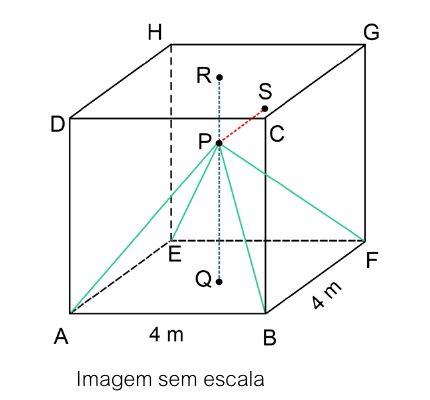
a) Assuming that the lateral edges of the pyramid measure 3 m, at what distance is the Is the lamp on the floor?
b) Assuming that the side edges of the pyramid form an angle of 45º with the ground, What is the length, in meters, of the side edge of the pyramid?
c) Considering the orthogonal projection of point P on the bottom plane of the cube, represented by point S, what will be the length of the projection of the edge PF on the plane EFGH, if the height PQ is $2\sqrt{2}$ m?
Resolution
The base of the pyramid is the floor ABFE (square of side 4 m) and Q is the center of this square. The distance from Q to any vertex of the base is half the diagonal:
$$QB = \frac{4\sqrt{2}}{2} = 2\sqrt{2} \text{ m}$$The triangle PQB is right-angled at Q (PQ is vertical, QB is on the ground).
a) By the Pythagorean theorem in the PQB triangle, with $PB = 3$:
$$PB^2 = PQ^2 + QB^2 \quad\Rightarrow\quad 9 = PQ^2 + 8 \quad\Rightarrow\quad PQ = 1 \text{ m}$$b) If the edge PB makes 45° with the ground, the right triangle PQB is isosceles: $PQ = QB = 2\sqrt{2}$. Then
$$PB = QB\sqrt{2} = 2\sqrt{2}\cdot\sqrt{2} = 4 \text{ m}$$Checking by cosine: $PB = \frac{QB}{\cos 45°} = \frac{2\sqrt{2}}{\sqrt{2}/2} = 4$. ✔
c) Place coordinates: A at the origin, AB on the $x$ axis, the depth (from AB for EF) on the $y$ axis and the height on the $z$ axis. Then $F = (4, 4, 0)$, the center of the ground is $Q = (2, 2, 0)$ and $P = (2, 2, 2\sqrt{2})$.
The EFGH background plane is $y = 4$. Projecting orthogonally on this plane means changing the coordinate $y$ by 4:
$$S = (2, 4, 2\sqrt{2}), \qquad F = (4, 4, 0) \text{ (já está no plano)}$$The projection of the edge PF is the segment SF:
$$SF = \sqrt{(4 - 2)^2 + (0 - 2\sqrt{2})^2} = \sqrt{4 + 8} = \sqrt{12} = 2\sqrt{3} \text{ m}$$Second path (without coordinates): the projection of Q on the EFGH plane is the midpoint M is EF, and S is exactly above M, with $SM = PQ = 2\sqrt{2}$. The SMF triangle is a rectangle in M, with $MF = 2$: $SF^2 = (2\sqrt{2})^2 + 2^2 = 12$, $SF = 2\sqrt{3}$. ✔
Response (a): 1 m. Response (b): 4 m. Response (c): $2\sqrt{3} \approx 3{,}46$ m.
For review, see Pythagorean Theorem.
Question M06: Modular function and the area of the triangle
Statement
Consider the modular real function $f(x) = \frac{|x|}{d}$, where $d > 0$.
a) What are the points of intersection between the line $y = 1$ and the graph of $f(x)$ to $d = 1$?
b) What is the area of the region obtained to the right of the axis $Oy$, below the line $y = 2$ and above the graph from $f(x)$ to $d = 2$?
c) What is the area of the region formed below the line $y = d$ and above the graph of $f(x)$?
Resolution
The graph of $f(x) = \frac{|x|}{d}$ is a “V” with apex at the origin: the ray $y = \frac{x}{d}$ to $x \ge 0$ and $y = -\frac{x}{d}$ to $x < 0$.
a) With $d = 1$, $f(x) = |x|$. Equating to 1:
$$|x| = 1 \quad\Rightarrow\quad x = 1 \quad \text{ou} \quad x = -1$$The points are $(1, 1)$ and $(-1, 1)$.
b) With $d = 2$ and $x \ge 0$, $f(x) = \frac{x}{2}$. The line $y = 2$ meets the graph when $\frac{x}{2} = 2$, that is, $x = 4$. The region to the right of $Oy$, below $y = 2$ and above the graph is the triangle of vertices $(0,0)$, $(0,2)$ and $(4,2)$: base 4 (horizontally, in $y = 2$) and height 2.
$$A = \frac{4 \cdot 2}{2} = 4$$Checking: the rectangle $[0,4]\times[0,2]$ has area 8, and the straight line $y = \frac{x}{2}$ is its diagonal; the triangle above the diagonal is half: $4$. ✔
c) The line $y = d$ meets the graph when
$$\frac{|x|}{d} = d \quad\Rightarrow\quad |x| = d^2 \quad\Rightarrow\quad x = \pm d^2$$The region between the “V” and the straight line $y = d$ is the triangle of vertices $(0,0)$, $(-d^2, d)$ and $(d^2, d)$: base $2d^2$ (on the straight line $y = d$) and height $d$.
$$A = \frac{2d^2 \cdot d}{2} = d^3$$Conferring with item b: the right half of this region, for $d = 2$, is the triangle from item b. The formula gives $A = 2^3 = 8$ for the entire region, and half is 4. ✔
Answer (a): $(1, 1)$ and $(-1, 1)$. Answer (b): 4 (area units). Response (c): $d^3$ (area units).
To review, see Cartesian Plane.