Seeing there is nothing that is so troublesome to mathematical practice, nor that doth more molest and hinder calculators, than the multiplications, divisions, square and cubical extractions of great numbers, I began therefore to consider in my mind by what certain and ready art I might remove those hindrances.
— John Napier, preface to the Mirifici logarithmorum canonis descriptio (1614)
John Napier (1550–1617) was not a mathematician by profession. He was a Scottish nobleman, laird of Merchiston Castle near Edinburgh, who looked after his estates, wrote about the Apocalypse and had a reputation as a sorcerer. In his spare time, for twenty years, he did calculations. In 1614 he published a book of 147 pages, almost all of them tables, with an invention that changed science: logarithms, numbers that turn multiplications into sums.
Astronomers, navigators and engineers began to do in minutes calculations that had taken days. Kepler computed the orbits of the planets with them. For 350 years, until electronic calculators arrived, every difficult calculation went through a table of logarithms or a slide rule, which is a logarithm made of wood.
In this track we tell Napier’s life and redo, with all the calculations, five of his inventions.
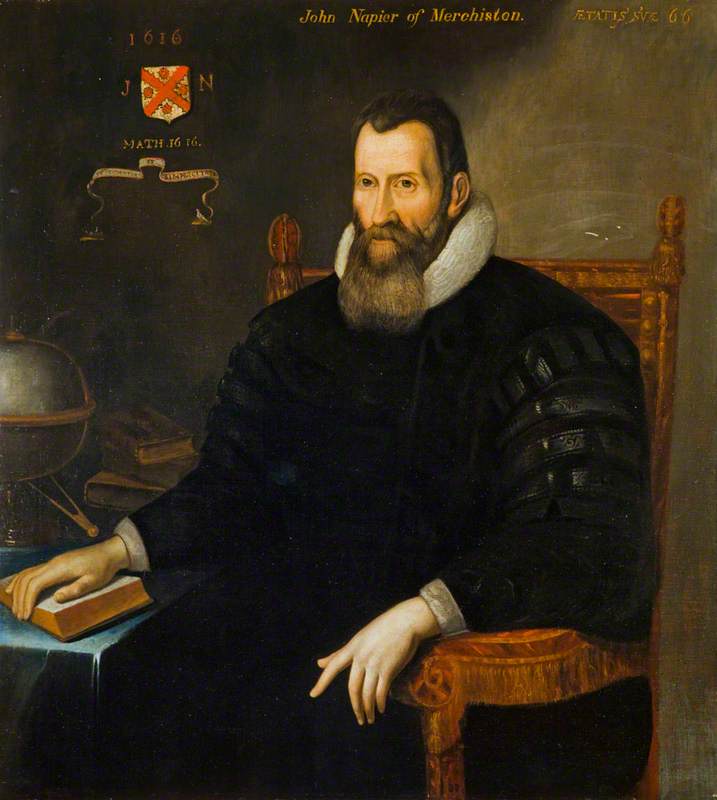
Who he was
John Napier
- Nascimento
- 1550, Merchiston Castle, Edinburgh
- Morte
- 4 April 1617, Merchiston
- Origem
- Scotland
- Áreas
- Logarithms, numerical calculation, spherical trigonometry and theology
Reading guide
Biography
Discovery and proof
- Multiplying by adding: the two progressions
- Napier’s two points: the definition of the logarithm
- Briggs and base-10 logarithms
- Napier’s bones: multiplying with rods
- The slide rule: logarithms that slide