
Euler's Eyes
2026-11-01
MEXT 2023 – Mathematics (B) solved
Source: MEXT / Study in Japan – Mathematics (B) paper and official answers. Files on the past exams page.
Mathematics (B) is the paper for undergraduate applicants in science and engineering. It has three fill-in questions; each box is worth 4 points. The statements below follow the original English.
Answer key
| Item | Topic | Answer |
|---|---|---|
| 1 (1) | Logarithmic equation | $9\sqrt3$ |
| 1 (2) | Area of triangle $BOC$ | $\frac94$ |
| 1 (3) | Rectangle | $\sqrt3$; $\sqrt2$ |
| 1 (4) | Cubic and line | $(1, -1)$ |
| 1 (5) | Minimum of $\frac{1}{4 - a^3}$ | $\frac{8}{59}$ |
| 1 (6) | Vectors | $6$; $\frac92$ |
| 2 | Sign and monotonicity of a cubic | $1, 4$; negative, positive; $4, 3$; $1, 3$; increasing, decreasing, increasing |
| 3 (1) | $a < b < c$ | $\frac{5}{54}$ |
| 3 (2) | $X$ a multiple of 4 | $112$; $\frac14$ |
| 3 (3) | $X = Y$ and $X = Y + 198$ | $\frac16$; $\frac19$ |
| 3 (4) | Maximum of $X - Y$ | $495$ |
Question 1: six short items
Item (1)
Statement. The solution of $\log_{81} X = \frac58$ is $X = \boxed{\phantom{0}}$.
Solution. $X = 81^{5/8} = (3^4)^{5/8} = 3^{5/2} = 9\sqrt3$.
Answer: $9\sqrt3$.
Item (2)
Statement. Let $O$ be the circumcenter of triangle $ABC$. If $\angle BAC = \frac{11}{12}\pi$ and $AO = 3$, the area of triangle $BOC$ is $\boxed{\phantom{0}}$.
Solution. The angle at $A$ is obtuse, so $A$ lies on the minor arc $BC$ and subtends the major arc, which measures $2\cdot\frac{11\pi}{12} = \frac{11\pi}{6}$. The minor arc $BC$, which is the central angle $\angle BOC$, measures $2\pi - \frac{11\pi}{6} = \frac\pi6$. With $OB = OC = 3$,
$$[BOC] = \frac12\cdot 3\cdot 3\cdot\sin\frac\pi6 = \frac94.$$Answer: $\frac94$.
Item (3)
Statement. In rectangle $ABCD$, with vertices listed counterclockwise, let $P$ be a point between $B$ and $C$ and $Q$ the intersection of $AC$ and $DP$. If $AB = 1$, $\angle DAC = \frac\pi6$ and $\angle AQP = \frac{5}{12}\pi$, then $AD =$ ① and $PD =$ ②.
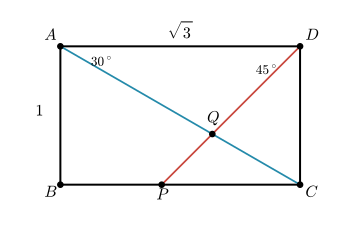
Solution.
1. $AD$. In triangle $ACD$, right-angled at $D$, $\tan\angle DAC = \frac{DC}{AD}$: $AD = \frac{1}{\tan(\pi/6)} = \sqrt3$.
2. The angle at $D$. In triangle $AQD$, the angle at $Q$ is the supplement of $\angle AQP$: $\pi - \frac{5\pi}{12} = \frac{7\pi}{12}$. Hence
$$\angle ADQ = \pi - \frac\pi6 - \frac{7\pi}{12} = \frac\pi4.$$3. $PD$. $\angle PDC = \frac\pi2 - \frac\pi4 = \frac\pi4$, and in triangle $PCD$, right-angled at $C$, $PD = \frac{DC}{\cos(\pi/4)} = \sqrt2$. (Indeed $PC = 1 < \sqrt3 = BC$, so $P$ lies between $B$ and $C$.)
Answer: ① $\sqrt3$; ② $\sqrt2$.
Item (4)
Statement. The curve $C: y = x^3 - 3x^2 + 1$ and the line $l$ meet at the points $(3, 1)$ and $(-1, -3)$. The other intersection point is $\boxed{\phantom{0}}$.
Solution. The line through the two points has slope $\frac{1 - (-3)}{3 - (-1)} = 1$: $y = x - 2$. Setting them equal,
$$x^3 - 3x^2 + 1 = x - 2 \iff x^3 - 3x^2 - x + 3 = (x - 3)(x^2 - 1) = 0.$$The missing root is $x = 1$, with $y = -1$.
Answer: $(1, -1)$.
Item (5)
Statement. For $-\frac32 \le a \le \frac32$, the minimum value of $\frac{1}{4 - a^3}$ is $\boxed{\phantom{0}}$.
Solution. $a^3$ ranges over $\left[-\frac{27}{8}, \frac{27}{8}\right]$, so $4 - a^3$ ranges over $\left[\frac58, \frac{59}{8}\right]$ and is always positive. The fraction is smallest when the denominator is largest, at $a = -\frac32$: $\frac{1}{59/8} = \frac{8}{59}$.
Answer: $\frac{8}{59}$.
Item (6)
Statement. Consider the vectors $\vec a = (x, -4)$, $\vec b = (6, x - 7)$ and $\vec c = (3, -5)$. The vectors $\vec a$ and $\vec b + \vec c$ are parallel if $x =$ ①. In that case, the vector $\vec d = (3,$ ②$)$ is orthogonal to $\vec a$.
Solution. $\vec b + \vec c = (9, x - 12)$. Parallel means zero determinant:
$$x(x - 12) - (-4)\cdot 9 = x^2 - 12x + 36 = (x - 6)^2 = 0 \iff x = 6.$$With $\vec a = (6, -4)$, $\vec d = (3, t)$ is orthogonal to $\vec a$ when $18 - 4t = 0$, that is, $t = \frac92$.
Answer: ① $6$; ② $\frac92$.
Question 2: the sign and monotonicity of a cubic
Statement
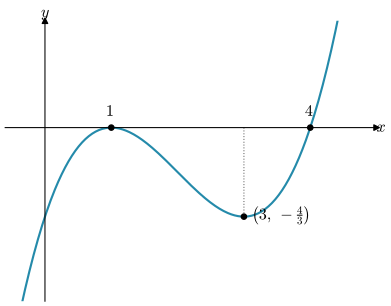
Answer ③ and ④ with “positive” or “negative”, and ⑨, ⑩ and ⑪ with “increasing” or “decreasing”. Consider the function $f(x) = \frac13x^3 - 2x^2 + 3x - \frac43$. It factors as
$$f(x) = \frac13(x - \text{①})^2(x - \text{②}).$$Then $f(x)$ is ③ if $x <$ ① and ④ if $x >$ ②. The derivative is $f'(x) = x^2 - \text{⑤}x + \text{⑥}$, which factors as $(x - \text{⑦})(x - \text{⑧})$, with ⑦ $<$ ⑧. So $f$ is ⑨ if $x <$ ⑦, ⑩ if ⑦ $< x <$ ⑧ and ⑪ if $x >$ ⑧.
Solution
1. Factoring. $3f(x) = x^3 - 6x^2 + 9x - 4$. Testing $x = 1$: $1 - 6 + 9 - 4 = 0$. Dividing by $x - 1$: $x^3 - 6x^2 + 9x - 4 = (x - 1)(x^2 - 5x + 4) = (x - 1)^2(x - 4)$.
2. Sign. $(x - 1)^2 \ge 0$, so the sign of $f$ is that of $x - 4$ (away from $x = 1$): $f < 0$ for $x < 1$ and $f > 0$ for $x > 4$.
3. Derivative. $f'(x) = x^2 - 4x + 3 = (x - 1)(x - 3)$. It is positive outside $[1, 3]$ and negative between $1$ and $3$: $f$ increases, decreases and increases. At $x = 1$ there is a local maximum with $f(1) = 0$ (the double root), and at $x = 3$ a local minimum with $f(3) = -\frac43$.
Answer
① $1$, ② $4$; ③ negative, ④ positive; ⑤ $4$, ⑥ $3$; ⑦ $1$, ⑧ $3$; ⑨ increasing, ⑩ decreasing, ⑪ increasing.
Question 3: three dice and two numbers
Statement
A fair six-sided die is rolled three times. Let $a$, $b$ and $c$ be the results of the first, second and third rolls, and let $X = 100a + 10b + c$ and $Y = 100c + 10b + a$.
- The probability that $a < b < c$ is $\boxed{\phantom{0}}$.
- The smallest value of $X$ that is a multiple of 4 is ①. The probability that $X$ is a multiple of 4 is ②.
- The probability that $X = Y$ is ①, and that $X = Y + 198$ is ②.
- The maximum value of $X - Y$ is $\boxed{\phantom{0}}$.
Solution
There are $6^3 = 216$ equally likely outcomes.
1. $a < b < c$. Each choice of three distinct values gives exactly one increasing triple: $\binom63 = 20$ cases, and $\frac{20}{216} = \frac{5}{54}$.
2. Multiple of 4. Since $100$ is a multiple of 4, $X$ is a multiple of 4 exactly when $10b + c$ is, that is, when $2b + c \equiv 0 \pmod 4$.
- The smallest $X$ has $a = 1$, $b = 1$ and $c$ with $2 + c \equiv 0$: $c = 2$, $X = 112$.
- Counting $(b, c)$: with $b$ odd, $2b \equiv 2$ and $c \in \{2, 6\}$ ($3 \cdot 2 = 6$ pairs); with $b$ even, $2b \equiv 0$ and $c = 4$ ($3$ pairs). That is $9$ of the $36$ pairs: probability $\frac14$.
3. $X - Y$. $X - Y = 99(a - c)$.
- $X = Y$ when $a = c$: probability $\frac16$.
- $X = Y + 198$ when $a - c = 2$: $(a, c) \in \{(3,1), (4,2), (5,3), (6,4)\}$, that is, $\frac{4}{36} = \frac19$.
4. Maximum. $a - c \le 6 - 1 = 5$, so $X - Y \le 99\cdot 5 = 495$ (with $a = 6$, $c = 1$).
Answer
- $\frac{5}{54}$.
- ① $112$; ② $\frac14$.
- ① $\frac16$; ② $\frac19$.
- $495$.