
Euler's Eyes
2026-10-16
Equivalence: fractions, clocks and Gauss's ≡
The pieces of writing $\frac12$ and $\frac24$ are different: one has the digits $1$ and $2$, the other $2$ and $4$. A pizza cut into two slices, of which you eat one, is not the same thing as a pizza cut into four, of which you eat two: there is one more cut. And yet we write without hesitation
$$\frac12=\frac24=\frac36=\frac{50}{100}.$$What this equals sign states is not that the pieces of writing are equal, nor that the pizzas are equal. It states that, for what matters, the amount eaten, they cannot be told apart.
Equal for what matters
This is the job of an equivalence relation: to group together different things that, from a certain point of view, count as the same. For fractions, the criterion is
$$\frac ab\sim\frac cd\quad\text{when}\quad a\cdot d=b\cdot c.$$With $\frac12$ and $\frac24$: $1\cdot4=2\cdot2$. With $\frac12$ and $\frac35$: $1\cdot5\neq2\cdot3$, and the fractions are not equivalent.
A relation like this only deserves a sign that looks like the equals sign if it has the same three laws that text 1 presented: being reflexive, symmetric and transitive. When it does, it does something remarkable: it divides the world into classes, drawers in which each object falls into exactly one. All fractions equivalent to $\frac12$ go into one drawer; all those equivalent to $\frac13$, into another.
And here is the idea that nineteenth-century mathematics made explicit: the rational number is the drawer, not the fraction. The fractions $\frac12$, $\frac24$, $\frac36$ are different names for a single object, the whole class. It is Frege’s distinction between sense and reference, seen from the other side: instead of starting from an object and finding its names, one starts from the names and builds the object by putting together those that are equivalent.
The clock
The most everyday example of equivalence is on your wrist. At $15$ o’clock, the hand points to $3$. In $13$ hours, the clock will show $3+13=16$, and $16$ o’clock appears as $4$. For the hand, the numbers $3$, $15$, $27$, $-9$ are all the same: they differ by a multiple of $12$.
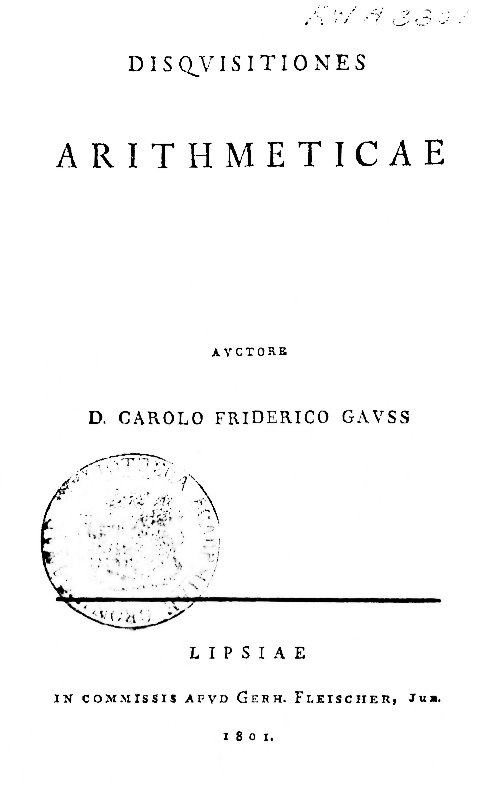
In 1801, Carl Friedrich Gauss gave this idea a name, a definition and a sign, right at the beginning of the Disquisitiones Arithmeticae. Two numbers are congruent modulo $m$ when their difference is divisible by $m$. And he wrote:
From now on we shall denote the congruence of numbers by this sign, ≡, adding the modulus in parentheses where necessary: −16 ≡ 9 (mod. 5), −7 ≡ 15 (mod. 11).
— Gauss, Disquisitiones Arithmeticae (1801), article 2
In a footnote, Gauss explained the choice: he adopted the sign “because of the great analogy that exists between equality and congruence”. It is a semiotic argument, of the same kind as Recorde’s: the sign looks like the equals sign because the relation behaves like equality. Three little lines instead of two: almost equal, but not quite.
A notation that calculates
Gauss’s analogy was not only visual. Congruences can be added and multiplied like equalities: if $a\equiv b$ and $c\equiv d$ (mod $m$), then
$$a+c\equiv b+d\pmod m\qquad\text{and}\qquad ac\equiv bd\pmod m.$$This makes $\equiv$ an active notation. What is the remainder of $7^{100}$ on division by $6$? Since $7\equiv1\pmod 6$, multiplying the congruence by itself a hundred times gives $7^{100}\equiv1^{100}=1\pmod 6$. A calculation impossible to do by hand becomes a single line.
But the analogy has a limit, and the limit is also instructive. With equality, if $2a=2b$, then $a=b$. With congruence, no: $2\cdot3\equiv2\cdot0\pmod 6$, because $6$ and $0$ leave the same remainder, but $3\not\equiv0\pmod 6$. Cancelling a factor from both sides is only allowed when it has no common divisor with the modulus. The similar sign invites you to do what you do with the equals sign, and the reader needs to know where the invitation ends.
Exercise: cast out the nines
Check $347\cdot28=9716$ by casting out nines. $347$: $3+4+7=14$, $1+4=5$. $28$: $2+8=10$, $1+0=1$. The product of the drawers is $5\cdot1=5$. Now the result: $9+7+1+6=23$, $2+3=5$. It matches. Had someone written $9176$, the sum would also be $23$ and the check would pass, even though the calculation was wrong.
Exercise: what day of the week?
Today is Friday. What day will it be in $100$ days? The days of the week repeat every $7$, so only the drawer of $100$ modulo $7$ matters: $100=14\cdot7+2$, so $100\equiv2\pmod 7$. In $100$ days it will be the same day as in $2$ days: Sunday.
Chapter index · ← Equation, identity, definition: three jobs for the same sign · ⇒ and ⇔: what is gained and what is lost when an equation is transformed →