
Euler's Eyes
2026-10-12
Chapter exercises 14 — Right triangles
Metric relationships
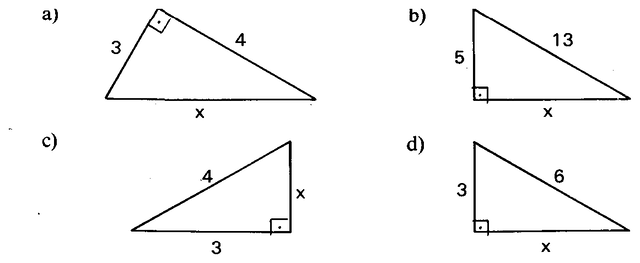
Determine the value of $x$ in the following cases:
Ver resposta
a) 5 · b) 12 · c) $\sqrt{7}$ · d) $3\sqrt{3}$
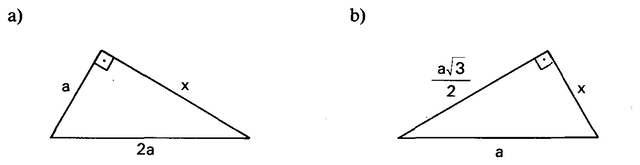
Determine $x$ as a function of $a$ in the following cases:
Ver resposta
a) $a\sqrt{3}$ · b) $\dfrac{a}{2}$
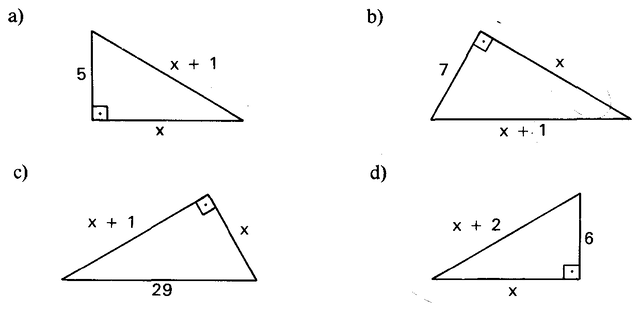
Determine $x$ in cases:
Ver resposta
a) 12 · b) 24 · c) 20 · d) 8
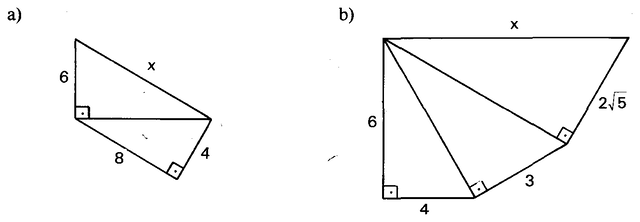
Determine $x$ in cases:
Ver resposta
a) $2\sqrt{29}$ · b) 9
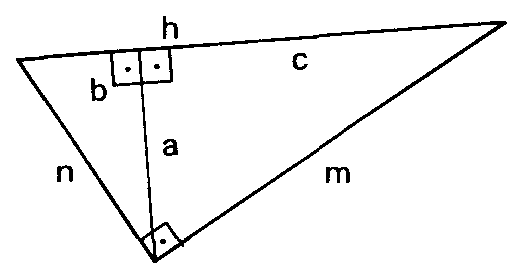
Write 10 metric relations with the elements indicated in the figure.
Ver resposta
Among others: $b^2 + a^2 = n^2$, $c^2 + a^2 = m^2$, $\dfrac{1}{m^2} + \dfrac{1}{n^2} = \dfrac{1}{a^2}$.
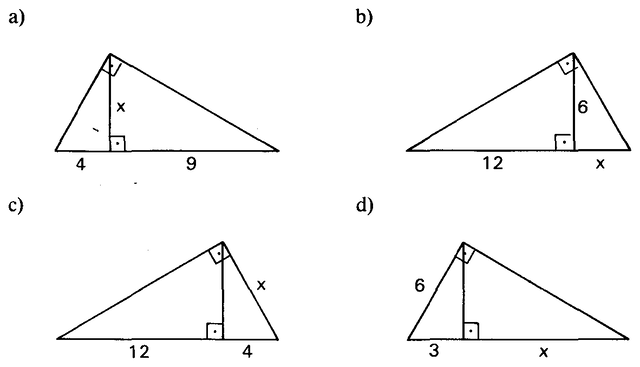
Determine $x$ in cases:
Ver resposta
a) 6 · b) 3 · c) 8 · d) 9
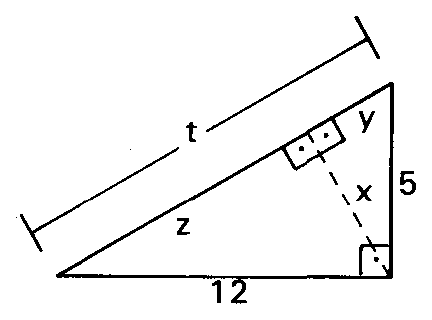
In the figure, determine the elements $x$, $y$, $z$ and $t$.
Ver resposta
$x = \dfrac{60}{13}$, $y = \dfrac{25}{13}$, $z = \dfrac{144}{13}$ e $t = 13$
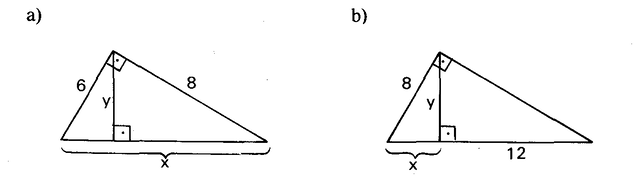
Determine $x$ and $y$ in the following cases:
Ver resposta
a) $x = 10$; $y = \dfrac{24}{5}$ · b) $x = 4$; $y = 4\sqrt{3}$
Determine the value of $x$.
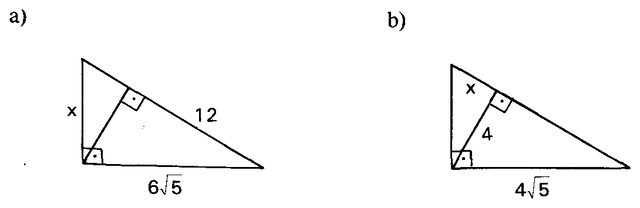
Ver resposta
a) $3\sqrt{5}$ · b) 2
Calculate the elements $y$, $z$, $t$ and $x$ in the figure.
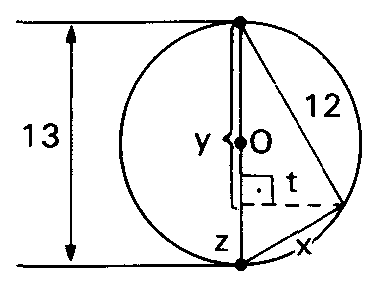
Ver resposta
$y = 5$; $z = \dfrac{144}{13}$; $t = \dfrac{25}{13}$; $x = \dfrac{60}{13}$
Determine the radius of the circle in the following cases:
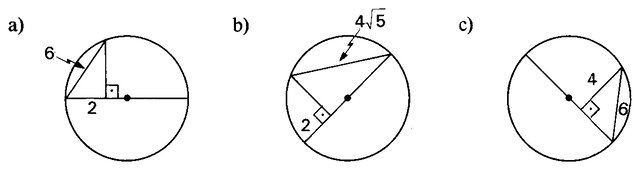
Ver resposta
a) 9 · b) 5 · c) $\dfrac{9\sqrt{5}}{5}$
Determine $x$ in the cases: a) isosceles triangle; b) equilateral triangle.
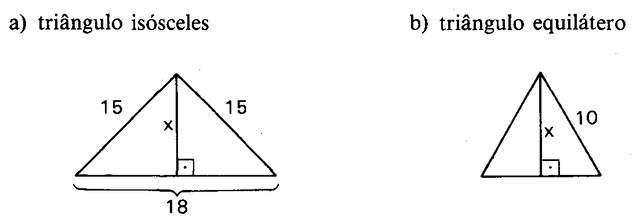
Ver resposta
a) 12 · b) $5\sqrt{3}$
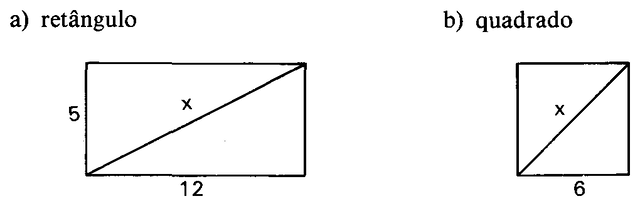
Determine the value of $x$ in the cases: a) rectangle; b) square.
Ver resposta
a) 13 · b) $6\sqrt{2}$
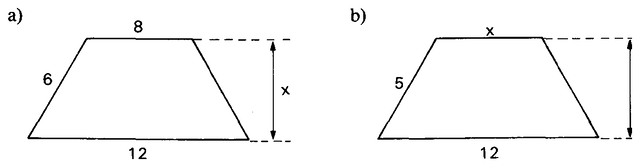
Determine the value of $x$ in isosceles trapezoids.
Ver resposta
a) $4\sqrt{2}$ · b) 6
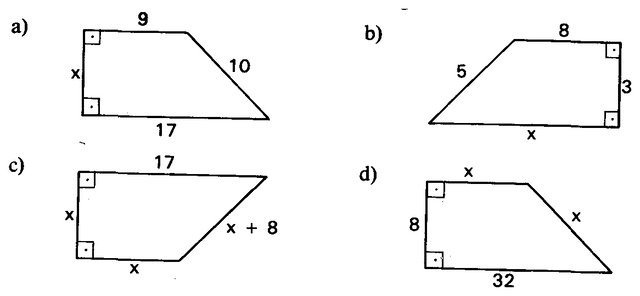
Determine the value of $x$ in the rectangular trapezoids.
Ver resposta
a) 6 · b) 12 · c) 5 or 45 · d) 17
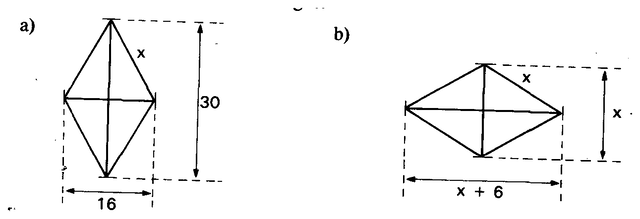
Determine the value of $x$ in the diamonds.
Ver resposta
a) 17 · b) 10
Determine the value of $x$ in parallelograms.
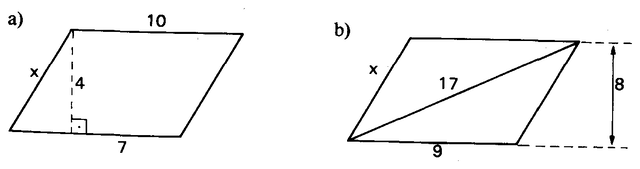
Ver resposta
a) 5 · b) 10
Determine the height of the trapezoid in the figure.
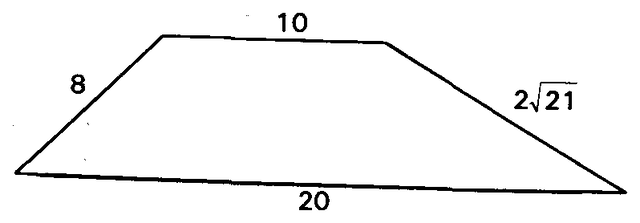
Ver resposta
$4\sqrt{3}$
Determine the value of $x$ in the cases.
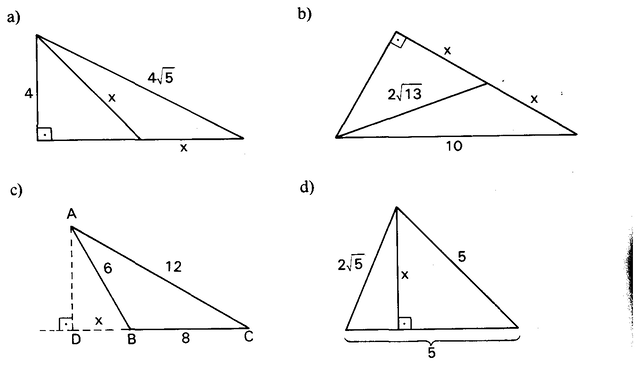
Ver resposta
a) 5 · b) 4 · c) $\dfrac{11}{4}$ · d) 4
Determine the value of $x$ in the following cases:
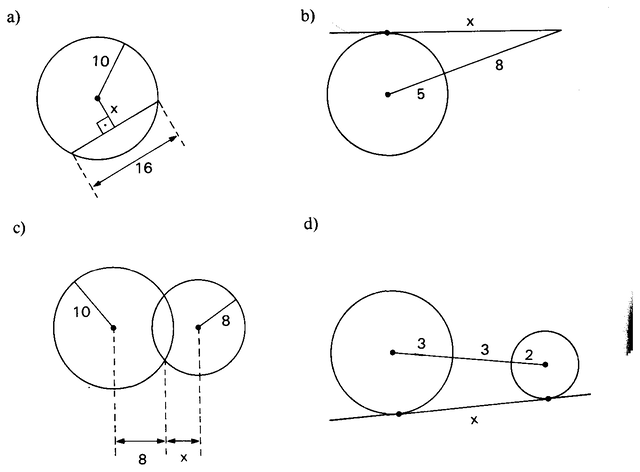
See the resolution of the book (item d)
Tracing the rays that go to the contact points, we obtain a rectangular trapezoid whose height is $x$. Applying Pythagoras’ theorem to the highlighted triangle:
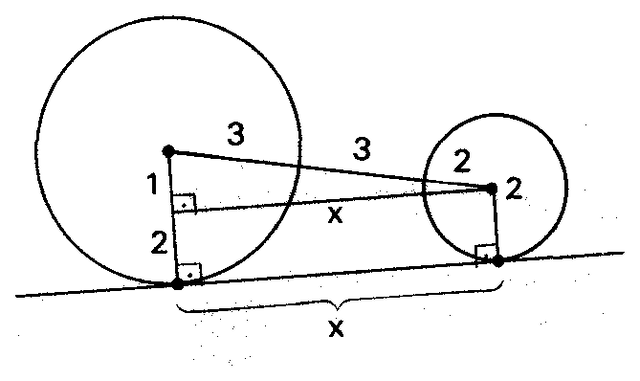
Ver resposta
a) 6 · b) 12 · c) $2\sqrt{7}$ · d) $3\sqrt{7}$
Determine the radius of the circle in the following cases:
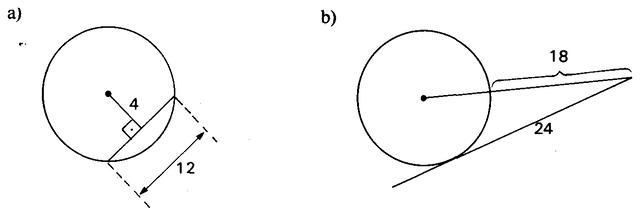
Ver resposta
a) $2\sqrt{13}$ · b) 7
Determine the value of $x$ in the cases (in b, $AB = 15$):
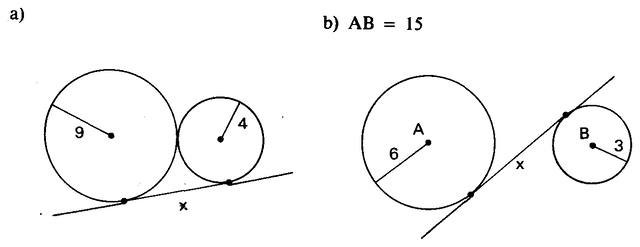
Ver resposta
a) 12 · b) 12
Determine the radius of the circle in the figures: a) rectangular trapezoid with bases 10 m and 15 m; b) $AH = 25$ m, $BC = 30$ m and $AB = AC$.
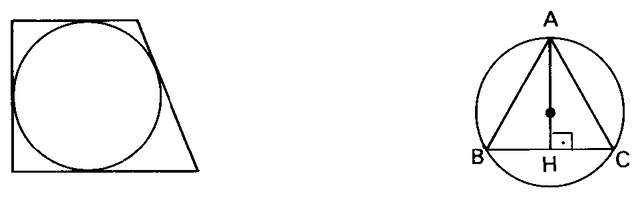
Ver resposta
a) 6 m · b) 17 m
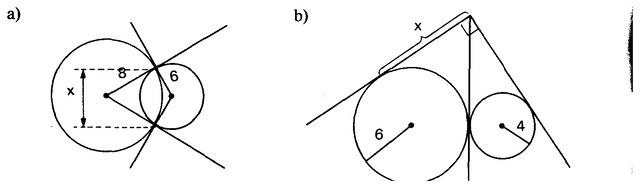
Determine the value of $x$ in the following cases:
Ver resposta
a) $\dfrac{48}{5}$ · b) 12
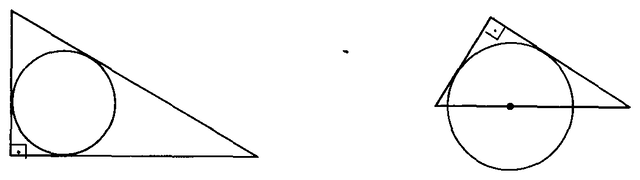
Determine the radius of the circle, in the cases, if the right-angled triangle has: a) sides of 6 m and 8 m; b) a side of 8 m and hypotenuse of $4\sqrt{13}$ m.
Ver resposta
a) 2 m · b) $\dfrac{24}{5}$ m
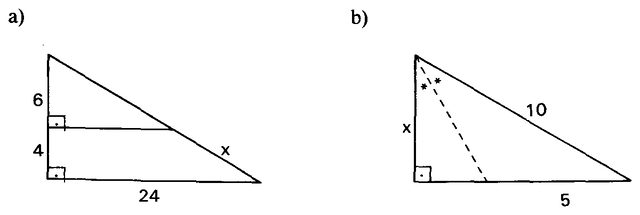
Determine the value of $x$ in the figures:
Ver resposta
a) $\dfrac{52}{5}$ · b) 6
Determine the diagonal of a square with perimeter 20 m.
Ver resposta
$5\sqrt{2}$ m
Determine the diagonal of a rectangle with perimeter 20 m and base 6 m.
Ver resposta
$2\sqrt{13}$ m
The perimeter of a rhombus is 52 m and a diagonal measures 10 m. Calculate the other diagonal.
Ver resposta
24 m
Determine the height of a perimeter equilateral triangle 24 m.
Ver resposta
$4\sqrt{3}$ m
Determine the perimeter of a height equilateral triangle 6 m.
Ver resposta
$12\sqrt{3}$ m
The perimeter of a isosceles triangle is 18 m and the height relative to the base measures 3 m. Determine the base.
Ver resposta
8 m
Determine the smallest height of a triangle whose sides measure 4 m, 5 m and 6 m.
Ver resposta
$\dfrac{5\sqrt{7}}{4}$ m
Determine the height not relative to the base of a isosceles triangle with sides 10 m, 10 m and 12 m.
Ver resposta
$\dfrac{48}{5}$ m
The height of a rectangle measures 8 m and the diagonal exceeds the base by 2 m. Calculate the diagonal.
Ver resposta
17 m
The perimeter of a rectangle is 30 m and the diagonal measures $5\sqrt{5}$ m. Determine the sides of this rectangle.
Ver resposta
5 m e 10 m
The height relative to the base by isosceles triangle exceeds the base by 2 m. Determine the base if the perimeter is 36 m.
See the resolution of the book
With $2x$ being the base measurement (to simplify the calculations), $a$ each congruent side and $h$ the height:
$$\begin{cases} h = 2x + 2 \\ 2x + 2a = 36 \\ x^2 + h^2 = a^2 \end{cases} \Rightarrow \begin{cases} h = 2x + 2 \\ a = 18 - x \\ x^2 + h^2 = a^2 \end{cases} \Rightarrow x^2 + (2x + 2)^2 = (18 - x)^2$$$$\Rightarrow 4x^2 + 44x - 320 = 0 \Rightarrow x^2 + 11x - 80 = 0 \Rightarrow x = 5.$$The base measures 10 m.
Ver resposta
10 m
Each of the congruent sides of a isosceles triangle exceeds the base by 3 m. Determine the base if the height relative to it is 12 m.
Ver resposta
10 m
The difference between the measurements of the diagonals of a rhombus with 68 m perimeter is 14 m. Determine the diagonals of this rhombus.
Ver resposta
30 m e 16 m
The bases of a rectangular trapezoid measure 3 m and 9 m and its perimeter is 30 m. Calculate the height.
Ver resposta
8 m
Calculate the height and projections of the legs on the hypotenuse, in the right-angled triangle of legs 12 cm and 16 cm.
Ver resposta
Height $\dfrac{48}{5}$ cm; projections $\dfrac{36}{5}$ cm and $\dfrac{64}{5}$ cm
Calculate the hypotenuse, the height relative to the hypotenuse and the projections of the legs on the hypotenuse of a right-angled triangle of legs 3 and 4.
Ver resposta
Hypotenuse 5; projections $\dfrac{9}{5}$ and $\dfrac{16}{5}$; height $\dfrac{12}{5}$
Given a equilateral triangle side $a$, calculate its height.
Ver resposta
$\dfrac{a\sqrt{3}}{2}$
A ladder 2,5 m high rests against a wall and its foot is 1,5 m away from the wall. Determine how high the ladder reaches the wall under these conditions.
Ver resposta
2 m
The height relative to the hypotenuse of a right-angled triangle measures 12 m. If the hypotenuse measures 25 m, calculate the legs.
Ver resposta
20 m e 15 m
In a triangle $ABC$, a rectangle in $A$, the height relative to the hypotenuse measures 1,2 cm and the hypotenuse measures 2,5 cm. Being $m$ and $n$, respectively, the projections of the largest and smallest sides on the hypotenuse, calculate $\dfrac{m}{n}$.
Ver resposta
$\dfrac{16}{9}$
Two cyclists leave the same city in a straight direction; one towards the east and the other towards the north. Determine the distance that separates them after two hours, knowing that the cyclists’ speed is 30 km/h and 45 km/h, respectively.
Ver resposta
$30\sqrt{13}$ km
The bases of an isosceles trapezoid measure 12 m and 20 m, respectively. The sum of the non-parallel sides is equal to 10 m. How tall is it?
Ver resposta
3 m
The bases of an isosceles trapezoid measure 7 and 19 and the non-parallel sides, 10. Calculate the height of this trapezoid.
Ver resposta
8
In a rectangular trapezoid, the sum of the bases is 16 cm, one of which is the $\dfrac{3}{5}$ of the other. Determine the height, knowing that the oblique side measures 5 cm.
Ver resposta
3 cm
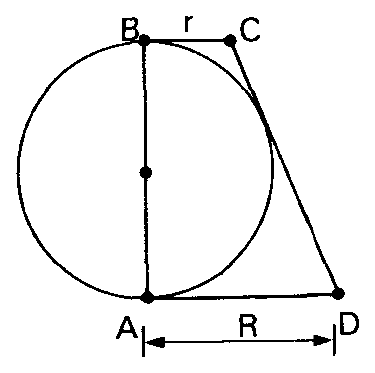
In the figure, calculate the height of the rectangular trapezoid $ABCD$.
Ver resposta
$2\sqrt{Rr}$
Knowing that the sum of the squares of the legs and the square of the hypotenuse of a right-angled triangle is equal to 200, determine the measure of the hypotenuse of that triangle.
Ver resposta
10
Calculate the perimeter of isosceles triangle of 16 cm in base and 6 cm in height.
Ver resposta
36 cm
Determine the height of a trapezoid with bases 24 cm and 10 cm, knowing that the non-parallel sides measure 15 cm and 13 cm respectively.
Ver resposta
12 cm
The largest base and one of the sides oblique to the bases of an isosceles trapezoid circumscribing a circle are respectively equal to 18 cm and 13 cm. Determine the height of the trapezoid.
Ver resposta
12 cm
A chord common to two secant circles measures 16 cm. With 10 cm and 17 cm measuring the radii of the circles, determine the distance between their centers.
Ver resposta
21 cm
Let it be a point $P$, external to a circle. The shortest distance from this point to the circumference is 6 cm and the greatest distance from this point to the circumference is 24 cm. Determine the length of the tangent segment to the circle through this point.
Ver resposta
12 cm
Two circles of radii 12 cm and 20 cm are externally tangent. Determine the length of the segment $\overline{PQ}$, a tangent common to the two circles, with $P$ and $Q$ points of tangency.
Ver resposta
$8\sqrt{15}$ cm
A circumscriptible isosceles trapezoid has bases measuring 8 cm and 16 cm. Calculate the height of the trapezoid.
Ver resposta
$8\sqrt{2}$ cm
Prove that the diameter of a circle inscribed in an isosceles trapezoid is the geometric mean between the bases of the trapezoid.
Ver resposta
With bases $2x$ and $2y$, the oblique sides measure $x + y$ and the diameter is $h = 2\sqrt{xy} = \sqrt{2x \cdot 2y}$.
Calculate the measurement of the radius of the circle, in the figure, knowing that $AD = 12$ cm, $AE = 15$ cm and $AB = 8$ cm.
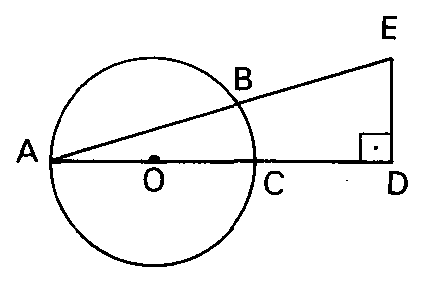
Ver resposta
5 cm
In a isosceles triangle of height 8, a circle of radius 3 is inscribed. Calculate the measurement of the base of the triangle.
Ver resposta
12
On the hypotenuse $\overline{AB}$ of a right triangle $ABC$ a second right triangle $ABD$ is constructed, with hypotenuse $\overline{AB}$. If $BC = 1$, $AC = b$ and $AD = 2$, calculate $BD$.
Ver resposta
$BD = \sqrt{b^2 - 3}$, with $b > \sqrt{3}$
In the trapezoid $ABCD$ in the figure, the diagonal $\overline{AC}$ is perpendicular to the oblique side $\overline{AD}$. With $CD = 25$ cm and $AD = 15$ cm, determine the height of the trapezoid.
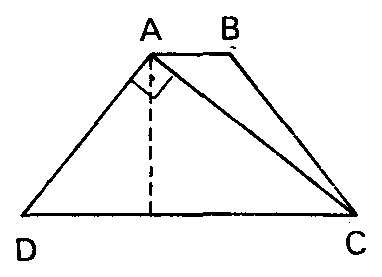
Ver resposta
12 cm
Determine the diagonal measurement $\overline{AC}$ of the rectangular trapezoid in the figure, knowing that the bases measure respectively 4 cm and 9 cm and that the side $\overline{BC}$ measures $\sqrt{34}$ cm.
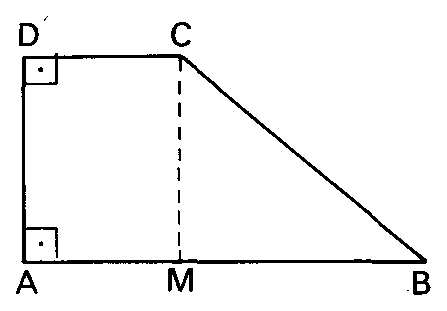
Ver resposta
5 cm
The segment $\overline{AB}$ has its ends $A$ and $B$ as points of tangency to the circumferences of centers $O_1$ and $O_2$. With 15 cm and 3 cm being the radii of these circles, respectively, and 24 cm being the distance between their centers, determine the segment $\overline{AB}$.
Ver resposta
$12\sqrt{3}$ cm or $6\sqrt{7}$ cm
Determine the measure of the hypotenuse of a right-angled triangle, with 24 m being its perimeter and $\dfrac{24}{5}$ m being the measure of the height relative to the hypotenuse.
Ver resposta
10 m
Consider a semicircle of diameter $AOB = 2r$. We internally construct two new semicircles with diameters $\overline{OA}$ and $\overline{OB}$ and a circle tangent to these three semicircles. Calculate the radius of this circle.
Ver resposta
$\dfrac{r}{3}$
On the same side of a straight line, three circles are drawn tangent to the straight line and tangent to each other two by two. Knowing that two of them have a radius equal to 16, calculate the radius of the third.
Ver resposta
4
A regular octagon is formed by cutting isosceles right triangles at the vertices of a square. If the side of the square measures 1, how long are the sides of the removed triangles?
Ver resposta
$\dfrac{2 - \sqrt{2}}{2}$
Let us consider two tangent circles as in the figure. With $E$ being the center of the smaller circle, $F$ the point of tangency between the two circles and $a$ the side of the square, determine the radius of the smaller circle as a function of $a$.
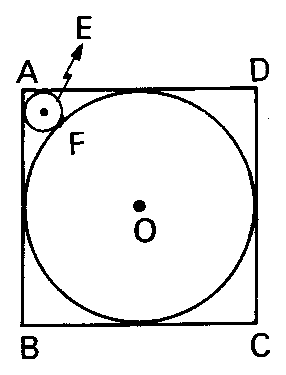
Ver resposta
$\dfrac{(3 - 2\sqrt{2})\,a}{2}$
Consider a square $Q$ with side $a$ and five circles of the same radius $r$ interior to $Q$, of which one is concentric with $Q$ and tangent externally to the four others, and each of these is tangent to two consecutive sides of $Q$. Determine the measurement of $r$ as a function of the measurement $a$ of the side of the square.
Ver resposta
$\dfrac{a(\sqrt{2} - 1)}{2}$
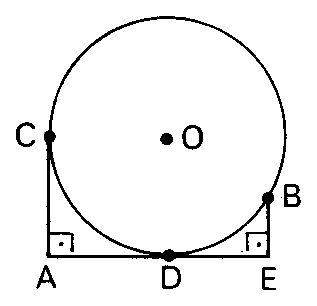
In the figure, determine the radius of the circle, knowing that $\overline{AC}$ and $\overline{AD}$ tangent to the circle at points $C$ and $D$, respectively, and that $BE = 12$ cm and $AE = 54$ cm.
Ver resposta
30 cm
Two cable cars $T_1$ and $T_2$ leave from a station $E$ located on a horizontal plane, towards the peaks $P_1$ and $P_2$ of two mountains. Determine the distance between $P_1$ and $P_2$, knowing that the cable cars covered 1 500 m and 2 900 m, respectively, that the first mountain is 900 m high and the second 2 000 m and that the feet of the mountains and $E$ are in a straight line.
Ver resposta
Considering $E$ between the mountains, approximately 3 478 m is obtained; considering the smallest between $E$ and the largest, approximately 1 421 m.
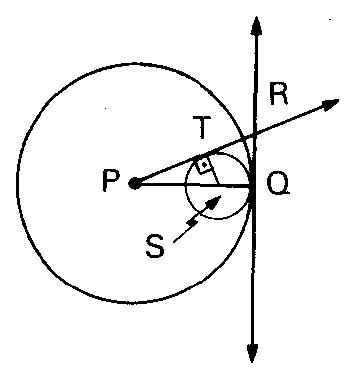
Let there be two circles tangent to each other, internally, as in the figure. Being $PQ = 8$ cm and $ST = 3$ cm, calculate the measurement of $\overline{RQ}$.
Ver resposta
6 cm
In a circle with center $O$ and radius $R$, a chord $AB = \dfrac{R}{2}$ is considered. Calculate the radius of the circle inscribed in the circular sector $OAB$.
Ver resposta
$\dfrac{R}{5}$
On the sides of a square, we draw externally four isosceles triangles with heights relative to the bases equal to 3 cm. Determine the perimeter of the square, knowing that the vertices of the four triangles belong to the same circle, with a radius equal to $3(\sqrt{2} + 2)$ cm.
Ver resposta
$24(\sqrt{2} + 1)$ cm
Two squares $ABCD$ and $CDEF$ have the side $\overline{CD}$ in common. We draw the diagonals $\overline{AC}$ and $\overline{EC}$. Being $AM = \dfrac{1}{3}AC$ and $EP = \dfrac{1}{2}CE$, with $M$ in $\overline{AC}$ and $P$ in $\overline{CE}$, determine the segment $\overline{PM}$, depending on the side $a$ of the squares.
Ver resposta
$\dfrac{5\sqrt{2}\,a}{6}$
Determine the distance between the feet of the height and median relative to the hypotenuse of a right-angled triangle with $(18 + 6\sqrt{3})$ m in perimeter, knowing that the projections of the legs on the hypotenuse are directly proportional to the numbers 1 and 3.
Ver resposta
3 m
Determine the perimeter of a right-angled triangle, knowing that the median and height relative to the hypotenuse measure, respectively, 4 cm and $2\sqrt{3}$ cm.
Ver resposta
$4(3 + \sqrt{3})$ cm
Given the right-angled triangle $ABC$ with legs $\overline{AB}$ and $\overline{AC}$ respectively equal to 80 cm and 60 cm, consider the height $\overline{AH}$ and the median $\overline{AM}$ relative to the hypotenuse of the triangle. Calculate the measurements of the segments $\overline{AH}$, $\overline{AM}$, $\overline{HB}$, $\overline{HC}$, $\overline{MH}$, as well as the hypotenuse of the triangle.
Ver resposta
$AH = 48$ cm, $AM = 50$ cm, $HB = 64$ cm, $HC = 36$ cm, $MH = 14$ cm and hypotenuse 100 cm
Determine the height relative to the base of a isosceles triangle as a function of the base $a$ and the radius $r$ of the inscribed circle.
Ver resposta
$\dfrac{2a^2 r}{a^2 - 4r^2}$
Determine the internal angle bisector relative to the hypotenuse of a right-angled triangle with legs $b$ and $c$.
See the resolution of the book
Let $x$ be the measurement of angle bisector $\overline{AS}$ relative to the hypotenuse. Through $S$ we draw a segment $\overline{SP}$ parallel to one of the legs — parallel to $b$, for example. The triangle $APS$ is rectangular and isosceles ($A\hat SP = 45^{\circ}$), with legs $y$:
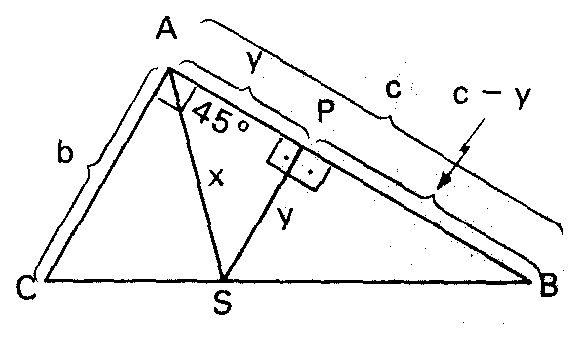
Triangles $BAC$ and $BPS$ are similar. Then:
$$\begin{cases} y^2 + y^2 = x^2 \\ \dfrac{b}{y} = \dfrac{c}{c - y} \end{cases} \Rightarrow \begin{cases} y = \dfrac{x}{\sqrt{2}} \\ c\,y = bc - by \end{cases} \Rightarrow c\,\frac{x}{\sqrt{2}} = bc - b\,\frac{x}{\sqrt{2}} \Rightarrow x = \frac{\sqrt{2}\,bc}{b + c}.$$Ver resposta
$\dfrac{\sqrt{2}\,bc}{b + c}$
Num isosceles triangle $ABC$, $M$ is any point in the base $\overline{BC}$. Show that $(AB)^2 - (AM)^2 = (MB) \cdot (MC)$.
Ver resposta
Use the Pythagorean theorem on triangles determined by height relative to the base.
Determine the perimeter of a isosceles triangle as a function of the projection $a$ of the height relative to the base of the triangle on one of the congruent sides, and as a function of this height $h$.
Ver resposta
$\dfrac{2h}{a}\left(h + \sqrt{h^2 - a^2}\right)$
In a square $ABCD$ we take a point $E$, on the side $\overline{AD}$, such as $AE = \dfrac{1}{4}AD$, and the point $O$, middle of $\overline{AB}$. Since $\overline{OP}$ is perpendicular to $\overline{CE}$, where $P$ is the foot of the perpendicular taken over $\overline{CE}$, prove that $(OP)^2 = (EP) \cdot (CP)$.
Ver resposta
Note that $\triangle EOC$ is a rectangle in $O$; apply relationship $h^2 = m \cdot n$.
Let us consider a triangle $ABC$ and the angle bisectors $\overline{AD}$ internal and $\overline{AE}$ external to the triangle. Prove that
$$\frac{\sqrt{AD^2 + AE^2}}{CD} - \frac{\sqrt{AD^2 + AE^2}}{BD} = 2.$$Ver resposta
Use the angle bisectors theorem and the fact that $\triangle DAE$ is a rectangle in $A$.
Let there be a semicircle of diameter $AB = 2r$ and the tangents $\overrightarrow{AX}$ and $\overrightarrow{BY}$ to the semicircle. The tangent at any point $C$ on the semicircle meets $\overrightarrow{AX}$ in $D$ and $\overrightarrow{BY}$ in $E$. Show that $(CD) \cdot (CE) = r^2$.
Ver resposta
With $O$ being the midpoint of $\overline{AB}$, $\triangle EOD$ is a rectangle in $O$ and $\overline{OC}$ is the height relative to the hypotenuse.
Applications and trigonometry
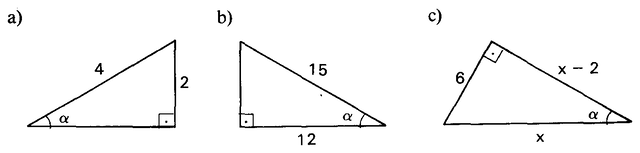
Determine $\operatorname{sen}\alpha$ in cases:
Ver resposta
a) $\dfrac{1}{2}$ · b) $\dfrac{3}{5}$ · c) $\dfrac{3}{5}$
Determine $\cos\alpha$ in cases:
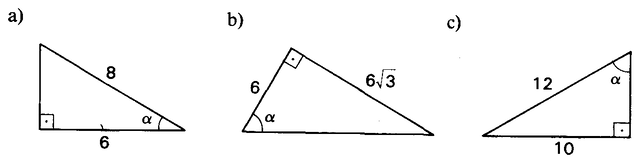
Ver resposta
a) $\dfrac{3}{4}$ · b) $\dfrac{1}{2}$ · c) $\dfrac{\sqrt{11}}{6}$
Get $\operatorname{tg}\alpha$ in cases:
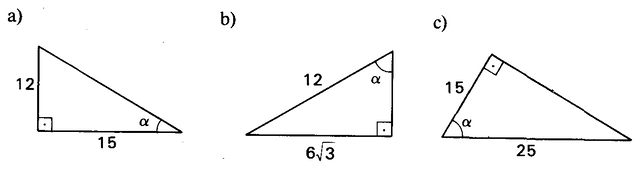
Ver resposta
a) $\dfrac{4}{5}$ · b) $\sqrt{3}$ · c) $\dfrac{4}{3}$
Determine the value of $x$ in the following cases:
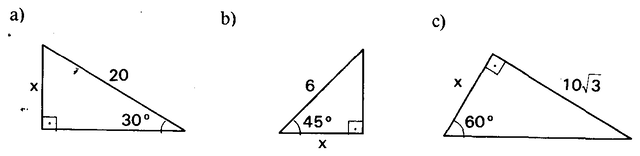
Ver resposta
a) 10 · b) $3\sqrt{2}$ · c) 10
Determine the value of $x$ in the following cases:
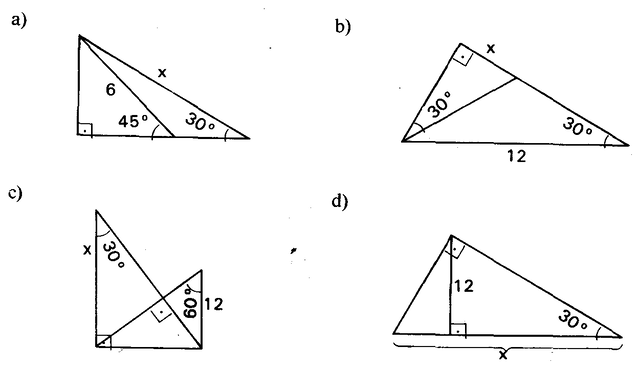
Ver resposta
a) $6\sqrt{2}$ · b) $2\sqrt{3}$ · c) 36 · d) $16\sqrt{3}$
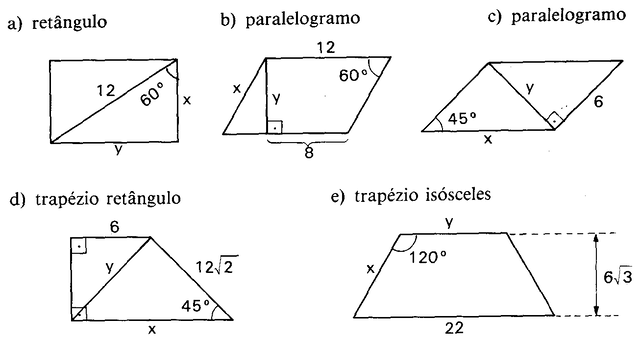
Determine the values of $x$ and $y$ in the cases: a) rectangle; b) parallelogram; c) parallelogram; d) rectangular trapezoid; e) isosceles trapezoid.
Ver resposta
a) $x = 6$; $y = 6\sqrt{3}$ · b) $x = 8$; $y = 4\sqrt{3}$ · c) $x = 6\sqrt{2}$; $y = 6$ · d) $x = 18$; $y = 6\sqrt{5}$ · e) $x = 12$; $y = 10$
Determine the value of $x$ in the following cases:
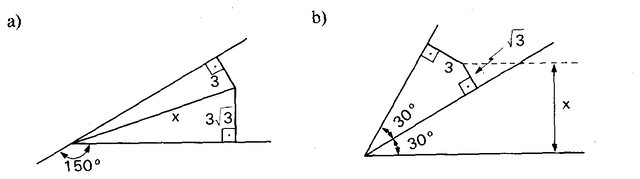
See book recommendations
a) Extending the measurement segment 3, we find $a$, then $b$, and from $x^2 = b^2 + 3^2$ we obtain $x = 6\sqrt{7}$.
b) Extending the measurement segment $\sqrt{3}$ until it meets both sides of the angle 60°, we obtain equilateral triangle, hence $x = 6$.
Ver resposta
a) $6\sqrt{7}$ · b) 6
A point on one side of an angle of 60° is 16 m from the vertex of the angle. How far is it on the other side of the angle?
Ver resposta
$8\sqrt{3}$ m
A point on one side of an angle of 30° is 6 m away from the other side. Determine the distance from the orthogonal projection of this point on this other side to the vertex of the angle.
Ver resposta
$6\sqrt{3}$ m
An internal point $P$ of a right angle is 4 m and 8 m from the sides of the angle. What is the distance between $P$ and the vertex of this angle?
Ver resposta
$4\sqrt{5}$ m
An internal point of a right angle is 4 m and 10 m from the sides of the angle. How far is this point from angle bisector of this angle?
Ver resposta
$3\sqrt{2}$ m
A point $P$, inside a right angle, is respectively $\sqrt{2}$ m and 2 m away from one side and angle bisector of the angle. Determine the distance between $P$ and the vertex of this angle.
Ver resposta
$2\sqrt{5}$ m
A point $P$, inside an angle of 60°, is 6 m and 9 m away from the sides of that angle. What is the distance between $P$ and angle bisector of the angle?
Ver resposta
$\sqrt{3}$ m
A point $P$, inside an angle of 60°, is 3 m and 6 m away from the sides of the angle. Determine the distance between $P$ and the vertex of this angle.
Ver resposta
$2\sqrt{21}$ m
A point $P$, inside an angle of 30°, is 3 m away from one side and $3\sqrt{13}$ m from the vertex of the angle. How far is this point on the other side of the angle?
Ver resposta
$\dfrac{3\sqrt{3}}{2}$ m
A point $P$, external to an angle of 60°, is $9\sqrt{3}$ m and $3\sqrt{3}$ m away from the sides of the angle, none of these distances being to the vertex of the angle. What is the distance between $P$ and angle bisector of the angle?
Ver resposta
12 m
In a right triangle, the square of the hypotenuse is twice the product of the legs. Calculate one of the acute angles of the triangle.
Ver resposta
45°
Through the vertex $B$ of a square $ABCD$ with side $a$, a segment $\overline{BS}$ is taken inside the square that forms an angle equal to 30° with $\overline{BA}$, with $S$ in $\overline{AD}$. Determine $AS$ and $BS$.
Ver resposta
$AS = \dfrac{a\sqrt{3}}{3}$; $BS = \dfrac{2a\sqrt{3}}{3}$
An observer views a building, built on level ground, at an angle of 60°. If he moves further away from the building 30 m, he will see it at an angle of 45°. Calculate the height of the building.
Ver resposta
$15(3 + \sqrt{3})$ m
The sides $\overline{AB}$ and $\overline{AC}$ of a triangle $ABC$ measure respectively $a$ and $2a$, with 45° being the angle formed by them. Calculate the measurement of the height $\overline{BD}$ and the side $\overline{BC}$ of the triangle, as a function of $a$.
Ver resposta
$BD = \dfrac{\sqrt{2}}{2}a$; $BC = \sqrt{5 - 2\sqrt{2}}\,a$
The bases of a rectangular trapezoid are $b$ and $2b$ and one of the angles measures 60°. Calculate the height.
Ver resposta
$\sqrt{3}\,b$
One of the acute angles of an isosceles trapezoid measures 60°. Since the non-parallel sides are congruent to the smaller base of the trapezoid and $m$ is the measurement of the larger base, determine the perimeter of the trapezoid in terms of $m$.
Ver resposta
$\dfrac{5m}{2}$
Determine the angle that the diagonal of an isosceles trapezoid forms with the height of the trapezoid, knowing that the height of the trapezoid is equal to its average base multiplied by $\sqrt{3}$.
Ver resposta
30°
The largest base of an isosceles trapezoid measures 100 cm and the smallest base, 60 cm. With 60° being the measure of each of its acute angles, determine the height and perimeter of the trapezoid.
Ver resposta
Height $20\sqrt{3}$ cm and perimeter 240 cm
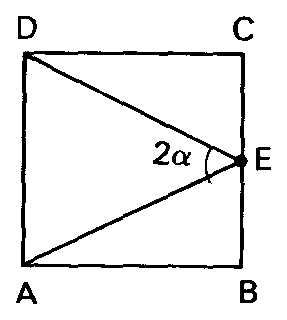
Determine $\operatorname{tg}\alpha$, knowing that $E$ is the midpoint of the side $\overline{BC}$ of the square $ABCD$.
Ver resposta
$\dfrac{1}{2}$
Determine the radius of a circle inscribed in a circular sector of 60° and 6 dm in radius.
Ver resposta
2 dm
Let $AB = 3r$ be tangent in $A$ to a circle with center $O$ and radius $r$. Draw the tangent $\overline{BC}$ through $B$, which has $C$ as a contact point. Calculate the distance from $C$ to the straight line $\overleftrightarrow{AB}$.
Ver resposta
$\dfrac{9}{5}r$
Let us consider a right-angled triangle $ABC$, where the measure of an acute angle is $\alpha$. Determine the measurement of the radius of the inscribed circle as a function of $\alpha$ and the hypotenuse $a$.
Ver resposta
$\dfrac{a}{2}(\operatorname{sen}\alpha + \cos\alpha - 1)$
A parallelogram has sides respectively equal to 10 cm and 8 cm. Knowing that one of its internal angles is worth 120°, calculate the perimeter of the convex quadrilateral formed by the angle bisectors of its internal angles.
Ver resposta
$2(\sqrt{3} + 1)$ cm
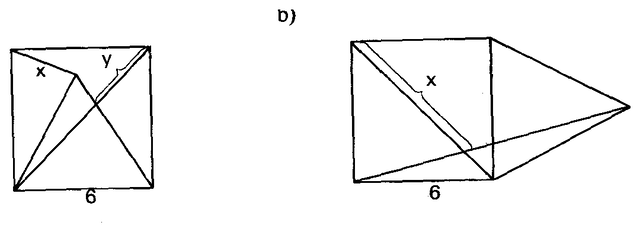
In the figure we have a square and a equilateral triangle. Determine the unknowns.
See the resolution of the book
a) Calculation of $x$. The vertex of equilateral triangle on the side 6 is at the height $h = \dfrac{6\sqrt{3}}{2} = 3\sqrt{3}$ of the base, that is, $6 - h$ on the top side of the square and 3 on the left side. Then $x^2 = 3^2 + (6 - 3\sqrt{3})^2$, whence $x = 6\sqrt{2 - \sqrt{3}} = 3(\sqrt{6} - \sqrt{2})$.
a) Calculation of $y$. In the triangle with an angle of 30°: $\operatorname{tg}30^{\circ} = \dfrac{a}{6 - a}$, that is, $\dfrac{\sqrt{3}}{3} = \dfrac{a}{6 - a}$, therefore $a = 3(\sqrt{3} - 1)$. As $\operatorname{sen}45^{\circ} = \dfrac{a}{y}$, comes $y = a\sqrt{2} = 3(\sqrt{6} - \sqrt{2})$.
b) With the measurements in the figure, $\operatorname{tg}\theta = \dfrac{3}{6 + 3\sqrt{3}} = \dfrac{1}{2 + \sqrt{3}}$ and $\operatorname{tg}\theta = \dfrac{6 - a}{a}$; logo $a = 3 + \sqrt{3}$. So $\operatorname{sen}45^{\circ} = \dfrac{a}{x}$ gives $x = 3\sqrt{2} + \sqrt{6}$.
Ver resposta
a) $x = y = 3(\sqrt{6} - \sqrt{2})$ · b) $x = 3\sqrt{2} + \sqrt{6}$