
Euler's Eyes
2026-09-26
ENEM 2024 – Solved mathematics: questions 136 to 150
Source: INEP – proof and template of the 2nd day, Notebook 5 – Yellow.
The ENEM Mathematics and Technologies test 2024 was administered on the 2nd day and will from question 136 to 180. This post addresses questions 136 to 150. The numbering used here is that of the Notebook 5 – Yellow; us In other notebooks the same questions appear in a different order.
Template
| Question | Subject | Template |
|---|---|---|
| 136 | Related function: production cost | C |
| 137 | Statistics: median | E |
| 138 | Proportional division | C |
| 139 | Combinatorial analysis: combinations | E |
| 140 | Probability of independent events | B |
| 141 | Reason: demographic density | E |
| 142 | Fractions and mixed numbers | D |
| 143 | Increasing plots (logical reasoning) | A |
| 144 | Arc length: pulleys and belt | D |
| 145 | equilateral triangle: circumcenter | C |
| 146 | Graph Reading: Sine Amplitude | A |
| 147 | Areas of regular polygons | A |
| 148 | Speed and furniture finding | D |
| 149 | Probability without replacement | E |
| 150 | Logarithm: Richter scale | C |
Question 136: Cost of producing backpacks (related function)
Statement
A company produces custom school backpacks. This company has a cost total production, composed of a fixed cost, which does not depend on the number of backpacks, plus a variable cost, which is proportional to the number of backpacks produced. The total cost grows linearly, and the table shows this cost for three quantities of backpacks produced.
| Number of backpacks | 30 | 50 | 100 |
|---|---|---|---|
| Total cost (R$) | 1 050,00 | 1 650,00 | 3 150,00 |
The total cost, in reais, for the production of 80 backpacks will be
- A) 2 400,00.
- B) 2 520,00.
- C) 2 550,00.
- D) 2 700,00.
- E) 2 800,00.
Resolution
The total cost is fixed cost + variable cost, and the variable cost is proportional to the number $x$ of backpacks. Then the cost is an affine function:
$$C(x) = b + a x$$where $b$ is the fixed cost and $a$ is the cost of each backpack.
1. Cost per backpack ($a$). From 30 to 50 backpacks, the cost goes up $1650 - 1050 = 600$ reais for 20 extra backpacks:
$$a = \frac{1650 - 1050}{50 - 30} = \frac{600}{20} = 30$$Checking with the third point: from 50 to 100 backpacks, $\frac{3150 - 1650}{100 - 50} = \frac{1500}{50} = 30$. The rate is the same as expected in a related function.
2. Fixed cost ($b$). Using $x = 30$:
$$1050 = b + 30 \cdot 30 \quad\Rightarrow\quad b = 1050 - 900 = 150$$Therefore, $C(x) = 150 + 30x$.
3. Cost of 80 backpacks.
$$C(80) = 150 + 30 \cdot 80 = 150 + 2400 = 2550$$Answer: alternative C (R$ 2 550,00).
Beware of the catch: alternative A (2 400,00) is just the cost variable, $30 \cdot 80$. She forgets the fixed cost of R$ 150,00.
Question 137: Median relative humidity
Statement
Relative air humidity is one of the indicators used in meteorology to make weather forecasts. The table presents the monthly averages, in percentage of relative air humidity over a period of six consecutive months in a city.
| Months | May | Jun. | Jul. | Aug. | Sept. | Oct. |
|---|---|---|---|---|---|---|
| Monthly average relative humidity (%) | 66 | 64 | 54 | 46 | 60 | 64 |
In this city, the median of these data, in percentage, of relative air humidity during the period considered was
- A) 56.
- B) 58.
- C) 59.
- D) 60.
- E) 62.
Resolution
The median is the central value of the data after it is placed in order. The table is in the order of months, not in the order of values, so the first step is to order.
1. Sort the data:
$$46, \quad 54, \quad 60, \quad 64, \quad 64, \quad 66$$2. Find the center. These are 6 values, an even quantity. There is not a single central term: the two in the middle are the 3rd and 4th, that is, 60 and 64. The median is their average:
$$\text{Mediana} = \frac{60 + 64}{2} = \frac{124}{2} = 62$$Answer: alternative E (62%).
Be careful with the catch: whoever takes the two middle values without sort (July and August, 54 and 46) finds 50, which is not among the alternatives. And alternative D (60) is just the 3rd term, forgetting to do the average with 4th.
To review the concept, see Position Measurements.
Question 138: Payment proportional to hours worked
Statement
An engineering company was hired to carry out a service worth R$ 71 250,00. The company’s partners decided that 40% of this amount would be allocated to the payment of three engineers who managed the service. Payment for each of them will be done directly proportional to the total hours worked. The number of days and the number of hours per day worked by engineers were, respectively:
- engineer I: 4 days, on a journey of 5 hours and a half per day;
- engineer II: 5 days, on a journey of 4 hours per day;
- engineer III: 6 days, on a journey of 2 hours and a half per day.
What is the biggest difference, in real terms, between the values received for this service? between two of these engineers?
- A) 1 000
- B) 1 500
- C) 3 500
- D) 3 800
- E) 5 250
Resolution
1. Value to be divided. Only 40% of the service goes to the engineers:
$$0{,}40 \cdot 71\thinspace 250 = 28\thinspace 500 \text{ reais}$$2. Total hours for each engineer(days × hours per day):
| Engineer | Calculation | Hours |
|---|---|---|
| I | $4 \cdot 5{,}5$ | 22 |
| II | $5 \cdot 4$ | 20 |
| III | $6 \cdot 2{,}5$ | 15 |
| Total | 57 |
3. Hourly rate. As payment is directly proportional to hours, each hour is worth the same:
$$\frac{28\thinspace 500}{57} = 500 \text{ reais por hora}$$4. How much each person receives:
- engineer I: $22 \cdot 500 = 11\thinspace 000$ reais;
- engineer II: $20 \cdot 500 = 10\thinspace 000$ reais;
- engineer III: $15 \cdot 500 = 7\thinspace 500$ reais.
5. Biggest difference. It’s between those who received more (I) and those who received less (III):
$$11\thinspace 000 - 7\thinspace 500 = 3\thinspace 500$$Answer: alternative C (R$ 3 500).
Shortcut: the largest time difference is $22 - 15 = 7$ hours, and $7 \cdot 500 = 3\thinspace 500$. There is no need to calculate the value of each one.
To review, see Proportions and Basic Percentage.
Question 139: Teams of doctors (combinations)
Statement
A hospital has 7 cardiologists and 6 neurologists on staff. staff. To perform a certain activity, the direction of that hospital will form a team with 5 doctors, at least 3 cardiologists.
The numerical expression that represents the maximum number of distinct ways of forming this team is
A)
$$\frac{7!}{4!} \times \frac{6!}{4!}$$B)
$$\frac{7!}{3! \times 4!} \times \frac{6!}{2! \times 4!}$$C)
$$\frac{7!}{3! \times 4!} + \frac{6!}{2! \times 4!} + \frac{5!}{1! \times 4!}$$D)
$$\left(\frac{7!}{3! \times 4!} + \frac{6!}{2! \times 4!}\right) \times \left(\frac{7!}{4! \times 3!} + \frac{6!}{1! \times 5!}\right) \times \left(\frac{7!}{5! \times 2!} + \frac{6!}{0! \times 6!}\right)$$E)
$$\left(\frac{7!}{3! \times 4!} \times \frac{6!}{2! \times 4!}\right) + \left(\frac{7!}{4! \times 3!} \times \frac{6!}{1! \times 5!}\right) + \left(\frac{7!}{5! \times 2!} \times \frac{6!}{0! \times 6!}\right)$$Resolution
The order of doctors on the team doesn’t matter, so we use combinations:
$$C_{n,p} = \binom{n}{p} = \frac{n!}{p! \thinspace (n-p)!}$$1. Separate the cases. “At least 3 cardiologists” in a team of 5 leaves three possibilities:
| Case | Cardiologists (from 7) | Neurologists (from 6) |
|---|---|---|
| 1 | 3 | 2 |
| 2 | 4 | 1 |
| 3 | 5 | 0 |
2. Count each case. Within a case, we choose the cardiologists e neurologists. Choices made together multiply:
- case 1: $\binom{7}{3} \times \binom{6}{2} = \dfrac{7!}{3! \times 4!} \times \dfrac{6!}{2! \times 4!}$
- case 2: $\binom{7}{4} \times \binom{6}{1} = \dfrac{7!}{4! \times 3!} \times \dfrac{6!}{1! \times 5!}$
- case 3: $\binom{7}{5} \times \binom{6}{0} = \dfrac{7!}{5! \times 2!} \times \dfrac{6!}{0! \times 6!}$
3. Put the cases together. One team is from case 1 or from case 2 or from case 3. Cases that are excluded add up. The expression is exactly that of alternative E.
Doing the math, to check:
$$35 \times 15 + 35 \times 6 + 21 \times 1 = 525 + 210 + 21 = 756 \text{ equipes}$$Answer: alternative E.
Why the others are wrong:
- B only counts the case 1 (exactly 3 cardiologists).
- D inverts the operations: sums within each case and multiplies the cases.
- C adds numbers that don’t make sense together, like $\frac{5!}{1! \times 4!}$.
The rule to remember: “e” multiply, “or” sum.
Question 140: Probability of catching two red traffic lights
Statement
To improve the flow of buses on an avenue that has two traffic lights, the City Hall will reduce the time each signal will be red, which is currently from 15 seconds to every 60 seconds. Admit that the instant of arrival of a bus every traffic light is random.
The city’s traffic engineer calculated the probability of a bus find each of them red, obtaining $\frac{15}{60}$. From there, established the same reduction in the amount of time, in seconds, in which each signal will turn red, so the probability of a bus encountering both red lights on the same trip is equal to $\frac{4}{100}$, considering independent events.
To do this, reducing the time in which the signal will be red, in seconds, established by the engineer was
- A) 1,35.
- B) 3,00.
- C) 9,00.
- D) 12,60.
- E) 13,80.
Resolution
1. Probability at a traffic light. If the light turns red during $t$ seconds every 60, the chance of the bus reaching red is
$$P(\text{vermelho}) = \frac{t}{60}$$(with $t = 15$ today, the probability is $\frac{15}{60}$, as the statement says).
**2. The two traffic lights.**The events are independent, so the probability of catching both red ones is the product of the probabilities. How the reduction is the same in both signals, they both have the same $t$:
$$\frac{t}{60} \cdot \frac{t}{60} = \left(\frac{t}{60}\right)^2 = \frac{4}{100}$$3. Find the new time. Taking the square root (only the positive root is valid, because time is not negative):
$$\frac{t}{60} = \frac{2}{10} \quad\Rightarrow\quad t = 12 \text{ segundos}$$4. The reduction. Red goes from 15 to 12 seconds:
$$15 - 12 = 3 \text{ segundos}$$Answer: alternative B (3,00 seconds).
Be careful with the catch: the question is the reduction, not the new time. Whoever answers the new time (12) is looking for a value that is not in the alternatives. The closest is D (12,60), which is not the answer.
To review the concept, see Introduction to Probability.
Question 141: Population density (ratio between quantities)
Statement
The demographic density of a region is defined as the ratio between the number of inhabitants of that region and its area, expressed in the unit inhabitants per square kilometer.
A region $R$ is subdivided into several others, one of which is region $Q$. A area of $Q$ is equal to three-quarters of the area of $R$, and the number of inhabitants of $Q$ is equal to half the number of inhabitants of $R$. Population densities corresponding to these regions are denoted by $d(Q)$ and $d(R)$.
The expression that relates $d(Q)$ and $d(R)$ is
- A) $d(Q) = \dfrac{1}{4} d(R)$
- B) $d(Q) = \dfrac{1}{2} d(R)$
- C) $d(Q) = \dfrac{3}{4} d(R)$
- D) $d(Q) = \dfrac{3}{2} d(R)$
- E) $d(Q) = \dfrac{2}{3} d(R)$
Resolution
1. Give names. Let $N$ be the number of inhabitants of $R$ and $A$ be the area of $R$. Then
$$d(R) = \frac{N}{A}$$2. Write the data for $Q$. $Q$ has half the inhabitants and three-quarters from the area:
$$d(Q) = \frac{\frac{1}{2} N}{\frac{3}{4} A}$$3. Simplify. Dividing by a fraction is multiplying by its inverse:
$$d(Q) = \frac{1}{2} \cdot \frac{4}{3} \cdot \frac{N}{A} = \frac{2}{3} \cdot \frac{N}{A} = \frac{2}{3} d(R)$$Answer: alternative E ($d(Q) = \frac{2}{3} d(R)$).
Be careful with the catch: alternative D ($\frac{3}{2}$) appears when The ratio is reversed, making the area divided by inhabitants. Density is inhabitants over area.
To review, see Fees.
Question 142: Difference between screen sizes (mixed fractions)
Statement
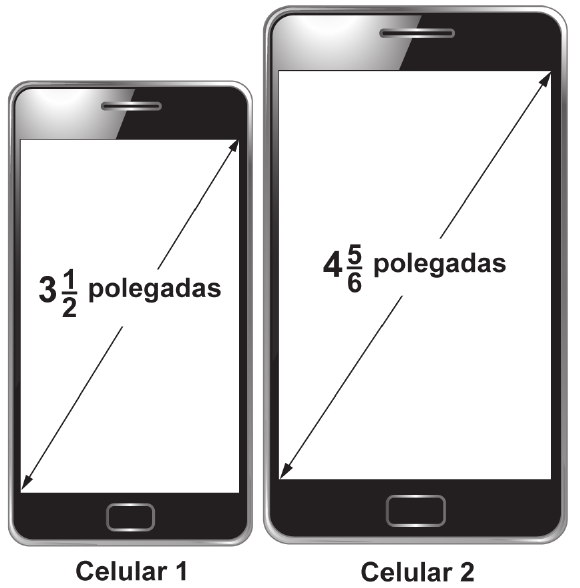
Currently, there are cell phones with screens of different sizes and formats. rectangular. Some of them feature screens measuring $3\frac{1}{2}$ inches, with certain technical specifications. Furthermore, in many models, with the inclusion of new functions on the cell phone, its screens became larger, being much It is common today to find screens measuring $4\frac{5}{6}$ inches, as the figure.
Available at: www.tecmundo.com.br. Accessed on: 5 nov. 2014 (adapted).
The difference in size, in absolute value, between the measurements, in inches, of the screens of the cell phone 2 and cell phone 1, represented with only one decimal place, is
- A) 0,1.
- B) 0,5.
- C) 1,0.
- D) 1,3.
- E) 1,8.
Resolution
1. Transform mixed numbers into fractions. $3\frac{1}{2}$ means $3 + \frac{1}{2}$, and $4\frac{5}{6}$ means $4 + \frac{5}{6}$:
$$3\frac{1}{2} = \frac{6}{2} + \frac{1}{2} = \frac{7}{2} = \frac{21}{6} \qquad 4\frac{5}{6} = \frac{24}{6} + \frac{5}{6} = \frac{29}{6}$$2. Subtract (already with the same denominator 6):
$$\frac{29}{6} - \frac{21}{6} = \frac{8}{6} = \frac{4}{3}$$3. Change to decimal:
$$\frac{4}{3} = 1{,}333\ldots \approx 1{,}3$$Answer: alternative D (1,3 inch).
Beware of the catch: $4\frac{5}{6}$ not is $4 \times \frac{5}{6}$. The mixed number is a sum: whole part plus fraction.
To review, see Operations with Rational Numbers.
Question 143: Increasing installments and the birthday month
Statement
A real estate agency started an advertising campaign to promote the sale of apartments that can be paid in 100 monthly installments. The value of the first of them is fixed at the time of purchase, with the payment of this first installment. A From the second installment onwards, the value is determined by applying an increase fixed percentage to the value of the previous installment. As an attraction, the real estate agency will payment of all installments corresponding to the birthday month of the buyer.
A customer, whose birthday is in May, decided to buy one of these apartments through financing offered by the real estate agency, and intends to choose the most appropriate month to make this purchase, so that the value total payments are as small as possible.
What month should this customer choose to purchase the apartment?
- A) February.
- B) April.
- C) May.
- D) June.
- E) August.
Resolution
1. The installments only grow. Each installment is the previous one with an addition fixed percentage, then the portion 2 is greater than 1, 3 greater than 2, and so on onwards. Installment 100 is the most expensive of all.
2. How many installments fall each month. The 1st installment is paid in the month of purchase. As $100 = 8 \cdot 12 + 4$, the installments cover 8 full years and plus 4 months. Then:
- the 4 first months from the purchase receive 9 installments each (for example, the 4th month receives installments 4, 16, 28, …, 88, 100);
- the other 8 months receive 8 installments each.
3. What the customer wants. He pays everything except the May installments. For pay the minimum, the May installments (paid by the real estate agency) must add up to the maximum possible.
4. Which position is best for May. If May is the 4th month from purchase, he receives the installments
$$4, \ 16, \ 28, \ \ldots, \ 88, \ 100$$There are 9 installments, including the 100th, which is the most expensive of all. Compare with any other position:
- if May is the 1st, 2nd or 3rd month, you also receive 9 installments, but each one is previous (therefore cheaper) to the corresponding installment of the 4th month;
- if May is from the 5th to the 12th month, you only receive 8 installments, and the largest of them is in the maximum at 96th. Pairing, each one is cheaper than one installment different from the list above (96th loses to 100th, 84th to 88th, etc.), and there is still the installment 4.
5. Find the month of purchase. May must be the 4th month counting from the month of purchase (which is the 1st): purchase in February → February (1st), March (2nd), April (3rd), May (4th).
Answer: alternative A (February).
Be careful with the catch: buying in May (alternative C) gives you May 9 installments, but the cheapest in your group (1, 13, …, 97). Does not include the 100th, which is the most expensive.
Question 144: Belt length between two pulleys
Statement
A system of circular pulleys and belts is one of the mechanisms responsible by transmitting movement in rotating machines. The engine manual provides a figure representing a system composed of two pulleys and a belt transmission, tensioned and perfectly adjusted on the pulleys, so as not to have gaps in the contacts with the pulleys. Consider that the parts of this belt that are not in contact with the pulleys are represented by segments of straight lines tangent to the pulleys.
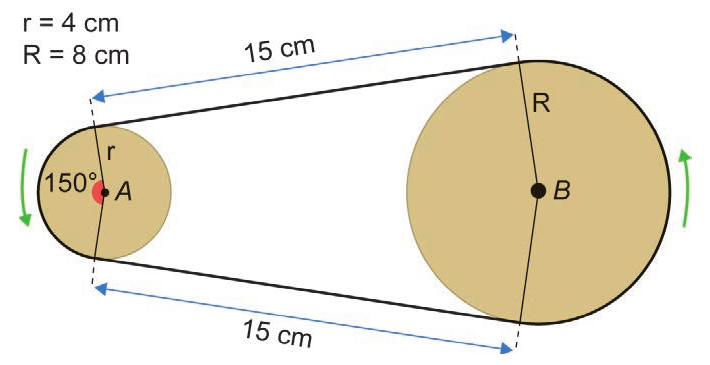
To replace this belt, it is necessary to specify its length.
Consider 3 as an approximate value for $\pi$.
The measurement of the length of this belt, in centimeters, is
- A) 54.
- B) 60.
- C) 66.
- D) 68.
- E) 72.
Resolution
The belt has four parts: two straight segments of 15 cm, an arc around the small pulley and a hoop around the large pulley.
1. Arc angles. On the small pulley, the arc in contact with the belt corresponds to the central angle of $150°$ marked in the figure.
At each point of tangency, the radius is perpendicular to the belt. So the radius of small pulley and the radius of the large pulley that reach the same straight segment are parallels. Therefore, the two arcs in contact complete each other: the pulley arc big has
$$360° - 150° = 210°$$2. Arc on small pulley($r = 4$ cm, $\pi = 3$): length is the fraction $\frac{150}{360}$ of the entire circumference:
$$\frac{150}{360} \cdot 2 \cdot 3 \cdot 4 = \frac{5}{12} \cdot 24 = 10 \text{ cm}$$3. Arc on large pulley($R = 8$ cm):
$$\frac{210}{360} \cdot 2 \cdot 3 \cdot 8 = \frac{7}{12} \cdot 48 = 28 \text{ cm}$$4. Add it all up:
$$15 + 15 + 10 + 28 = 68 \text{ cm}$$Answer: alternative D (68 cm).
Be careful with the trick: whoever uses $150°$ on the large pulley will also find $30 + 10 + 20 = 60$ (alternative B). And whoever uses half a turn ($180°$) in each pulley finds $30 + 12 + 24 = 66$ (alternative C). The big pulley hugs more than half of the belt.
To review, see Angles and Circumferences.
Question 145: Point equidistant from three stations (equilateral triangle)
Statement
A city council plans to build three health posts. These posts must be built in locations equidistant from each other and in such a way that the distances from these three stations to the hospital in that city are equal. Were three locations were achieved for the construction of health posts that present the desired characteristics, and which are 10 km apart, according to the scheme, in the which point $H$ represents the place where the hospital is built; the points $P_1$, $P_2$ and $P_3$, the health posts; and these four points are in one same plan.
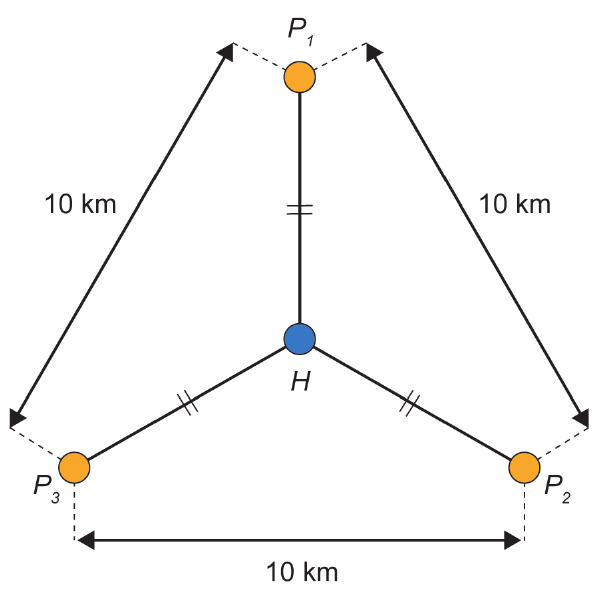
The distance, in kilometers, between the hospital and each of the health posts, is a value between
- A) 2 e 3.
- B) 4 e 5.
- C) 5 e 6.
- D) 7 e 8.
- E) 8 e 9.
Resolution
1. The figure. The stations form a equilateral triangle side 10 km, and $H$ is the same distance from the three vertices. This point is the center of the triangle (circumcenter). In equilateral triangle it coincides with the centroid, which is $\frac{2}{3}$ from each height, counting from the vertex.
2. Height of equilateral trianglefrom side $\ell = 10$:
$$h = \frac{\ell\sqrt{3}}{2} = \frac{10\sqrt{3}}{2} = 5\sqrt{3}$$3. Distance from $H$ to each station:
$$d = \frac{2}{3} h = \frac{2}{3} \cdot 5\sqrt{3} = \frac{10\sqrt{3}}{3} \approx \frac{10 \cdot 1{,}732}{3} \approx 5{,}77 \text{ km}$$Answer: alternative C (between 5 and 6 km).
Be careful with the catch: the distance from $H$ to a side of the triangle it is only $\frac{1}{3}$ high, about 2,89 km (alternative A). And the height entire length, around 8,66 km, leads to alternative E.
To review, see Notable Points of the Triangle.
Question 146: Oscillation graph of a shock absorber
Statement
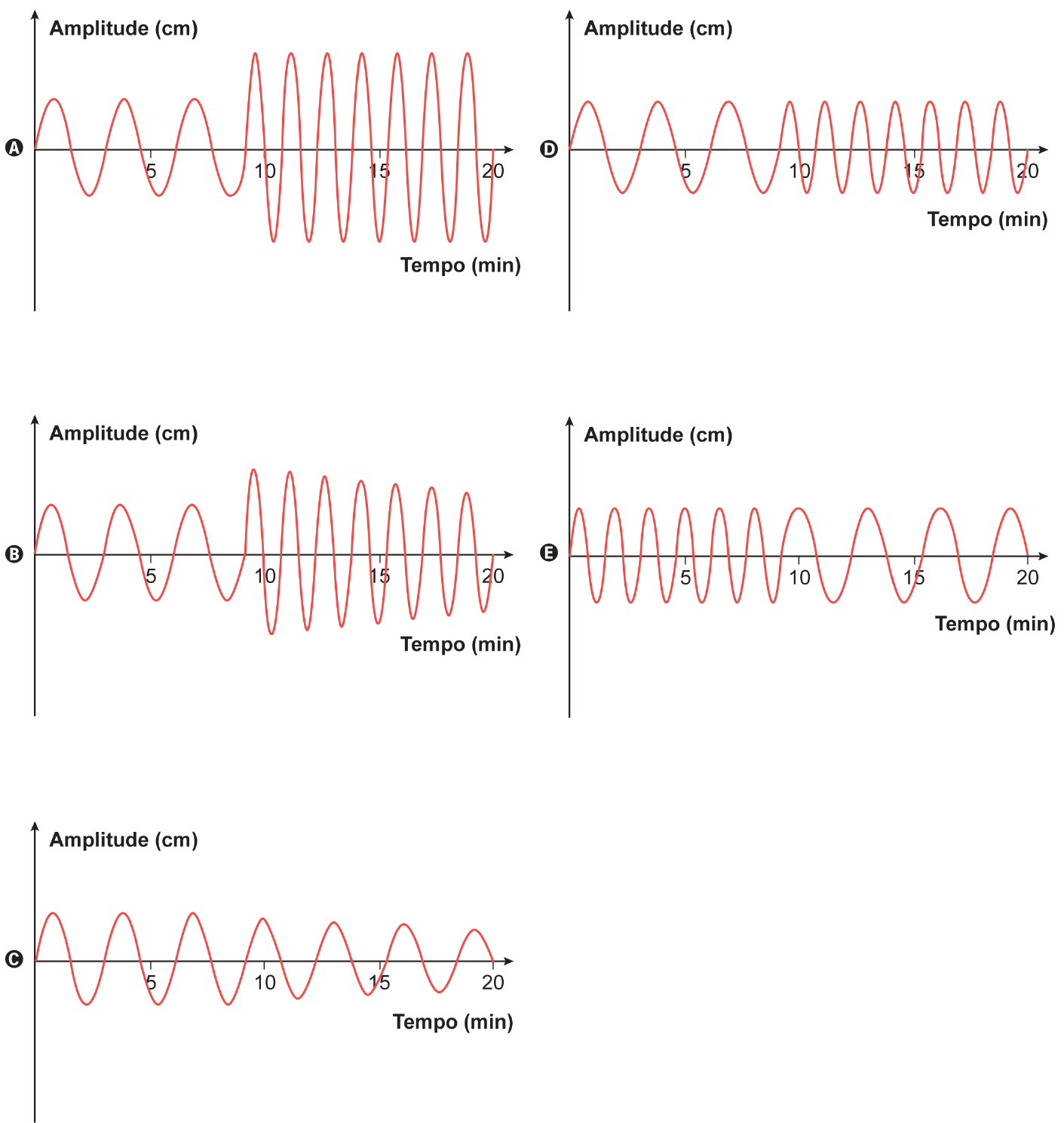
Designers at a shock absorber factory carried out a series of experiments that produced oscillations similar to the behavior of the graph of a sinusoid, for any type of road. Each experiment lasted 20 minutes, with 9 being the first minutes on a surface that simulates a highway asphalt, and the remaining 11 minutes on a surface that simulates a highway floor.
For the shock absorbers to be approved in the experiment, it is required that the amplitudes of oscillatory waves, on each type of surface, are constant and, furthermore, that the amplitude of the shock absorber oscillation on the asphalt is smaller than that than its oscillation amplitude on the dirt road.
The type of graph that describes the oscillatory behavior of a damper approved in this experiment is
Resolution
The amplitude is the height of the wave peaks (the distance from the axis to the point higher). There are three requirements:
- from 0 to 9 minutes (asphalt), the amplitude is constant;
- from 9 to 20 minutes (floor), the amplitude is constant;
- the amplitude on asphalt is smaller than on the ground.
Analyzing each graph:
- A: peaks all the same up to 9 minutes; then, peaks all the same and more high. Meets all three requirements.
- B: on the dirt road, the peaks get smaller. The amplitude is not constant.
- C: the peaks decrease over time. It is not constant and does not increase over time floor.
- D and E: the amplitude is the same on both surfaces; just change the frequency (the wave becomes “tighter” or “wider”). Does not comply with requirement 3.
Answer: alternative A.
Be careful with the catch: do not confuse amplitude (wave height) with frequency (how many oscillations fit into an interval). In D and E changes the frequency, not amplitude.
Question 147: Largest area with the same perimeter (regular polygons)
Statement
A gardener has $k$ linear meters of low fence to make a garden ornamental. The garden, delimited by this fence, must have the shape of a equilateral triangle, a regular square or hexagon. The choice will be by in a way that results in the largest area.
The gardener will choose the way to
- A) regular hexagon, as the area of the garden, in square meters, will be $\dfrac{k^2\sqrt{3}}{24}$.
- B) regular hexagon, as the area of the garden, in square meters, will be $\dfrac{3k^2\sqrt{3}}{2}$.
- C) square, as the area of the garden, in square meters, will be $\dfrac{k^2}{16}$.
- D) equilateral triangle, as the area of the garden, in square meters, will be $\dfrac{k^2\sqrt{3}}{36}$.
- E) equilateral triangle, as the area of the garden, in square meters, will be $\dfrac{k^2\sqrt{3}}{4}$.
Resolution
The perimeter is always $k$ (the entire fence). We calculate the area of each shape.
1. equilateral triangle: side $\frac{k}{3}$.
$$A_\triangle = \frac{\ell^2\sqrt{3}}{4} = \frac{\left(\frac{k}{3}\right)^2\sqrt{3}}{4} = \frac{k^2\sqrt{3}}{36}$$2. Square: side $\frac{k}{4}$.
$$A_\square = \left(\frac{k}{4}\right)^2 = \frac{k^2}{16}$$3. Regular hexagon: side $\frac{k}{6}$. The regular hexagon is formed by 6 equilateral triangles with this side:
$$A_{hex} = 6 \cdot \frac{\left(\frac{k}{6}\right)^2\sqrt{3}}{4} = 6 \cdot \frac{k^2\sqrt{3}}{144} = \frac{k^2\sqrt{3}}{24}$$4. Compare (using $\sqrt{3} \approx 1{,}732$):
| Shape | Area | Approximation |
|---|---|---|
| Triangle | $\frac{k^2\sqrt{3}}{36}$ | $0{,}048 k^2$ |
| Square | $\frac{k^2}{16}$ | $0{,}0625 k^2$ |
| Hexagon | $\frac{k^2\sqrt{3}}{24}$ | $0{,}072 k^2$ |
The hexagon has the largest area.
Answer: alternative A (regular hexagon, with area $\frac{k^2\sqrt{3}}{24}$).
Be careful with the catch: alternative B uses the hexagon formula $\frac{3\ell^2\sqrt{3}}{2}$ with $\ell = k$, forgetting which side is $\frac{k}{6}$. With the same perimeter, the more sides the regular polygon has, the larger the area.
To review, see Regular Polygons.
Question 148: Meeting of two buses (speeds)
Statement
An airport offers a free shuttle service between its two terminals using buses A and B, which depart simultaneously, every hour time, from different terminals. The distance between the terminals is 9 000 meters, and the total route of the buses, from one terminal to the other, is monitored by a system of five cameras that cover different parts of the stretch, according to the scheme.
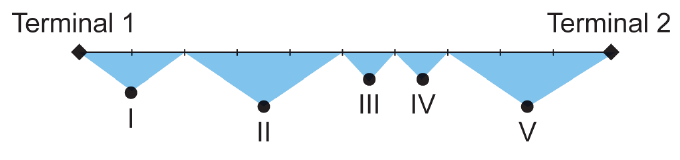
The range of each of the five cameras is:
- camera I: $\frac{1}{5}$ of the route;
- camera II: $\frac{3}{10}$ of the route;
- camera III: $\frac{1}{10}$ of the route;
- IR camera: $\frac{1}{10}$ of the route;
- camera V: $\frac{3}{10}$ of the route.
At a certain time, bus A departs from terminal 1 and travels total with constant speed of 250 m/min; while bus B, which leaves from terminal 2, performs the total distance at a constant speed of 150 m/min.
Which camera records the moment buses A and B meet?
- A) I
- B) II
- C) III
- D) IV
- E) V
Resolution
1. Time until the meeting. The buses move towards each other, so the distance between them decreases $250 + 150 = 400$ meters per minute:
$$t = \frac{9\thinspace 000}{400} = 22{,}5 \text{ minutos}$$2. Where is the meeting. During this time, bus A went, from terminal 1,
$$250 \cdot 22{,}5 = 5\thinspace 625 \text{ metros}$$(Checking: B walked $150 \cdot 22{,}5 = 3\thinspace 375$ m, and $5\thinspace 625 + 3\thinspace 375 = 9\thinspace 000$.)
3. Excerpt from each camera. Fractions add up $\frac{2}{10} + \frac{3}{10} + \frac{1}{10} + \frac{1}{10} + \frac{3}{10} = 1$, and the cameras cover the route in sequence, starting from terminal 1:
| Camera | Fraction | Excerpt (m, from terminal 1) |
|---|---|---|
| I | $\frac{1}{5}$ | 0 a 1 800 |
| II | $\frac{3}{10}$ | 1 800 a 4 500 |
| III | $\frac{1}{10}$ | 4 500 a 5 400 |
| IV | $\frac{1}{10}$ | 5 400 a 6 300 |
| V | $\frac{3}{10}$ | 6 300 a 9 000 |
The point 5 625 m is between 5 400 and 6 300: IR camera excerpt.
Answer: alternative D (IR camera).
Be careful with the prank: whoever imagines that buses meet in the middle of the path (4 500 m) is on the border between cameras II and III. As A is more Quickly, the meeting is closer to terminal 2.
Question 149: Probability of discovering a Caesar Cipher
Statement
Cryptography refers to the construction and analysis of protocols that prevent third parties from reading private messages. Julius Caesar, Roman emperor, used a code to protect messages sent to his generals. So, if the message fell into enemy hands, the information could not be understood. In this code, each letter of the alphabet was replaced by the letter three positions ahead. front, that is, the “A” was replaced by the “D”, the “B” by the “E”, the “C” by the “F”, and so on.

Available at: www.code.ibict.br. Accessed at: 15 Oct. 2019.
Any code that has a letter substitution pattern as described is considered a Caesar Cipher or a Caesar Code. Note that to decipher a Caesar Cipher, just find out which letter the “A” was replaced with, because this defines all other substitutions to be made.
A message, in an alphabet of 26 letters, has been encoded using a Caesar. Consider the probability of randomly discovering the pattern used in this coding, and that a failed attempt must be eliminated in subsequent attempts.
The probability of discovering the pattern of this Caesar Cipher only in third attempt is given by
- A) $\dfrac{1}{25} + \dfrac{1}{25} + \dfrac{1}{25}$
- B) $\dfrac{24}{25} + \dfrac{23}{24} + \dfrac{1}{23}$
- C) $\dfrac{1}{25} \times \dfrac{1}{24} \times \dfrac{1}{23}$
- D) $\dfrac{24}{25} \times \dfrac{23}{25} \times \dfrac{1}{25}$
- E) $\dfrac{24}{25} \times \dfrac{23}{24} \times \dfrac{1}{23}$
Resolution
1. How many patterns are possible. The pattern is defined by the letter that replaces the “A”. It can be any of the other 25 letters (if the “A” remained “A”, the message would not be encoded). These are 25 possibilities.
**2. “Only on the third attempt”**means: miss the 1st, miss the 2nd and get the 3rd right. As each wrong attempt is eliminated, the number of options decreases each time:
- 1st wrong attempt: 24 wrong among 25 options → $\frac{24}{25}$;
- 2nd wrong attempt: 24 options left, 23 wrong → $\frac{23}{24}$;
- 3rd correct attempt: 23 options remain, 1 correct → $\frac{1}{23}$.
3. Multiply. The three facts need to happen together (“and”), so we multiply:
$$P = \frac{24}{25} \times \frac{23}{24} \times \frac{1}{23}$$(Simply put, $P = \frac{1}{25}$: without repeating attempts, getting it right the first time, 2nd or 3rd attempt has the same chance.)
Answer: alternative E.
Be careful with the catch: alternative D forgets to eliminate attempts frustrated (keep 25 in the denominator). A B adds instead of multiplying.
To review, see Introduction to Probability.
Question 150: Magnitude of earthquakes (logarithm)
Statement
In a region with a high incidence of earthquakes, it was observed that two earthquakes that occurred had magnitudes $M_1$ and $M_2$, measured according to the Richter scale, and released energies equal to $E_1$ and $E_2$, respectively. Among scholars on the subject, an algebraic expression is known relating these values given by
$$M_2 - M_1 = \frac{2}{3} \log\left(\frac{E_2}{E_1}\right)$$More comprehensive studies observed that the first earthquake presented the magnitude $M_1 = 6{,}9$ and the energy released was one tenth of that observed in the second earthquake.
The approximate value of the magnitude $M_2$ of the second earthquake, expressed with a decimal place is equal to
- A) 5,4.
- B) 6,2.
- C) 7,6.
- D) 8,2.
- E) 8,4.
Resolution
1. Translate the energy data. “The energy of the first was a tenth of that of the second”:
$$E_1 = \frac{E_2}{10} \quad\Rightarrow\quad \frac{E_2}{E_1} = 10$$2. Replace in formula. As $\log 10 = 1$:
$$M_2 - 6{,}9 = \frac{2}{3} \log 10 = \frac{2}{3} \cdot 1 = \frac{2}{3}$$3. Isolate $M_2$:
$$M_2 = 6{,}9 + 0{,}666\ldots = 7{,}566\ldots \approx 7{,}6$$Answer: alternative C (7,6).
Beware of the catch: if the ratio is reversed ($\frac{E_2}{E_1} = \frac{1}{10}$), the logarithm is worth $-1$ and we obtain $6{,}9 - 0{,}67 \approx 6{,}2$ (alternative B). The second earthquake released more energy, so it has greater magnitude.
To review, see Properties of Logarithms.