
Euler's Eyes
2026-10-11
Fermat's last theorem: from the margin to Wiles's proof
Everyone knows Pythagoras’s theorem: $3^2+4^2=5^2$. There are infinitely many triples of whole numbers like this, such as $5,12,13$ and $8,15,17$.
What about cubes? Are there positive integers with $a^3+b^3=c^3$? And with fourth powers?
The note in the margin
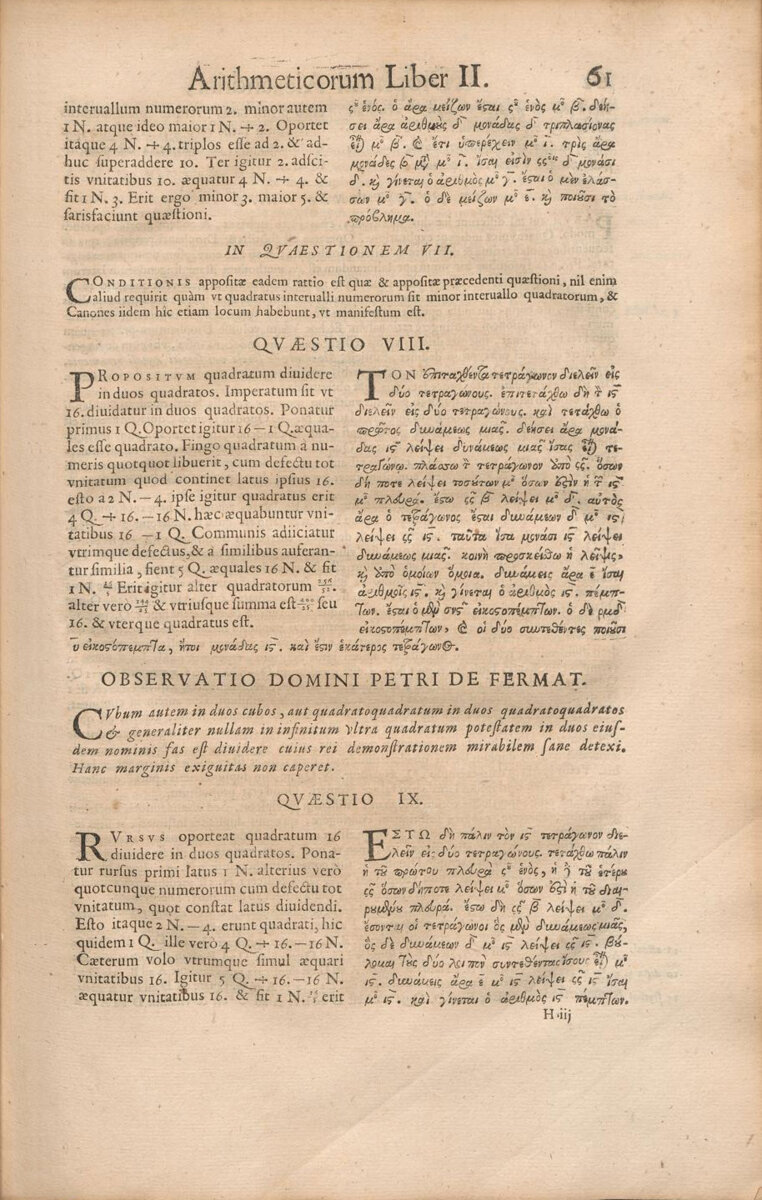
Around 1637, reading Diophantus’s problem about splitting a square into two squares, Fermat wrote in the margin of the book, in Latin:
It is impossible to separate a cube into two cubes, or a fourth power into two fourth powers, or in general any power higher than the second into two like powers. I have discovered a truly marvellous proof of this, which this margin is too narrow to contain.
— Pierre de Fermat, around 1637
In today’s language: for $n>2$ there are no positive integers $a$, $b$, $c$ with
$$a^n+b^n=c^n.$$The note only became public in 1670, when Fermat’s son published the book with his father’s annotations. The proof was never found. Every other claim in the margins was eventually proved or disproved. This was the last one to hold out, which is why it came to be called the last theorem.
358 years of attempts
Fermat himself proved the case $n=4$, with infinite descent. The others followed, one by one:
- 1770: Euler proves the case $n=3$.
- 1825: Dirichlet and Legendre prove the case $n=5$.
- 1820s: Sophie Germain, who signed her letters with a man’s name so as to be taken seriously, proves a general result for a whole family of primes.
- 1839: Lamé proves the case $n=7$.
- 1847: Ernst Kummer creates new ideas and proves the theorem for all “regular” primes up to 100, except three.
But nobody could find a proof for every exponent.
Why only primes matter
We can prove part of the way right here. If there were a solution for $n=6$, then
$$a^6+b^6=c^6\quad\Longrightarrow\quad(a^2)^3+(b^2)^3=(c^2)^3,$$and we would have a solution for $n=3$. In general, if $n$ has an odd prime divisor $q$, a solution for $n$ becomes a solution for $q$. If $n$ has no odd prime divisor, it is a power of 2 greater than 2, hence a multiple of 4, and a solution becomes a solution for $n=4$.
Conclusion: it is enough to prove the theorem for $n=4$, which Fermat did, and for all odd primes. This reduction is easy; the hard part is precisely the infinitely many primes.
Testing is not enough
With computers, it was checked that there are no solutions for exponents up to the millions. But that is not a proof: the theorem is about all integers, and no search, however large, reaches all of them. In mathematics, a million examples do not replace a proof.
The boy in the library
In 1963 a ten-year-old English boy named Andrew Wiles came across the problem in a book in the Cambridge public library. He was struck: a statement he could understand and that nobody, in three centuries, had managed to prove. He decided that one day he would solve it.
Wiles became a mathematician and for years set the dream aside. In 1986 Ken Ribet proved that the last theorem would follow from another conjecture, about elliptic curves and modular forms, which Wiles knew very well. He dropped everything and worked seven years in secret, in his attic, telling almost no one.
In June 1993, in a series of lectures in Cambridge, he announced the proof. The audience gave him a standing ovation. But in review, the experts found a gap. Wiles spent more than a year trying to fix it, with the help of his former student Richard Taylor, and almost gave up. In September 1994 he found the way through. The complete proof, more than a hundred pages long, came out in 1995.
In 2016 Wiles received the Abel Prize, one of the highest honours in mathematics.
Did Fermat really have a proof?
Almost certainly not. Wiles’s proof uses 20th-century mathematics that Fermat could not have known. Most likely Fermat found a proof that only worked for some exponents, perhaps generalizing the case $n=4$, and later realized his mistake. Indeed, in later letters he mentions the cases $n=3$ and $n=4$ as challenges but never again speaks of the general case.
Exercise: a solution with exponent 6 would give a solution for which prime exponent?
Since $6=2\cdot3$, we write $(a^2)^3+(b^2)^3=(c^2)^3$, a solution for the prime exponent 3.
Exercise: and a solution with exponent 8?
8 has no odd prime divisor. Since $8=4\cdot2$: $(a^2)^4+(b^2)^4=(c^2)^4$, a solution for $n=4$, which Fermat proved impossible.
Sources: Fermat biography, MacTutor · Andrew Wiles biography, MacTutor · 2016 Abel Prize.
All Fermat topics · ← Infinite descent: a smaller solution leads to a contradiction · Fermat’s legacy →