From a long view of the history of mankind, seen from, say, ten thousand years from now, there can be little doubt that the most significant event of the 19th century will be judged as Maxwell’s discovery of the laws of electrodynamics.
— Richard Feynman, The Feynman Lectures on Physics, volume II (1964)
James Clerk Maxwell (1831–1879) was a Scottish boy who asked of everything “what’s the go o’ that?”, had a mathematics paper presented to the Royal Society of Edinburgh at 14 and was nicknamed “Dafty” at school. He died at 48, and in that short time he changed physics three times.
He took the first colour photograph in history. He proved that Saturn’s rings cannot be solid. He invented the way of describing a gas through the probabilities of the speeds of its molecules. And above all, he wrote the equations that unite electricity, magnetism and light. With them he calculated the speed of an electromagnetic wave and found exactly the speed of light. Radio, television, mobile phones and wi-fi all came out of that calculation.
In this track we tell Maxwell’s life and redo, with all the calculations shown, six of his discoveries.
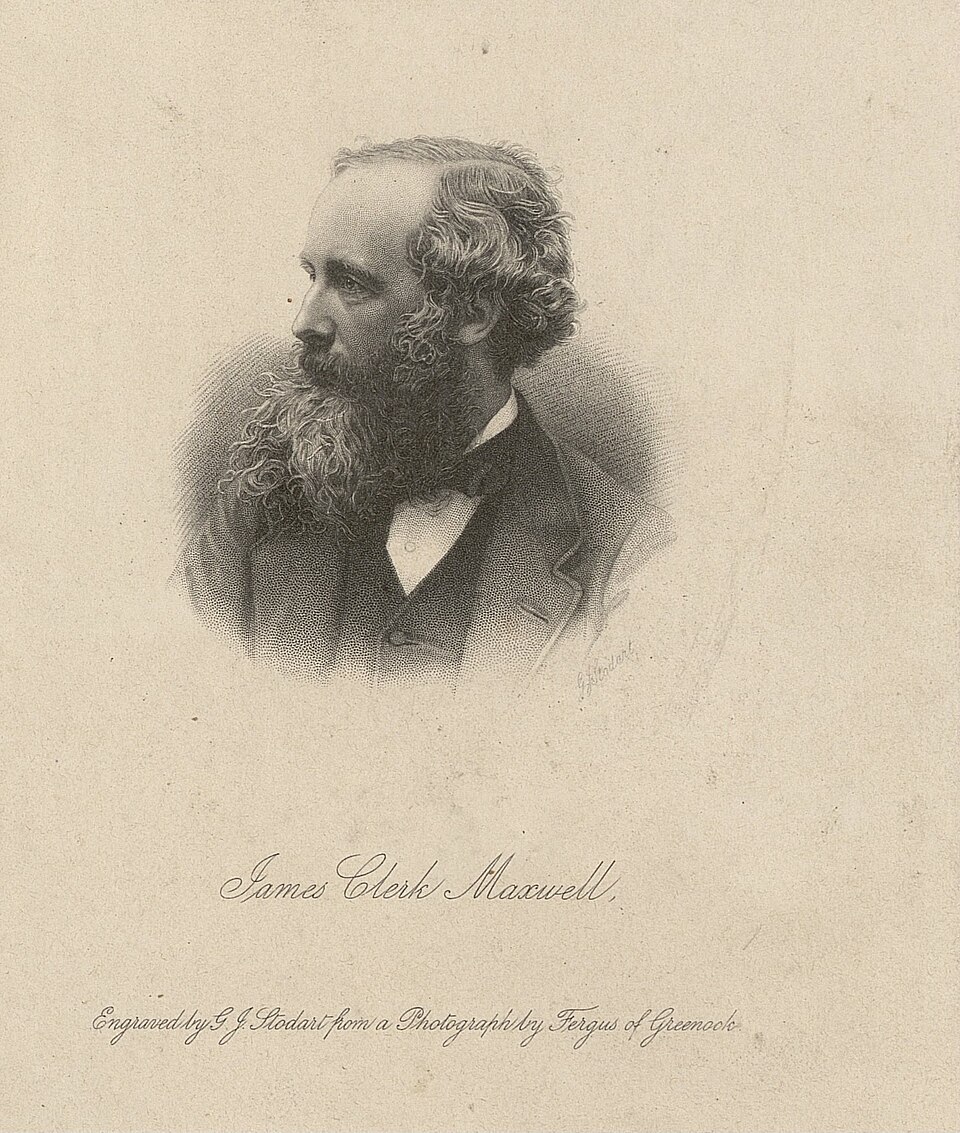
Who he was
James Clerk Maxwell
- Nascimento
- 13 June 1831, Edinburgh
- Morte
- 5 November 1879, Cambridge
- Origem
- Scotland (United Kingdom)
- Áreas
- Electromagnetism, kinetic theory of gases, optics, colour and astronomy
Reading guide
Biography
Discovery and proof
- Colour: the spinning top and the tartan ribbon
- Saturn’s rings cannot be solid
- The speeds of molecules: the Maxwell distribution
- Maxwell’s equations: from Faraday’s lines of force to vectors
- The displacement current: the missing term
- Light is an electromagnetic wave