
Euler's Eyes
2026-10-14
The life of Johann Bernoulli
Timeline
- 1667Born on 27 July in Basel, the tenth child of Nicolaus Bernoulli.
- 1682Sent to Neuchâtel to learn the trade. He has no talent for it.
- 1683Enters the University of Basel. Studies medicine and, with his brother Jakob, mathematics.
- 1691Solves the catenary problem. Travels to Geneva and then to Paris.
- 1692Begins teaching the calculus to the Marquis de l’Hôpital.
- 1694Takes his doctorate in medicine. Signs a contract with l’Hôpital and marries Dorothea Falkner.
- 1695Becomes professor of mathematics in Groningen, in Holland.
- 1696Issues the challenge of the brachistochrone. L’Hôpital’s book, made from his lessons, comes out.
- 1705Returns to Basel. Jakob dies, and Johann inherits his chair.
- 1717States the principle of virtual work in a letter to Varignon.
- 1720Begins guiding the young Leonhard Euler.
- 1734Shares a Paris Academy prize with his son Daniel and throws him out of the house.
- 1748Dies on 1 January in Basel, aged 80.
- He is born, the tenth child of Nicolaus Bernoulli, who wants to make him a merchant.
- He is sent to learn trade. He has no talent for it.
- He studies medicine and, with his brother Jakob, Leibniz’s calculus. He solves the problem of the catenary.
- He passes through Geneva on his way to Paris.
- He meets Malebranche’s circle and starts teaching calculus to the Marquis de l’Hôpital, also at the château of Oucques.
- Professor of mathematics in Holland. In 1696 he issues the brachistochrone challenge.
- He returns home, inherits Jakob’s chair, guides the young Euler and quarrels with his son Daniel. He dies in 1748, aged 80.
- 1667–1682 · Basel
- 1682 · Neuchâtel
- 1683–1691 · Basel
- 1691 · Geneva
- 1691–1692 · Paris
- 1695–1705 · Groningen
- 1705–1748 · Basel
The youngest son who did not want to sell spices
Johann was the tenth child of Nicolaus Bernoulli, a spice merchant and Basel councillor. The father had already lost one battle: his eldest, Jakob, who was meant to be a pastor, thought only of mathematics. With the youngest it would be different. At 15, Johann was sent to Neuchâtel to learn French and the merchant’s trade.
It did not work. Johann hated commerce, and in 1683 his father agreed to let him enter the university, provided he studied medicine, a proper profession. Johann studied medicine. But his brother Jakob, twelve years older, had just discovered Leibniz’s papers on the new calculus, and the two began to study them together, first in secret, then openly. Within a few years the Bernoulli brothers were among the very few people in Europe who really understood what Leibniz had written.
The chain and the sleepless night
Johann’s first great success came in 1691. The year before, Jakob had challenged the readers of the Acta Eruditorum to find the shape of a chain hanging by its ends. Jakob could not do it. Johann, then 24, could, and boasted about it for the rest of his life. The story of the catenary is told in the first post of this track.
The marquis and the contract
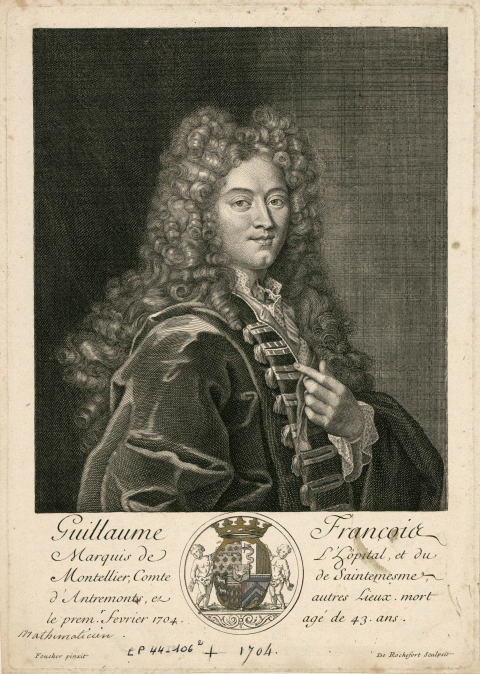
In the autumn of 1691 Johann went to Paris. There he met the circle of the philosopher Malebranche and a 30-year-old aristocrat, Guillaume de l’Hôpital, Marquis de Sainte-Mesme, who loved mathematics and wanted at all costs to learn Leibniz’s calculus. Johann began giving him lessons, in Paris and at the marquis’s castle in Oucques, and when he returned to Basel in 1692 he went on teaching him by letter.
In 1694 l’Hôpital made an unusual proposal: he would pay Johann a pension of 300 livres a year, and in return Johann would send him his discoveries and show them to nobody else. Johann, newly married and without a post, accepted. Two years later the first book of differential calculus in history came out in Paris, the Analysis of the Infinitely Small, signed by l’Hôpital. Much of it came from Johann’s lessons, including the rule still called l’Hôpital’s rule.
Groningen
In 1695, on Christiaan Huygens’s recommendation, Johann became professor of mathematics in Groningen, in Holland. He stayed ten years. Several of his children were born there, among them Daniel, in 1700. There too, in 1696, he issued the challenge that made him famous, that of the brachistochrone, and quarrelled with theologians of the city, who saw heresy in his ideas on physics.
The war with Jakob, meanwhile, dragged on in the journals. In 1705 Johann’s father-in-law, by then an old man, wanted his daughter and grandchildren back in Basel and obtained a chair of Greek for his son-in-law. Johann set off with his family. On the way he received the news: Jakob had died. On arriving, Johann took over his brother’s chair of mathematics, which he would hold for 42 years.
Euler’s teacher
Johann was the great teacher of Europe. He taught mathematics to his sons Nicolaus II, Daniel and Johann II, who also became mathematicians, and received pupils from everywhere, among them the Frenchmen Maupertuis and Clairaut. Around 1720 a teenager studying theology, Leonhard Euler, son of a pastor who had been a pupil of Jakob’s, began coming to his house on Saturdays. Johann did not exactly give him lessons: he pointed him to difficult books and helped when the young man got stuck. Euler would recall:
He advised me to study some of the more difficult mathematical books on my own, and whenever I came across some objection or difficulty, he gave me permission to visit him freely every Saturday afternoon, and he kindly explained to me everything I could not understand.
— Leonhard Euler, autobiographical note (1767)
It was Johann who persuaded Euler’s father to let his son swap theology for mathematics.
Quarrels with everyone
Johann had a talent for mathematics and for quarrelling. In the dispute between Newton and Leibniz over the invention of the calculus, he was Leibniz’s fiercest defender and spent years challenging the English mathematicians with hard problems. When l’Hôpital died in 1704, he complained publicly that the marquis’s book was his, and hardly anyone believed him.
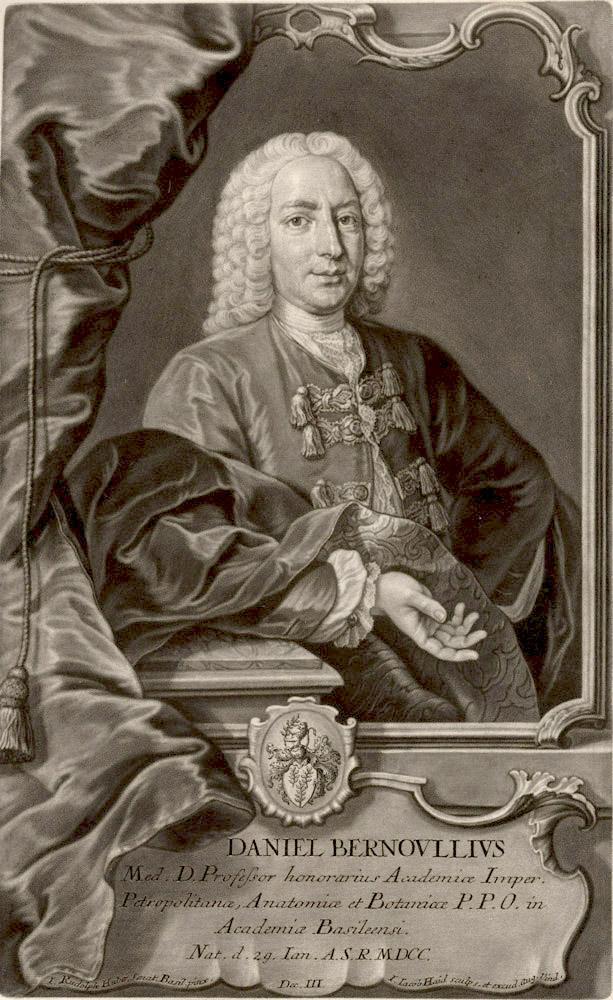
The saddest quarrel was with his own son. In 1734 the Paris Academy divided its grand prize between Johann and Daniel. Johann, furious at being put on the same level as his son, forbade him to enter the house. Years later, when Daniel published the Hydrodynamics (1738), one of the great books of physics, Johann wrote a Hydraulics with very similar results and dated it 1732, as if it came first. It was only published in 1742.
Sources: biography of Johann Bernoulli, MacTutor · Otto Spiess, Die Mathematikerfamilie Bernoulli (1955) · William Dunham, The Calculus Gallery (Princeton, 2005), ch. 3.
All topics on Johann Bernoulli · The catenary: the hanging chain →