
Euler's Eyes
2026-10-14
General relativity: from the lift to the Sobral eclipse
I was sitting in a chair in the patent office in Bern when all of a sudden a thought occurred to me: if a person falls freely, he will not feel his own weight. I was startled. This simple thought made a deep impression on me. It impelled me towards a theory of gravitation.
— Albert Einstein, on an idea of 1907
The relativity of 1905 had a flaw: it did not include gravity. Newton’s law says the Sun pulls the Earth instantly, across 150 million kilometres, and relativity says nothing travels faster than light. Einstein spent eight years trying to fix this. His starting point was what he called “the happiest thought of my life”.
The falling lift
Imagine yourself in a lift whose cable snaps. You and everything in the lift fall together, with the same acceleration. If you let go of an apple, it floats in front of you. Inside the lift it is as if there were no gravity. Astronauts on the Space Station live this all the time: they float not because they are far from the Earth, but because they are falling around it.
And the other way round: in a rocket in empty space, far from everything, accelerating at $9.8$ m/s², you feel your feet pressed against the floor, exactly as on Earth. No experiment done inside a small cabin can tell gravity from acceleration. This is the equivalence principle.
Now switch on a torch, horizontally, inside the accelerating rocket. While the light crosses the cabin, the rocket moves up, and the light reaches the opposite wall a little below where it left: inside the rocket, light follows a curve. If gravity cannot be told from acceleration, then gravity also bends light.
Gravity is geometry
Einstein took the idea to the extreme: gravity is not a force, it is the shape of space and time. A large mass, like the Sun, curves spacetime around it, and bodies in free fall, light included, simply follow the straightest possible lines in that curved space, the geodesics. The Earth goes round the Sun not because it is pulled, but because it is moving “in a straight line” in a space curved by the Sun.
To write this down, Einstein needed the geometry of curved spaces that Gauss had begun and Riemann had generalised, and which he did not know. He asked his friend Marcel Grossmann for help and spent years of trial and error. On 25 November 1915 he presented to the Prussian Academy the field equations:
$$G_{\mu\nu}=\frac{8\pi G}{c^4}\,T_{\mu\nu}.$$On the left, $G_{\mu\nu}$ describes the curvature of spacetime; on the right, $T_{\mu\nu}$ describes the matter and energy that are there. The physicist John Wheeler summed it up: “matter tells space how to curve; space tells matter how to move”. They are ten intertwined equations, and solving them is hard; but for weak fields they give back Newton’s gravitation.
The first test: Mercury
Mercury’s orbit is not a perfectly fixed ellipse: the ellipse slowly turns around the Sun. Almost all of this turning is explained by the pull of the other planets, but a remainder of 43 arcseconds per century was left that Newton’s physics could not explain. Some proposed an invisible planet, Vulcan, between Mercury and the Sun.
In November 1915 Einstein calculated the effect with his equations and found exactly 43 arcseconds per century. He wrote to a friend that he was “beside himself with joy” for days, and that he felt his heart beating faster.
The second test: bent light
For a ray of light grazing the Sun, the theory predicted a deflection of
$$\alpha=\frac{4GM_\odot}{R_\odot c^2}.$$With $GM_\odot\approx1.327\times10^{20}$ m³/s² and the Sun’s radius $R_\odot\approx6.96\times10^8$ m,
$$\alpha\approx\frac{4\cdot1.327\times10^{20}}{6.96\times10^8\cdot9\times10^{16}}\approx8.5\times10^{-6}\ \text{rad}\approx1.75''.$$That is the apparent size of a coin seen from 3 km away. To measure it, one has to photograph stars that appear next to the Sun, and compare them with their positions months later, at night, when the Sun is elsewhere in the sky. But stars next to the Sun can only be seen during a total eclipse.
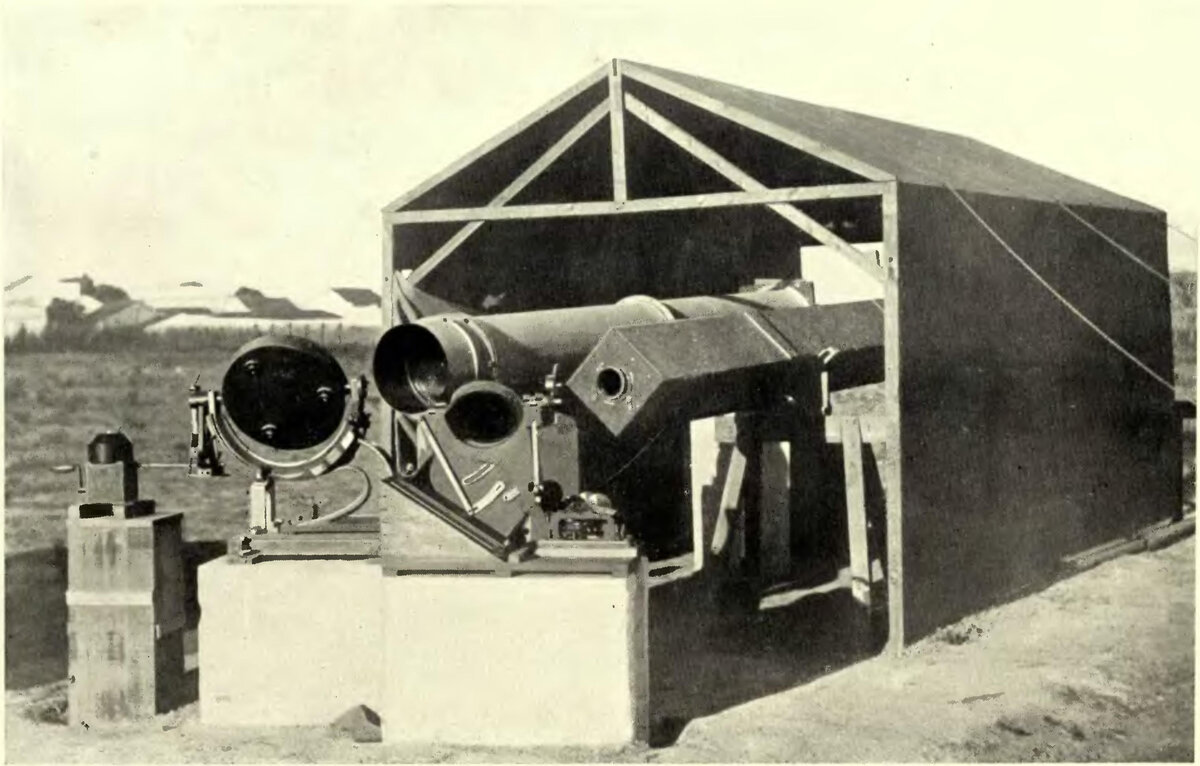
Sobral, 29 May 1919
The eclipse of 29 May 1919 was ideal: the Sun would be in front of a group of bright stars, the Hyades. The path of totality crossed northern Brazil and the coast of Africa. The Royal Astronomical Society sent two expeditions: Arthur Eddington went to the island of Príncipe, in the Gulf of Guinea, and Andrew Crommelin and Charles Davidson went to Sobral, in Ceará. Astronomers from the National Observatory in Rio de Janeiro were also in Sobral, to study the solar corona.
On Príncipe it rained in the morning, and the clouds only parted in the middle of the eclipse; the photos came out faint. In Sobral the sky cleared in time. The 5 minutes of totality produced the best plates, and the deflection measured was about $1.98''$, with an uncertainty of about $0.12''$. Together with the Príncipe data, $1.61''$, the results lay close to Einstein’s value and far from half of it, $0.87''$, which was expected from a Newton-style calculation.
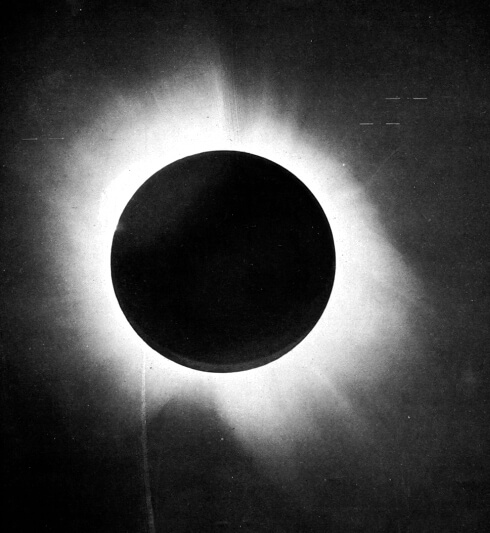
On 6 November 1919, at a joint meeting of the Royal Society and the Royal Astronomical Society in London, under a portrait of Newton, the Astronomer Royal Frank Dyson announced that light was bent as Einstein had predicted. The next day newspapers all over the world were talking about the man who had overthrown Newton. Six years later, in Rio de Janeiro, Einstein thanked the sky of Brazil.
Time bends too
General relativity also predicts that time passes more slowly where gravity is stronger. Near the Earth’s surface, a clock runs slow compared with another one higher up. On GPS satellites, 20,000 km up, the clocks gain about 45 microseconds a day because they are farther from the Earth, and lose about 7 because of their speed. The balance, 38 microseconds a day, is corrected on the satellites. Without the correction, the position error would grow by about 11 km a day.
Exercise: what would be the deflection of a ray of light grazing Jupiter, with GM ≈ 1.27 × 10¹⁷ m³/s² and a radius of 7.0 × 10⁷ m?
A hundred times less than at the Sun. This deflection was measured in 2002, with radio telescopes, when Jupiter passed in front of a quasar.
Exercise: 38 microseconds a day is what fraction of a day? And how far does light travel in that time?
A day has $86{,}400$ s, so the fraction is $\frac{38\times10^{-6}}{86\,400}\approx4.4\times10^{-10}$, less than half a billionth. In 38 microseconds light travels $3\times10^8\cdot38\times10^{-6}\approx11{,}400$ m. Since GPS works out distances from the time the signal takes, an error of half a billionth becomes more than 11 km.
Sources: F. W. Dyson, A. S. Eddington and C. Davidson, “A determination of the deflection of light by the Sun’s gravitational field”, Philosophical Transactions of the Royal Society A 220 (1920) · Ildeu de Castro Moreira and Antonio Augusto Passos Videira (eds.), Einstein e o Brasil (Editora UFRJ, 1995) · Einstein Online, general relativity.
All topics on Albert Einstein · ← E = mc²: the energy hidden in mass · The legacy of Albert Einstein →