
Euler's Eyes
2026-11-05
MEXT 2024 – Mathematics (Specialized Training College) solved
Source: MEXT / Study in Japan – Mathematics paper and official answers (mathematics is on the last page). Files on the past exams page.
This is the Mathematics exam for scholarship applicants to specialized training colleges (専修学校, senmon gakkō: two- to three-year vocational courses). It lasts 60 minutes and has four fill-in questions. The statements below follow the original English.
Answer key
| Item | Topic | Answer |
|---|---|---|
| 1 (1) | Special product | $-1$ |
| 1 (2) | Absolute values with $\pi$ | $2$ |
| 1 (3) | Sum of trigonometric squares | $2$ |
| 1 (4) | Linear system | $x = 3$, $y = -2$ |
| 1 (5) | Quadratic inequality | $-3 < x < 5$ |
| 2 | Committees of four | $715$; $280$; $640$ |
| 3 (1) | Exponential equation | $1$ and $2$ |
| 3 (2) | Logarithmic equation | $9$ |
| 3 (3) | Binomial coefficient | $1080$ |
| 3 (4) | Value, derivative and integral | $45$; $20$; $3$ |
| 4 | Vectors in the plane | $(7, -2)$; $\frac72$, $2$; $2$ |
Question 1: five short items
Item (1)
Statement. $(x - 1)(x + 1)(x^2 + 1)(x^4 + 1) = x^8 + \boxed{\phantom{0}}$.
Solution. The difference of squares applies three times in a row: $(x - 1)(x + 1) = x^2 - 1$, then $(x^2 - 1)(x^2 + 1) = x^4 - 1$ and $(x^4 - 1)(x^4 + 1) = x^8 - 1$.
Answer: $-1$.
Item (2)
Statement. $|\pi - 4| + |\pi - 2| = \boxed{\phantom{0}}$.
Solution. Since $2 < \pi < 4$, $|\pi - 4| = 4 - \pi$ and $|\pi - 2| = \pi - 2$. The sum is $2$.
Answer: $2$.
Item (3)
Statement. For every real $\theta$, $(\sin\theta + \cos\theta)^2 + (\sin\theta - \cos\theta)^2 = \boxed{\phantom{0}}$.
Solution. Expanding, the terms $\pm2\sin\theta\cos\theta$ cancel, leaving $2(\sin^2\theta + \cos^2\theta) = 2$.
Answer: $2$.
Item (4)
Statement. Solve the system $3x + y = 7$, $x - 4y = 11$.
Solution. From the first, $y = 7 - 3x$. Substituting into the second: $x - 28 + 12x = 11$, $13x = 39$, $x = 3$, and $y = 7 - 9 = -2$. (Check: $3 - 4(-2) = 11$.)
The official key prints “2” in the blank for $y$ (also accepting “$y = -2$”); the correct value is $-2$.
Answer: $x = 3$ and $y = -2$.
Item (5)
Statement. Solve $x^2 - 2x - 15 < 0$.
Solution. $x^2 - 2x - 15 = (x - 5)(x + 3)$. The parabola opens upward, so it is negative between the roots.
Answer: $-3 < x < 5$.
Question 2: choosing four people
Statement. There are eight boys and five girls, and we choose four of them.
- How many choices are there?
- How many have exactly two boys and two girls?
- How many have at least one boy and at least one girl?
Solution.
1. There are 13 people: $\binom{13}{4} = \frac{13\cdot12\cdot11\cdot10}{24} = 715$.
2. Choose the boys and the girls separately: $\binom82\binom52 = 28\cdot10 = 280$.
3. By complement: remove the all-boy choices, $\binom84 = 70$, and the all-girl ones, $\binom54 = 5$. That leaves $715 - 70 - 5 = 640$.
Answer: $715$; $280$; $640$.
Question 3: equations, the binomial theorem and calculus
Item (1)
Statement. Solve $2^{2x} - 6\cdot2^x + 8 = 0$.
Solution. With $t = 2^x$: $t^2 - 6t + 8 = (t - 2)(t - 4) = 0$. So $2^x = 2$ or $2^x = 4$, that is, $x = 1$ or $x = 2$.
Answer: $x = 1$ and $x = 2$.
Item (2)
Statement. Solve $\log_2(x - 1) = 3$.
Solution. $x - 1 = 2^3 = 8$, so $x = 9$ (and $x - 1 > 0$, as required).
Answer: $x = 9$.
Item (3)
Statement. What is the coefficient of $x^2$ in $(2x + 3)^5$?
Solution. The $x^2$ term is $\binom52(2x)^2\,3^3 = 10\cdot4\cdot27\,x^2 = 1080\,x^2$.
Answer: $1080$.
Item (4)
Statement. Let $f(x) = 6x^2 - 4x + 3$. Compute $f(3)$, $f'(2)$ and $\int_0^1 f(x)\,dx$.
Solution.
- $f(3) = 54 - 12 + 3 = 45$.
- $f'(x) = 12x - 4$, so $f'(2) = 20$.
- $\int_0^1(6x^2 - 4x + 3)\,dx = \left[2x^3 - 2x^2 + 3x\right]_0^1 = 2 - 2 + 3 = 3$.
Answer: $45$; $20$; $3$.
Question 4: vectors in the plane
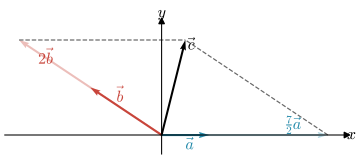
Statement. Let $\vec a = (2, 0)$, $\vec b = (-3, 2)$ and $\vec c = (1, 4)$.
- Compute $2\vec a - \vec b$.
- Write $\vec c$ as a linear combination of $\vec a$ and $\vec b$.
- Compute the dot product $\vec a\cdot\vec c$.
Solution.
1. $2\vec a - \vec b = (4, 0) - (-3, 2) = (7, -2)$.
2. We want $s\vec a + t\vec b = (2s - 3t,\ 2t) = (1, 4)$. The second coordinate gives $t = 2$, and the first, $2s - 6 = 1$, $s = \frac72$. So $\vec c = \frac72\vec a + 2\vec b$.
3. $\vec a\cdot\vec c = 2\cdot1 + 0\cdot4 = 2$.
Answer: $(7, -2)$; $\vec c = \frac72\vec a + 2\vec b$; $2$.