
Euler's Eyes
2026-09-26
ENEM 2023 – Solved mathematics: questions 151 to 165
Source: INEP – proof and template of the 2nd day, Notebook 5 – Yellow.
The ENEM Mathematics and Technologies test 2023 was administered on the 2nd day and will from question 136 to 180. This post addresses questions 151 to 165. The numbering used here is that of the Notebook 5 – Yellow; us In other notebooks the same questions appear in a different order.
Template
| Question | Subject | Template |
|---|---|---|
| 151 | Percentage: daycare waiting list | B |
| 152 | Sequences: pentagonal numbers | E |
| 153 | Periodic functions: Ferris wheel | A |
| 154 | Scatter and percentage plot | B |
| 155 | Profit, revenue and cost | D |
| 156 | Exponential growth | D |
| 157 | Multiplicative principle and probability | A |
| 158 | Conditional probability in steps | A |
| 159 | Geometric progression | D |
| 160 | Quadratic function: minimum value | D |
| 161 | Percentage and algebraic expression | A |
| 162 | Graph reading (parametric curve) | B |
| 163 | Logarithms: sound level in decibels | B |
| 164 | Volume of cone, frustum and cylinder | B |
| 165 | Weighted average | C |
Question 151: New rooms for the daycare center (percentage)
Statement
In January last year, the management of a factory opened a daycare center for children of its employees, with 10 rooms, each with the capacity to serve 10 children each year. Vacancies are drawn among employees’ children. registered, while those not included in the draw form a waiting list. Last year, the waiting list had 400 names, and this year, that number grew 10%.
The factory management carried out a survey and found that the waiting list for next year there will be the same number of names on this year’s waiting list. year. He then decided to build, throughout that year, new rooms for the daycare center, also with capacity for 10 children each, so that the number of names on the waiting list next year will be 25% lower than this year.
The minimum number of rooms that must be built is
- A) 10.
- B) 11.
- C) 13.
- D) 30.
- E) 33.
Resolution
1. This year’s waiting list. 400 increased by 10%:
$$400 \cdot 1{,}10 = 440 \text{ nomes}$$2. Target for next year. Without new rooms, the list would be 440 again. A goal is 25% less:
$$440 \cdot 0{,}75 = 330 \text{ nomes}$$3. Extra children that need to be taken care of. $440 - 330 = 110$ children.
4. Rooms. Each new room serves 10 children:
$$\frac{110}{10} = 11 \text{ salas}$$Answer: alternative B (11 rooms).
Beware of the gotcha: alternative A (10) uses 400 instead of 440, forgetting the increase of 10% ($400 \cdot 0{,}25 = 100$). And alternative E (33) divides by 10 the final size of the list (330), when the new rooms need to absorb is the reduction of the list, 110 names.
To review, see Percentage Basics.
Question 152: The eighth pentagonal number
Statement
Pentagonal figurative numbers were probably introduced by Pythagoreans around the 5th century BC. The figures illustrate how to obtain the six first of them, the others being obtained following the same geometric pattern.
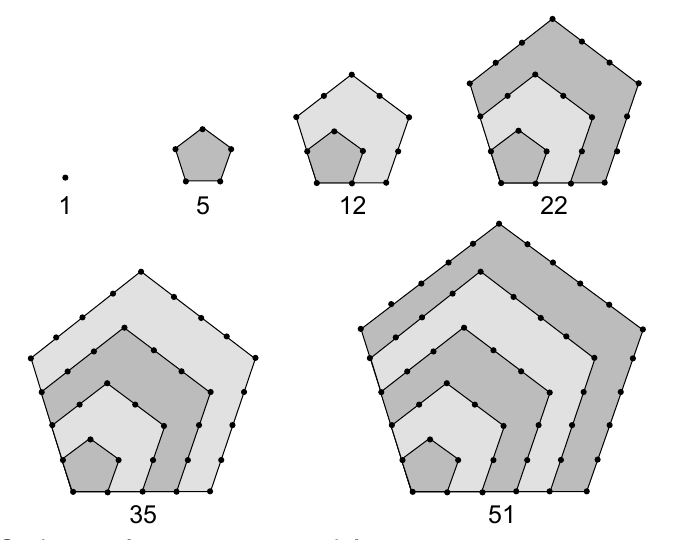
The eighth pentagonal number is
- A) 59.
- B) 83.
- C) 86.
- D) 89.
- E) 92.
Resolution
1. Differences between terms. The first six numbers are 1, 5, 12, 22, 35, 51. The differences between neighboring terms are
$$4, \quad 7, \quad 10, \quad 13, \quad 16$$They grow from 3 to 3 (forming a PA of ratio 3). This makes sense in the figure: each new “layer” has 3 new sides, and each side has one more point than in the previous layer.
2. Continue pattern. The next differences are 19 and 22:
- 7th number: $51 + 19 = 70$;
- 8th number: $70 + 22 = 92$.
3. Checking with the formula. The $n$-th pentagonal number is $P_n = \frac{n(3n - 1)}{2}$. For $n = 8$: $P_8 = \frac{8 \cdot 23}{2} = 92$.
Answer: alternative E (92).
Be careful with the catch: the sequence 1, 5, 12, 22, 35, 51 is not a SHOVEL; the differences between the terms are what form a PA. Also remember that 51 is the sixth number: two steps left until the eighth.
To review, see Arithmetic Progression and Geometry with sequences of numbers.
Question 153: Height on the Ferris wheel (periodic function)
Statement
The figure illustrates a Ferris wheel at the exact moment the chair on which it sits find the person $P$ is at the highest point of this Ferris wheel.
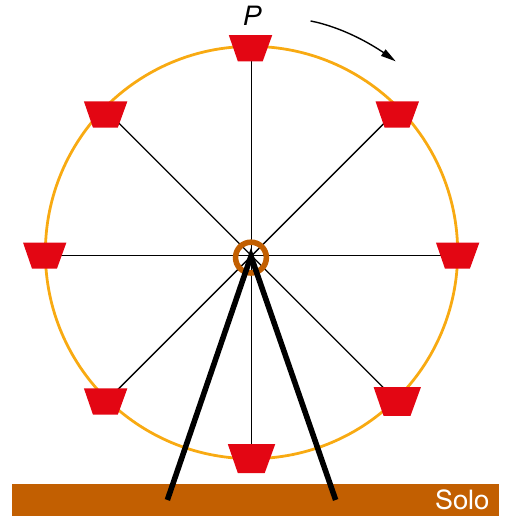
Over time, as the Ferris wheel rotates, with angular velocity constant and clockwise, the height of the chair where the person is $P$, in relation to the ground, changes.
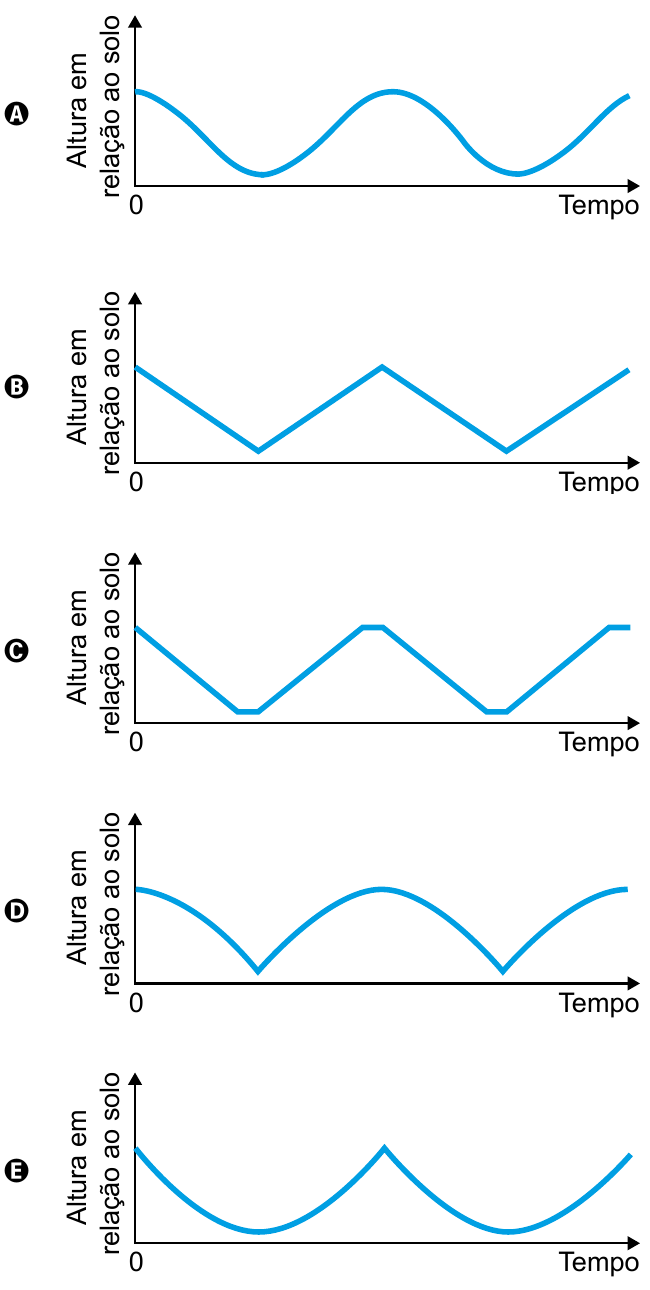
The graph that best represents the variation in this height, as a function of time, counted from the moment the person’s chair $P$ is in the highest position of the Ferris wheel, it is
Resolution
1. Height as a function of angle. It is $h_c$ the height of the wheel center and $R$ the radius. If the chair turned an angle $\theta$ from the highest point, its height is
$$h = h_c + R\cos\theta$$As the angular velocity is constant, $\theta$ increases proportionally to the time: $\theta = \omega t$. Then $h(t) = h_c + R\cos(\omega t)$, a curve cosineoid.
2. Chart characteristics.
- starts at the maximum value (at $t = 0$ the chair is at the top);
- it is smooth, without “peaks”: near the top and near the bottom the height varies slowly (the chair is moving almost horizontally), and close to the height of the center it varies quickly;
- It is symmetrical: it goes up the same way it goes down, and repeats the shape with each turn.
3. Eliminate the alternatives. B and C are formed by straight segments (the height would always change at the same speed, and C still has stopped sections). D has nozzles at minimum and E has nozzles at maximum; At no point on the wheel does the height change abruptly. Only graph A is the smooth cosine curve.
Answer: alternative A.
Question 154: Mass below average and height above average
Statement
A teacher, to promote student learning in statistics, proposed an activity. The objective was to verify the percentage of students with body mass below the average and height above the average of a group of students. To do this, using a scale and a measuring tape, he evaluated a sample of ten students, recording the observed measurements. The graph shows the body mass, in kilograms, and height, in meters, obtained during the activity.
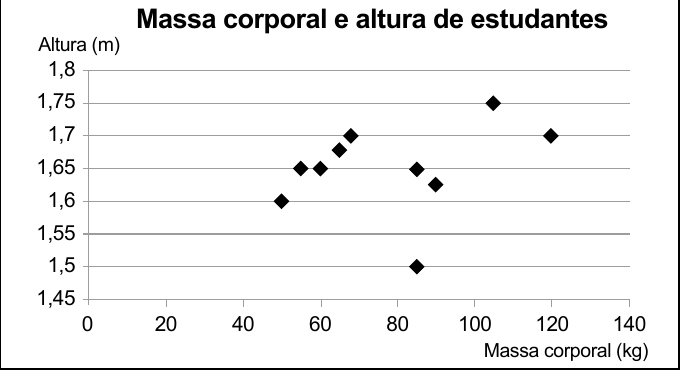
After collecting the data, the students calculated the average of the values obtained, referring to body mass and height, obtaining, respectively, 80 kg and 1,65 m.
What is the percentage of students in this sample with body mass below the average and above average height?
- A) 10
- B) 20
- C) 30
- D) 50
- E) 70
Resolution
1. Assemble the region we are looking for. We want points with a mass less than 80 kg (to the left of 80 on the horizontal axis) e height greater than 1,65 m (above from the line of 1,65).
2. Look at the points with masses below 80 kg. There are five points, with masses around 50, 55, 60, 65 and 68 kg:
- 50 kg: height 1,60 m (below 1,65);
- 55 kg and 60 kg: height exactly 1,65 m (not above average);
- about 65 kg: height just above 1,65 m ✔;
- about 68 kg: height 1,70 m ✔.
3. Percentage. There are 2 students in 10:
$$\frac{2}{10} = 20\%$$Answer: alternative B (20%).
Be careful with the catch: the two points that are on the 1,65 m are equal in height to the average, not above. Counting them leads to 40%, which isn’t even alternative; counting only those to the left of 80 kg leads to 50% (D).
To review, see Position Measurements.
Question 155: How many helpers should the fisherman hire
Statement
A fisherman has a fixed daily cost of R$ 900.00 with fuel, bait, maintenance of your boat and other small expenses. He sells every kilogram of fish for R$5.00. Your goal is to make a minimum profit of R$800.00 per day. Alone, he manages, at the end of a day’s work, to catch 180 kg of fish, which is just enough to cover the daily fixed cost. Therefore, you need hire helpers, paying each one R$ 250.00 per day of work. Beyond of this amount, 4% of the revenue obtained from the sale of fish is shared equally among the helpers. Considering the size of his boat, he can hire up to 5 helpers. He knows that with a helper the daily catch is 300 kg and that, starting from the second hired helper, the amount of fish caught by a helper on a working day.
The minimum number of helpers this fisherman needs to hire to achieving the desired daily profit is
- A) 1.
- B) 2.
- C) 3.
- D) 4.
- E) 5.
Resolution
1. Fishing with $k$ helpers. With 1 helper they are 300 kg, and each helper plus add 100 kg:
$$Q = 300 + 100(k - 1) \text{ kg}$$2. Profit. Revenue is $5Q$. The costs are the fixed cost (900), the daily ($250k$) and 4% of the revenue divided between the helpers ($0{,}04 \cdot 5Q$). Then
$$L = 5Q - 0{,}04 \cdot 5Q - 900 - 250k = 4{,}8Q - 900 - 250k$$3. Test the values of $k$.
| Helpers $k$ | Fishing $Q$ (kg) | Profit (R$) |
|---|---|---|
| 1 | 300 | $1440 - 900 - 250 = 290$ |
| 2 | 400 | $1920 - 900 - 500 = 520$ |
| 3 | 500 | $2400 - 900 - 750 = 750$ |
| 4 | 600 | $2880 - 900 - 1000 = 980$ |
With 3 helpers the profit (R$ 750,00) still does not reach R$ 800,00; with 4 helpers passes (R$ 980,00).
Answer: alternative D (4 helpers).
Be careful with the trick: who forgets the 4% of revenue paid to helpers calculates, with 3 helpers, $2500 - 900 - 750 = 850 \geq 800$ and marks C.
Question 156: Larvae that multiply by 10 (exponential)
Statement
A farmer is informed about a method of protecting his crops that consists of inserting specific, rapid-reproducing larvae. The reproduction of these larvae causes their population to multiply by 10 every 3 days and, To avoid possible imbalances, it is possible to stop this reproduction applying a product X. The farmer decides to start this method with 100 larvae and has 5 liters of product exactly 1 liter for each population of 200 000 larvae. The total amount of product X available to him must be applied once.
How many days after starting this method should the farmer apply product X?
- A) 2
- B) 4
- C) 6
- D) 12
- E) 18
Resolution
1. Population that 5 liters treat. Exactly 1 liter for each 200 000 larvae:
$$5 \cdot 200\thinspace 000 = 1\thinspace 000\thinspace 000 = 10^6 \text{ larvas}$$2. Growth. Starting with $100 = 10^2$ larvae and multiplying by 10 the every 3 days:
| Days | 0 | 3 | 6 | 9 | 12 |
|---|---|---|---|---|---|
| Larvae | $10^2$ | $10^3$ | $10^4$ | $10^5$ | $10^6$ |
In formula: $10^2 \cdot 10^{t/3} = 10^6 \Rightarrow \frac{t}{3} = 4 \Rightarrow t = 12$.
Answer: alternative D (12 days).
Be careful with the catch: alternative B (4) is the number of multiplications by 10, not the number of days. Each multiplication takes 3 days.
Question 157: Which password is hardest to guess
Statement
When registering on an investment application, the user who created a password, being allowed to use only the following characters:
- digits from 0 to 9;
- 26 lowercase letters of the alphabet;
- 26 capital letters of the alphabet;
- 6 special characters !, @, #, $, *, &.
Three types of password structures were presented to the user:
- type I: formed by any four distinct characters, chosen from those allowed;
- type II: formed by five distinct characters, starting with three letters, followed by a number and, at the end, a special character;
- type III: formed by six distinct characters, starting with two letters, followed by two numbers and, at the end, two special characters.
Consider $p_1$, $p_2$ and $p_3$ the probabilities of discovering each other by chance, in the first attempt, passwords of types I, II and III, respectively.
Under these conditions, the type of password that has the least probability of being discovered by chance, on the first attempt, is the
- A) type I, because $p_1 < p_2 < p_3$.
- B) type I, as it has fewer characters.
- C) type II, as it has a greater number of letters.
- D) type III, because $p_3 < p_2 < p_1$.
- E) type III, as it has a greater number of characters.
Resolution
The probability of getting it right on the first try is $\frac{1}{N}$, where $N$ is the number of possible passwords. The more passwords, the lower the probability.
1. Available characters. $10 + 26 + 26 + 6 = 68$ characters, being $52$ letters.
2. Count passwords (multiplicative principle, without repeating characters).
- type I: $N_1 = 68 \cdot 67 \cdot 66 \cdot 65 = 19\thinspace 545\thinspace 240$;
- type II: $N_2 = \underbrace{52 \cdot 51 \cdot 50}_{\text{letras}} \cdot \underbrace{10}_{\text{algarismo}} \cdot \underbrace{6}_{\text{especial}} = 7\thinspace 956\thinspace 000$;
- type III: $N_3 = \underbrace{52 \cdot 51}_{\text{letras}} \cdot \underbrace{10 \cdot 9}_{\text{algarismos}} \cdot \underbrace{6 \cdot 5}_{\text{especiais}} = 7\thinspace 160\thinspace 400$.
3. Compare. $N_1 > N_2 > N_3$, then
$$p_1 = \frac{1}{N_1} < p_2 = \frac{1}{N_2} < p_3 = \frac{1}{N_3}$$Type I password is the most difficult to discover.
Answer: alternative A.
Be careful with the catch: more characters alone does not mean more security (alternative E). Type III has 6 characters, but the positions are very restricted (only 10 digits and 6 special); type I has 4 characters, but each can be any of 68.
Question 158: Draw with two ballot boxes (probability)
Statement
In a public school, admission to the first year is by lottery. This year there are 55 candidates, whose applications are numbered 01 to 55. The draw for each registration number will be carried out in stages, using two ballot boxes. From In the first ballot box, a ball will be drawn from among balls numbered from 0 to 9, which will represent the digit of the units of the registration number to be drawn and, then, from the second ballot box, a ball will be drawn to represent the number of the tens of that number. After the first draw, and before drawing the tens digit, the balls that will be present in the second urn will be only those whose numbers form, with the digit already drawn, a number of 01 to 55.
The probabilities of candidate registration numbers 50 and 02 being drawn are, respectively,
- A) $\frac{1}{50}$ e $\frac{1}{60}$
- B) $\frac{1}{50}$ e $\frac{1}{50}$
- C) $\frac{1}{50}$ e $\frac{1}{10}$
- D) $\frac{1}{55}$ e $\frac{1}{54}$
- E) $\frac{1}{100}$ e $\frac{1}{100}$
Resolution
In each case: probability of drawing the correct units digit times the probability of then drawing the correct ten.
1. Registration 50. Unit 0: probability $\frac{1}{10}$. Numbers from 01 to 55 ending in 0: 10, 20, 30, 40, 50. The second urn has 5 balls (1, 2, 3, 4, 5), and the chance of getting 5 is $\frac{1}{5}$:
$$P(50) = \frac{1}{10} \cdot \frac{1}{5} = \frac{1}{50}$$2. Registration 02. Unit 2: probability $\frac{1}{10}$. Numbers from 01 to 55 ending in 2: 02, 12, 22, 32, 42, 52. The second urn has 6 balls (0 to 5), and the chance of getting 0 is $\frac{1}{6}$:
$$P(02) = \frac{1}{10} \cdot \frac{1}{6} = \frac{1}{60}$$Answer: alternative A ($\frac{1}{50}$ and $\frac{1}{60}$).
Be careful with the catch: the draw is not equiprobable between 55 candidates (alternative D would be the case of a single ballot box). The numbers that ending in 0 divide the chance between only 5 candidates, and those ending in 1 5 divide between 6.
To review, see Introduction to Probability.
Question 159: Light in the depth of the river (geometric progression)
Statement
The diagram shows how the light intensity decreases with increasing depth in a river, with $L_0$ being the intensity at its surface.
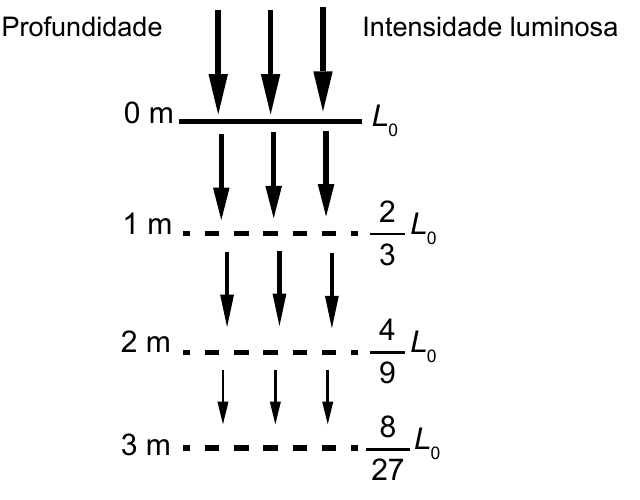
Consider that the light intensity decreases with each meter added to the depth, according to the same pattern as the scheme.
The luminous intensity corresponding to the depth of 6 m is equal to
- A) $\frac{1}{9} L_0$
- B) $\frac{16}{27} L_0$
- C) $\frac{32}{243} L_0$
- D) $\frac{64}{729} L_0$
- E) $\frac{128}{2\thinspace 187} L_0$
Resolution
1. Find the pattern. From one meter to the next, the intensity is multiplied by $\frac{2}{3}$:
$$L_0 \to \frac{2}{3}L_0 \to \frac{4}{9}L_0 \to \frac{8}{27}L_0$$It is a geometric progression of ratio $\frac{2}{3}$. At depth $n$ meters:
$$L(n) = \left(\frac{2}{3}\right)^n L_0$$2. Depth of 6 m.
$$L(6) = \left(\frac{2}{3}\right)^6 L_0 = \frac{64}{729} L_0$$Answer: alternative D ($\frac{64}{729} L_0$).
Beware of the catch: alternative E is $\left(\frac{2}{3}\right)^7$ and C is $\left(\frac{2}{3}\right)^5$: “one more / one less” errors. In surface (0 m) the exponent is 0, then the 6 m the exponent is 6.
Question 160: Lowest daily amount (quadratic function)
Statement
Analyzing a company’s sales, the manager concluded that the daily amount collected, in thousands of reais, could be calculated by the expression $V(x) = \frac{x^2}{4} - 10x + 105$, where the values of $x$ represent the days of the month, ranging from 1 to 30.
One of the factors to evaluate the company’s monthly performance is to check what the lowest daily amount $V_0$ collected throughout the month and classify the performance according to the categories presented below, in which the quantities are expressed in thousands of reais.
- Great: $V_0 \geq 24$
- Good: $20 \leq V_0 < 24$
- Normal: $10 \leq V_0 < 20$
- Bad: $4 \leq V_0 < 10$
- Bad: $V_0 < 4$
In the case analyzed, what would be the company’s performance classification?
- A) Great.
- B) Good.
- C) Normal.
- D) Bad.
- E) Terrible.
Resolution
$V$ is a 2nd degree function with a positive coefficient of $x^2$ ($a = \frac{1}{4}$), then its parabola has concavity upwards and the smaller ** value is at the vertex**.
1. Vertex abscissa.
$$x_v = -\frac{b}{2a} = -\frac{-10}{2 \cdot \frac{1}{4}} = \frac{10}{\frac{1}{2}} = 20$$Day 20 is between 1 and 30, so the minimum occurs within the month.
2. Minimum value.
$$V_0 = V(20) = \frac{400}{4} - 200 + 105 = 100 - 200 + 105 = 5$$3. Sort. $4 \leq 5 < 10$: Poor performance.
Answer: alternative D (Bad).
Beware of the catch: the initial value $V(0) = 105$ or $V(1) = 95{,}25$ are high and may lead one to think “Great”, but the criterion is the smallest amount for the month.
To review, see 2th degree equation.
Question 161: Blood alcohol concentration
Statement
Driving after drinking alcoholic beverages is an extremely dangerous attitude, a since, from the first dose onwards, the person already begins to experience loss of sensitivity of movements and reflexes. Although the elimination and absorption of alcohol depends on each person and how the body can metabolize the substance, at the end of the first hour after ingestion, the alcohol concentration ($C$) in the blood corresponds to approximately 90% of the amount ($q$) of alcohol ingested, and the total elimination of this concentration can take up to 12 hours.
Available on: http://g1.globo.com. Accessed on: 1 Dec. 2018 (adapted).
Under these conditions, at the end of the first hour after ingesting the quantity $q$ of alcohol, the concentration $C$ of this substance in the blood is expressed algebraically by
- A) $C = 0{,}9q$
- B) $C = 0{,}1q$
- C) $C = 1 - 0{,}1q$
- D) $C = 1 - 0{,}9q$
- E) $C = q - 10$
Resolution
“$C$ matches 90% of $q$” directly translates:
$$C = 90\% \cdot q = \frac{90}{100} q = 0{,}9q$$Answer: alternative A ($C = 0{,}9q$).
Be careful with the catch: alternative B ($0{,}1q$) would be the part that is not in the blood (the remaining 10%). And “90% of $q$” is a multiplication, not a subtraction as in C, D and E.
To review, see Percentage Basics.
Question 162: When cryptocurrency A was worth more than B
Statement
A beginning investor observed the graph that shows the evolution of values of two cryptocurrencies A and B in relation to time.
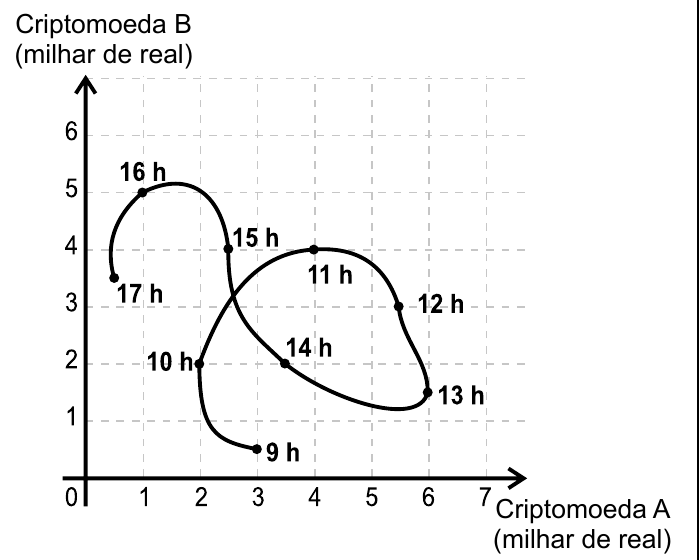
During consecutive hours, these values were observed in nine instants, represented by exact hours.
In how many of these moments was cryptocurrency A more valued than cryptocurrency cryptocurrency B?
- A) 3
- B) 4
- C) 6
- D) 7
- E) 9
Resolution
Here the graph does not have time on the horizontal axis. Each point marked is a instant: the horizontal coordinate is the value of cryptocurrency A and the vertical coordinate is the value of cryptocurrency B (both in thousands of reais). A is more valued when the horizontal coordinate is greater than the vertical one.
1. Read the nine points.
| Time | A (thousand) | B (thousand) | A > B? |
|---|---|---|---|
| 9 h | 3 | 0,5 | Yes |
| 10 h | 2 | 2 | not (equal) |
| 11 h | 4 | 4 | not (equal) |
| 12 h | 5,5 | 3 | Yes |
| 13 h | 6 | 1,5 | Yes |
| 14 h | 3,5 | 2 | Yes |
| 15 h | 2,5 | 4 | no |
| 16 h | 1 | 5 | no |
| 17 h | 0,5 | 3,5 | no |
2. Count. A was worth more than B at 9 h, 12 h, 13 h and 14 h: 4 instants.
A visual way: draw the line $B = A$ (the diagonal that passes through (1, 1), (2, 2)…). The points below it are the instants with A > B.
Answer: alternative B (4).
Be careful with the catch: at 10 h and 11 h the values are equal (the points are on the diagonal). “More valued” requires inequality strict; counting them gives 6 (alternative C).
Question 163: Sound level of the new machine (logarithms)
Statement
Exposure to some sound levels can cause hearing damage. Therefore, in an industry, preventive measures are adopted according to the machine that the employee operates and the level $N$ of sound intensity, measured in decibel (dB), the that the worker is exposed, being $N = \log_{10} I^{10} - \log_{10} I_0^{10}$, $I$ the sound intensity and $I_0 = 10^{-12}$ W/m².
Available at: www.sofisica.com.br. Accessed on: 8 Jul. 2015 (adapted).
When the sound is considered low, i.e. $N = 48$ dB or less, it must be preventive measure I is used. In case the sound is moderate, when $N$ is in the range (48 dB, 55 dB), preventive measure II must be used. When the sound is moderately loud, which is equivalent to $N$ in the range (55 dB, 80 dB), the measurement preventive measure to be used is III. If $N$ is in the range (80 dB, 115 dB), when the sound is considered loud, the IV preventive measure should be used. And if the sound is considered very loud, with $N$ greater than 115 dB, you must use the preventive measure V.
A new machine, with $I = 8 \times 10^{-8}$ W/m², was purchased and will be classified according to the level of noise it produces.
Consider 0,3 as an approximation for $\log_{10} 2$.
The employee who will operate the new machine must adopt preventive measures
- A) I.
- B) II.
- C) III.
- D) IV.
- E) V.
Resolution
1. Simplify the formula. By properties $\log a^n = n \log a$ and $\log a - \log b = \log \frac{a}{b}$:
$$N = 10\log_{10} I - 10\log_{10} I_0 = 10 \log_{10} \frac{I}{I_0}$$2. Ratio of intensities.
$$\frac{I}{I_0} = \frac{8 \times 10^{-8}}{10^{-12}} = 8 \times 10^{4}$$3. Logarithm. As $8 = 2^3$:
$$\log_{10}(8 \times 10^4) = 3\log_{10} 2 + 4 = 3 \cdot 0{,}3 + 4 = 4{,}9$$4. Sound level. $N = 10 \cdot 4{,}9 = 49$ dB.
5. Rate. 49 dB is in the range (48 dB, 55 dB): moderate sound, preventive measure II.
Answer: alternative B (II).
Beware of the catch: 49 is very close to the limit of 48. Who forget the factor 10 of the exponent, find $N = 4{,}9$ and mark the measure I.
To review, see Properties of Logarithms.
Question 164: Mass of the sculpture (cone, trunk and cylinder)
Statement
A visual artist carves a sculpture from a block of hardwood, in stages. Initially, carve a straight cone with 36 cm in height and diameter of the base measuring 18 cm. Then, remove from this cone a smaller cone, whose diameter of the base measures 6 cm, thus obtaining a frustum of a cone, as illustrated in figure.
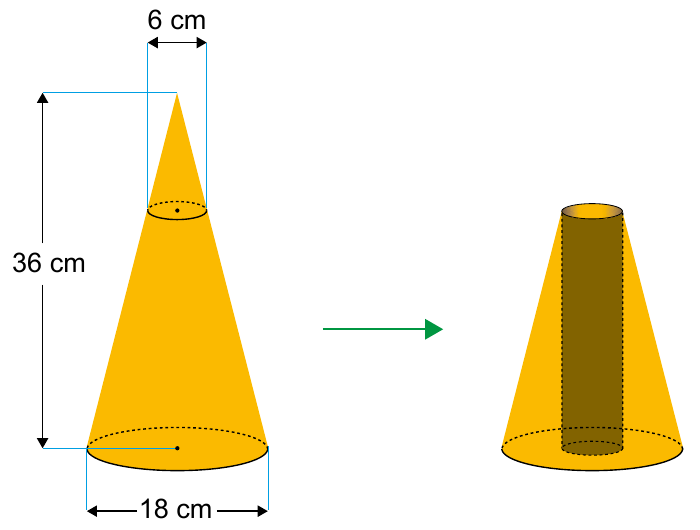
Then, drill this frustum of the cone, removing a straight cylinder, with a diameter 6 cm, whose axis of symmetry is the same as that of the original cone. This way, in the end, the sculpture has the shape of a frustum cone with a cylindrical base perforation the base.
The type of wood used to produce this sculpture has a mass equal to 0,6 g per cubic centimeter of volume. Use 3 as an approximation for $\pi$.
What is the mass, in grams, of this sculpture?
- A) 1 198,8
- B) 1 296,0
- C) 1 360,8
- D) 4 665,6
- E) 4 860,0
Resolution
Cone volume: $V = \frac{1}{3}\pi r^2 h$. Cylinder volume: $V = \pi r^2 h$.
1. Large cone. Radius 9 cm, height 36 cm:
$$V_1 = \frac{1}{3} \cdot 3 \cdot 9^2 \cdot 36 = 81 \cdot 36 = 2\thinspace 916 \text{ cm}^3$$2. Small cone (removed from the top). It is similar to the large cone. The lightning is 3 cm, the third part of 9, so the height is also the third part: 12 cm.
$$V_2 = \frac{1}{3} \cdot 3 \cdot 3^2 \cdot 12 = 108 \text{ cm}^3$$3. Trunk. $V_1 - V_2 = 2\thinspace 916 - 108 = 2\thinspace 808$ cm³, with height $36 - 12 = 24$ cm.
4. Cylindrical hole. Radius 3 cm, crosses the trunk from base to base (height 24 cm):
$$V_3 = 3 \cdot 3^2 \cdot 24 = 648 \text{ cm}^3$$5. Volume and mass of the sculpture.
$$V = 2\thinspace 808 - 648 = 2\thinspace 160 \text{ cm}^3 \qquad m = 2\thinspace 160 \cdot 0{,}6 = 1\thinspace 296 \text{ g}$$Answer: alternative B (1 296,0 g).
Be careful with the catch: alternative C (1 360,8) corresponds to $(2\thinspace 916 - 648) \cdot 0{,}6$: forget to remove the small cone from the top. Another common mistake is to use the hole with height 36 cm instead of 24 cm.
Question 165: Average salaries (weighted average)
Statement
A company’s 100 employees are distributed across two sectors: Production and Administration. Employees in the same sector receive salaries with values equal. The table shows the number of employees per sector and their respective salaries.
| Sector | Number of employees | Salary (in reais) |
|---|---|---|
| Production | 75 | 2 000,00 |
| Administration | 25 | 7 000,00 |
The average salary of 100 employees of this company, in reais, is
- A) 2 000,00.
- B) 2 500,00.
- C) 3 250,00.
- D) 4 500,00.
- E) 9 000,00.
Resolution
Each salary is weighed by the number of employees who receive it (average weighted):
$$\bar{x} = \frac{75 \cdot 2\thinspace 000 + 25 \cdot 7\thinspace 000}{100} = \frac{150\thinspace 000 + 175\thinspace 000}{100} = \frac{325\thinspace 000}{100} = 3\thinspace 250$$Answer: alternative C (R$ 3 250,00).
Be careful with the catch: alternative D (4 500,00) is the simple average $\frac{2\thinspace 000 + 7\thinspace 000}{2}$, which ignores that there are three times more employees in Production. E (9 000,00) is just the sum of the two salaries.
To review, see Position Measurements.