
Euler's Eyes
2026-10-25
Read before you calculate: Bogdanov-Belsky's painting
In 1895 the Russian painter Nikolai Bogdanov-Belsky exhibited a painting called Mental Arithmetic. In the Public School of S. A. Rachinsky. In a village classroom, barefoot peasant boys stare at the blackboard, some with a hand on their chin, one whispering in the teacher’s ear. On the blackboard is written:
$$\frac{10^2 + 11^2 + 12^2 + 13^2 + 14^2}{365}.$$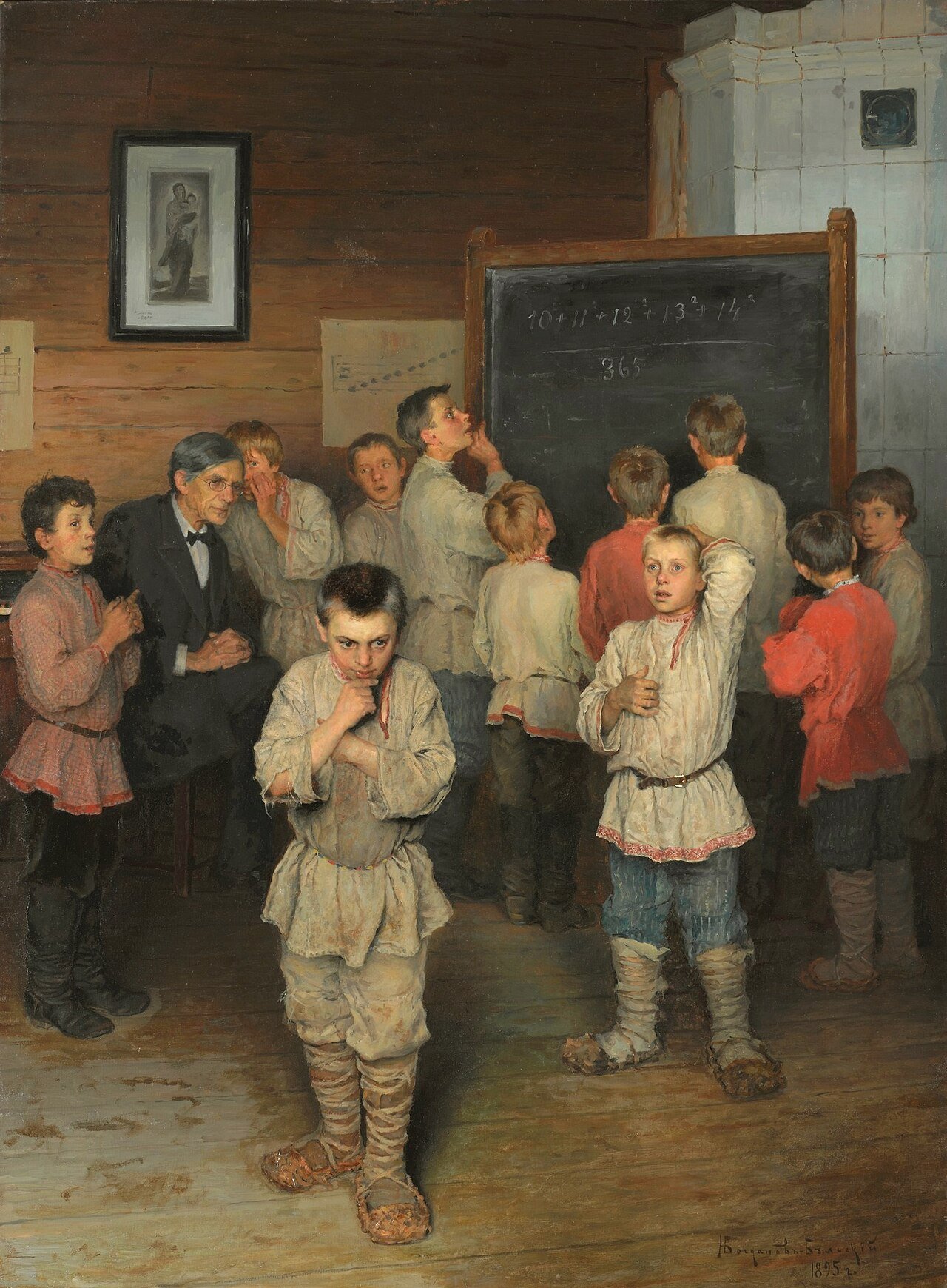
The teacher really existed. Sergei Rachinsky was a professor of botany at Moscow University who gave up his career to teach peasant children in the village of Tatevo, where he had been born. He liked to set sums that looked enormous and had a shortcut. Bogdanov-Belsky himself had been one of his pupils.
The sum that need not be done
Whoever calculates in the order they read has to square five numbers, add three-digit results and divide by $365$. It can be done, but it is long. Whoever looks first notices something else:
$$10^2 + 11^2 + 12^2 = 100 + 121 + 144 = 365, \qquad 13^2 + 14^2 = 169 + 196 = 365.$$The numerator is $365 + 365$, and the answer is $2$. The number $365$ in the denominator was a clue: it warns that the numerator should split into pieces of that size.
The difference between the two paths is not in the ability to calculate. It is in the reading. An expression has a shape: before any calculation, one can see that it is a fraction, that the numerator is a sum of five squares, that the numbers are consecutive. Chapter 2 showed that every formula has a hidden tree; reading well means seeing the tree before climbing it.
The two-faced symbol
For Rachinsky’s boys, $13^2$ is at the same time an instruction (“multiply 13 by 13”) and a thing (the number $169$, which can be added to another). The mathematics educators Eddie Gray and David Tall called this double role a procept, a blend of process and concept, in a 1994 paper. The same sign $3+4$ can be read as “add 3 and 4” or as the number $7$; $\frac{a}{b}$ as “divide” or as a fraction to be compared with others.
According to Gray and Tall, much of the difference between students who progress and those who get stuck lies here. Those who see only the process have to redo everything at each step and drown in long calculations. Those who can treat the symbol as an object can store it, compare it, combine it. The active notation this book talks about is precisely the kind that allows this switch: writing $13^2$ instead of “thirteen times thirteen” turns a task into an object.
By the former is meant what I have always meant by understanding: knowing both what to do and why. Instrumental understanding I would until recently not have regarded as understanding at all. It is what I have in the past described as “rules without reasons”.
— Richard Skemp, “Relational understanding and instrumental understanding” (1976)
In 1976 the English psychologist Richard Skemp separated these two ways of understanding. Instrumental understanding applies the right rule at the right moment and works very well as long as the problem is the usual one. Relational understanding knows where the rule comes from and therefore notices when a shortcut is available, like the $365$ on the blackboard.
Exercise: the next blackboard
The equality $10^2 + 11^2 + 12^2 = 13^2 + 14^2$ has a bigger sister, with four squares on the left and three on the right. Check that $21^2 + 22^2 + 23^2 + 24^2 = 25^2 + 26^2 + 27^2$.
On the left: $441 + 484 + 529 + 576 = 2030$. On the right: $625 + 676 + 729 = 2030$. The family goes on: $36^2+\cdots+40^2 = 41^2+\cdots+44^2$, with five and four squares. A teacher like Rachinsky could write $\frac{21^2+22^2+23^2+24^2+25^2+26^2+27^2}{2030}$ on the board, and the answer would again be $2$.
Exercise: which is the last operation?
Without calculating, say which is the main operation (the last one to be done) in $3 + 4 \cdot 5^2$ and in $(3+4) \cdot 5^2$. Then calculate both.
In the first, the last operation is the addition: $3 + (4 \cdot 25) = 103$. In the second, it is the multiplication: $7 \cdot 25 = 175$. Recognising the main operation means recognising the root of the expression’s tree, and it is the first step towards knowing what can be simplified.
Chapter index · ← Counting, saying and writing numbers · Two languages in one sentence: the mathematics register →