
Euler's Eyes
2026-10-10
Systems of equations: the determinant and Gaussian elimination
To calculate orbits using least squares, Gauss needed to solve systems of equations with many unknowns. Two names that every student knows come from this story: the determinant and the Gaussian elimination.
The determinant. Take a system with two equations:
It all depends on the number $ad - bc$ in the denominator: if it is not zero, the system has a single solution. This number “determines” the system.
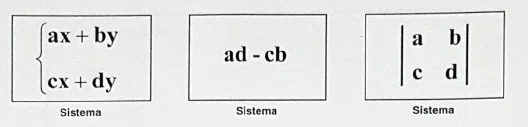
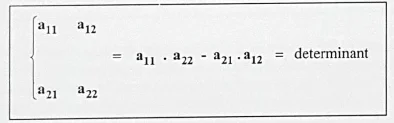
The word first appeared in Gauss’s Disquisitiones, in 1801. He called it determinans the number that decides the properties of a form of the 2nd degree, $ax^2 + 2bxy + cy^2$. In 1815, Frenchman Augustin-Louis Cauchy adopted the term and gave credit:
Gauss used this term to great advantage in his analytical research, to discover the general properties of second-degree forms. I will keep that name.
— Augustin-Louis Cauchy, Journal de l'École Polytechnique, 1815
- 1750Gabriel Cramer solves systems with formulas that we write today with determinants.
- 1801Gauss uses the word determinans in Disquisitiones Arithmeticae.
- 1815Cauchy adopts the term déterminant in today’s sense.
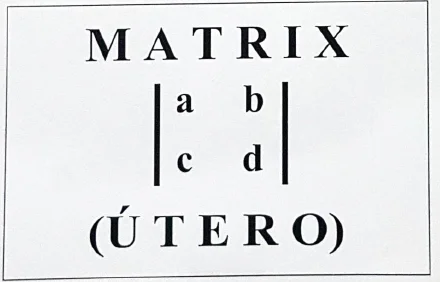
- 1841Arthur Cayley writes the determinant between two vertical bars.
- 1850James Joseph Sylvester creates the word matrix.
Gaussian elimination. With three or more unknowns, the formulas become huge. Gauss’s path It’s about eliminating one unknown at a time, until you’re left with an equation with just one unknown. See with a example:
Eliminating step by step (click to advance)
- Remove $x$ from the 2nd equation: (2nd) − 2·(1st) gives $y - z = -1$.
- Remove $x$ from the 3rd equation: (3rd) − (1st) gives $y + 2z = 8$.
- Remove $y$: subtracting the two new equations, $(y + 2z) - (y - z) = 8 - (-1)$, that is, $3z = 9$ and $z = 3$.
- Go back up: $y - 3 = -1$ gives $y = 2$, and $x + 2 + 3 = 6$ gives $x = 1$.
- Check the 3rd equation: $1 + 2 \cdot 2 + 3 \cdot 3 = 14$. ✓
The method already appeared in a Chinese book almost 2000 years old, The Nine Chapters on the Mathematical Art. Gauss organized it for astronomy calculations, and it is what computers still use today to solve systems with thousands of unknowns.
All topics by Carl Friedrich Gauss · ← The Egregium Theorem and curvature · Gaussian quadrature: integrate with two points →