Euler's Eyes
2026-10-24
Heights, medians, angle bisectors and radii
We will deduce formulas that allow us to calculate the notable segments of a triangle — heights, medians, internal angle bisectors, radii of the inscribed and circumscribed circles — knowing only the measurements of the sides. In all of them, the semiperimeter $p = \frac{a + b + c}{2}$ appears.
The story
The formula for the area on three sides is named after Heron of Alexandria (1st century), who demonstrated it in the Metric, a manual of practical measurements. The Persian mathematician al-Biruni, however, attributed it to Archimedes, two and a half centuries earlier. Heron’s demonstration is purely geometric, with the circumference inscribed; the one we will do here is algebraic, starting from the law of cosines.
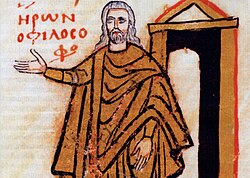
Sources: Heron (MacTutor) · Heron, Metric, book I, proposition 8.
In everyday life
- Area with just a tape measure. A plot of land with sides 13 m, 14 m and 15 m has, according to Heron’s formula, $p = 21$ and area $\sqrt{21 \cdot 8 \cdot 7 \cdot 6} = 84$ m² — without measuring any angle.
- The largest round fountain. On the same land, the largest circular fountain that fits has a radius of $r = \frac{S}{p} = \frac{84}{21} = 4$ m: it is the inscribed circumference.
- One antenna for three cities. The equidistant point of three cities is the center of the circumscribed circle; with sides of 13, 14 and 15 km, it is $R = \frac{abc}{4S} = \frac{2730}{336} \approx 8{,}1$ km from each.
Theory
Heights
TeoremaHeights
$$h_a = \frac{2}{a}\sqrt{p(p - a)(p - b)(p - c)}$$$$h_b = \frac{2}{b}\sqrt{p(p - a)(p - b)(p - c)}$$$$h_c = \frac{2}{c}\sqrt{p(p - a)(p - b)(p - c)}$$View the demo
Let $\overline{CD}$ be the height relative to the side $c$. In the right triangle $ADC$, $h_c = b\operatorname{sen}\hat{A}$; then, using the law of cosines,
$$h_c^2 = b^2(1 - \cos^2\hat{A}) = b^2 - b^2\left(\frac{b^2 + c^2 - a^2}{2bc}\right)^2 = \frac{(2bc)^2 - (b^2 + c^2 - a^2)^2}{4c^2}.$$The numerator is a difference of squares:
$$(2bc + b^2 + c^2 - a^2)(2bc - b^2 - c^2 + a^2) = [(b + c)^2 - a^2][a^2 - (b - c)^2] = (b + c + a)(b + c - a)(a - b + c)(a + b - c).$$Such as $a + b + c = 2p$, $b + c - a = 2(p - a)$, $a - b + c = 2(p - b)$ and $a + b - c = 2(p - c)$:
$$h_c^2 = \frac{16p(p - a)(p - b)(p - c)}{4c^2} = \frac{4p(p - a)(p - b)(p - c)}{c^2}.$$The other two are analogous.
Area: Heron’s formula
TeoremaHeron's formula
$$S = \sqrt{p(p - a)(p - b)(p - c)}$$View the demo
$S = \frac{a h_a}{2} = \frac{b h_b}{2} = \frac{c h_c}{2}$; Substituting any of the heights above, we get the formula.
ExemploThe triangle 13, 14, 15
$p = 21$ and $S = \sqrt{21 \cdot 8 \cdot 7 \cdot 6} = \sqrt{7056} = 84$. The heights are $h_{13} = \frac{168}{13}$, $h_{14} = 12$ and $h_{15} = \frac{56}{5}$.
Medians
TeoremaMedians
$$m_a = \frac{1}{2}\sqrt{2b^2 + 2c^2 - a^2}$$$$m_b = \frac{1}{2}\sqrt{2a^2 + 2c^2 - b^2}$$$$m_c = \frac{1}{2}\sqrt{2a^2 + 2b^2 - c^2}$$View the demo
Let $M$ be the midpoint of $\overline{BC}$. Applying the law of cosines to the triangles $AMB$ and $AMC$, where the angles in $M$ are supplementary (opposite cosines):
$$c^2 = m_a^2 + \frac{a^2}{4} - a\,m_a\cos\theta \qquad b^2 = m_a^2 + \frac{a^2}{4} + a\,m_a\cos\theta.$$Adding, $b^2 + c^2 = 2m_a^2 + \frac{a^2}{2}$, that is, $m_a^2 = \frac{2b^2 + 2c^2 - a^2}{4}$. The others are analogous.
angle bisectors internal
Teoremaangle bisectors internal
$$S_a = \frac{2}{b + c}\sqrt{bcp(p - a)}$$$$S_b = \frac{2}{a + c}\sqrt{acp(p - b)}$$$$S_c = \frac{2}{a + b}\sqrt{abp(p - c)}$$View the demo
Let $\overline{AS}$ be the internal angle bisector of $\hat{A}$, with $S$ in $\overline{BC}$, $x = BS$ and $y = SC$. By the law of sines in triangles $ABS$ and $ACS$, whose angles in $S$ are supplementary (same sine $\operatorname{sen}\theta$):
$$\frac{x}{\operatorname{sen}\frac{\hat{A}}{2}} = \frac{c}{\operatorname{sen}\theta} \qquad \frac{y}{\operatorname{sen}\frac{\hat{A}}{2}} = \frac{b}{\operatorname{sen}\theta} \;\Longrightarrow\; \frac{x}{c} = \frac{y}{b} = \frac{x + y}{b + c} = \frac{a}{b + c},$$the internal angle bisector theorem; logo $x = \frac{ac}{b + c}$. Applying the law of cosines to the triangle $ABS$:
$$S_a^2 = x^2 + c^2 - 2xc\cos\hat{B} = \left(\frac{ac}{b + c}\right)^2 + c^2 - 2\frac{ac}{b + c} \cdot c \cdot \frac{a^2 + c^2 - b^2}{2ac}.$$Reducing to the denominator $(b + c)^2$ and simplifying, the numerator becomes $bc[(b + c)^2 - a^2] = bc(a + b + c)(b + c - a) = 4bcp(p - a)$, where the formula comes from.
Radius of the inscribed circle
TeoremaRadius of the inscribed circle
$$r = \frac{S}{p} = \sqrt{\frac{(p - a)(p - b)(p - c)}{p}}$$$$r = (p - a)\operatorname{tg}\frac{\hat{A}}{2} = (p - b)\operatorname{tg}\frac{\hat{B}}{2} = (p - c)\operatorname{tg}\frac{\hat{C}}{2}$$View the demos
Connecting incenter $I$ to the vertices, we divide $ABC$ into three triangles $ABI$, $ACI$ and $BCI$, all with height $r$:
$$S = \frac{c \cdot r}{2} + \frac{b \cdot r}{2} + \frac{a \cdot r}{2} = \frac{a + b + c}{2} \cdot r = p\,r,$$and with Heron’s formula we obtain the first expression. For the second, let $x$, $y$, $z$ be the tangent segments drawn from $A$, $B$, $C$ (the two tangents of the same vertex are equal). Then $x + y = c$, $y + z = a$, $z + x = b$, and solving the system,
$$x = \frac{b + c - a}{2} = p - a \qquad y = p - b \qquad z = p - c.$$As $I$ is in angle bisector of $\hat{A}$, $\operatorname{tg}\frac{\hat{A}}{2} = \frac{r}{x}$, that is, $r = (p - a)\operatorname{tg}\frac{\hat{A}}{2}$; and in the same way for the other vertices.
Radius of circumscribed circle
TeoremaRadius of circumscribed circle
$$R = \frac{abc}{4S} = \frac{abc}{4\sqrt{p(p - a)(p - b)(p - c)}}$$View the demo
We saw in the previous topic that $S = \frac{abc}{4R}$; just isolate $R$ and use Heron’s formula.
The exercises in this section are numbers 400 to 410 from chapter list.