
Euler's Eyes
2026-11-02
MEXT 2018 – Mathematics (A) solved
Source: MEXT / Study in Japan – Mathematics (A) paper and official answers. Files on the past exams page.
Mathematics (A) is the paper for undergraduate applicants in the humanities. It lasts 60 minutes and has three fill-in questions: each box $\boxed{\text{1-1}}$, $\boxed{\text{1-2}}$, … takes a number or an expression. The statements below follow the original English.
Answer key
| Question | Topic | Answers |
|---|---|---|
| 1 | Eleven short items | see the table in the question |
| 2 | A cubic | $2,\ 3;\ 2 - \sqrt3,\ 2,\ 2 + \sqrt3;\ 0,\ 1$ |
| 3 | Volumes by scaling | $\frac{\pi}{5};\ 3,\ 2;\ 6;\ \frac{6\pi}{5}$ |
Question 1: eleven short items
| Item | Boxes | Answer |
|---|---|---|
| (1) | 1-1, 1-2 | $2263$, $7$ |
| (2) | 1-3 | $\sqrt5 - 1$ |
| (3) | 1-4 | $\frac{\sqrt{15}}{3}$ |
| (4) | 1-5 | $5$ |
| (5) | 1-6 | $2$ |
| (6) | 1-7 | $9$ |
| (7) | 1-8 to 1-12 | $(\frac74, 0)$, $(\frac75, \frac75)$, $\sqrt{17}$ |
| (8) | 1-13 to 1-16 | $1$; $2$, $2$; $4$ |
| (9) | 1-17 to 1-19 | $-3$, $6$, $2$ |
| (10) | 1-20 to 1-23 | $n + 1$, $k$; $n - 1$, $n + 1$ |
| (11) | 1-24 | $20021100110$ |
Item (1)
Statement. Using $\log_{10}3 = 0.4771$ and $\log_{10}7 = 0.8451$, the number of digits of $7^{2677}$ is $\boxed{\text{1-1}}$ and its last digit is $\boxed{\text{1-2}}$.
Solution.
1. $\log_{10}7^{2677} = 2677\cdot 0.8451 = 2262.33\ldots$, so $10^{2262} < 7^{2677} < 10^{2263}$: it has $2263$ digits.
2. The last digits of the powers of 7 repeat with period 4: $7, 9, 3, 1, 7, \dots$ Since $2677 = 4\cdot 669 + 1$, the last digit is the same as that of $7^1$, namely $7$.
Answer: $2263$ and $7$.
Item (2)
Statement. Simplify
$$\frac{1}{1 + \sqrt2} + \frac{1}{\sqrt2 + \sqrt3} + \frac{1}{\sqrt3 + \sqrt4} + \frac{1}{\sqrt4 + \sqrt5}.$$The result is $\boxed{\text{1-3}}$.
Solution. Rationalizing, $\frac{1}{\sqrt k + \sqrt{k + 1}} = \sqrt{k + 1} - \sqrt k$. The sum telescopes: $(\sqrt2 - 1) + (\sqrt3 - \sqrt2) + (\sqrt4 - \sqrt3) + (\sqrt5 - \sqrt4) = \sqrt5 - 1$.
Answer: $\sqrt5 - 1$.
Item (3)
Statement. Let $0 < \theta < \frac\pi4$. If $\sin2\theta = \frac14$, then
$$\frac{\sin\theta + \cos\theta}{-\sin\theta + \cos\theta} = \boxed{\text{1-4}}.$$Solution. $(\cos\theta \pm \sin\theta)^2 = 1 \pm \sin2\theta$, that is, $\frac54$ and $\frac34$. For $0 < \theta < \frac\pi4$, $\cos\theta > \sin\theta > 0$, so both expressions are positive and
$$\frac{\cos\theta + \sin\theta}{\cos\theta - \sin\theta} = \sqrt{\frac{5/4}{3/4}} = \sqrt{\frac53} = \frac{\sqrt{15}}{3}.$$Answer: $\frac{\sqrt{15}}{3}$ (or $\frac{5}{\sqrt{15}}$).
Item (4)
Statement. Let $P_1, \dots, P_6$ be the vertices of a regular hexagon, counterclockwise. A fair die is rolled three times and the results $(i, j, k)$ are recorded. The probability that $P_i, P_j, P_k$ form a triangle is $\dfrac{\boxed{\text{1-5}}}{9}$.
Solution. Three distinct vertices of a regular hexagon are never collinear (they lie on a circle). So we only need $i, j, k$ to be distinct: $\frac{6\cdot5\cdot4}{6^3} = \frac{120}{216} = \frac59$.
Answer: $5$.
Item (5)
Statement. The real solution of $4^x - 2^x - 12 = 0$ is $x = \boxed{\text{1-6}}$.
Solution. With $t = 2^x > 0$: $t^2 - t - 12 = (t - 4)(t + 3) = 0$, so $t = 4$ and $x = 2$.
Answer: $2$.
Item (6)
Statement. In the pyramid $OABC$, the centroids of triangles $OAB$, $OBC$ and $OCA$ are $F$, $G$ and $H$. For the centroid $P$ of triangle $FGH$,
$$\vec{OP} = \frac{2}{\boxed{\text{1-7}}}\left(\vec{OA} + \vec{OB} + \vec{OC}\right).$$Solution. With origin at $O$: $\vec{OF} = \frac{\vec{OA} + \vec{OB}}{3}$, $\vec{OG} = \frac{\vec{OB} + \vec{OC}}{3}$ and $\vec{OH} = \frac{\vec{OC} + \vec{OA}}{3}$. Hence
$$\vec{OP} = \frac{\vec{OF} + \vec{OG} + \vec{OH}}{3} = \frac{2(\vec{OA} + \vec{OB} + \vec{OC})}{9}.$$Answer: $9$.
Item (7)
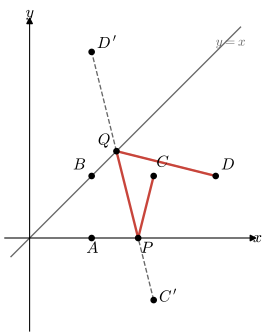
Statement. Let $O$ be the origin and $A(1, 0)$, $B(1, 1)$, $C(2, 1)$, $D(3, 1)$. We start at $C$, pass through a point of line $OA$, then through a point of line $OB$, and arrive at $D$, along the shortest path. The point on line $OA$ is $(\boxed{\text{1-8}}, \boxed{\text{1-9}})$, the one on line $OB$ is $(\boxed{\text{1-10}}, \boxed{\text{1-11}})$, and the length is $\boxed{\text{1-12}}$.
Solution.
1. Reflections. Line $OA$ is the $x$-axis and line $OB$ is $y = x$. Reflect $C$ in the $x$-axis: $C' = (2, -1)$. Reflect $D$ in the line $y = x$: $D' = (1, 3)$. For $P$ on $OA$ and $Q$ on $OB$, $CP + PQ + QD = C'P + PQ + QD' \ge C'D'$.
2. The segment $C'D'$. Parametrizing $(2 - s,\ -1 + 4s)$, $0 \le s \le 1$:
- it crosses the $x$-axis at $s = \frac14$: $P = \left(\frac74, 0\right)$;
- it crosses $y = x$ when $2 - s = -1 + 4s$, $s = \frac35$: $Q = \left(\frac75, \frac75\right)$.
The crossings occur in the right order ($P$ before $Q$), so the path is valid.
3. The length. $C'D' = \sqrt{1^2 + 4^2} = \sqrt{17}$.
Answer: $\left(\frac74, 0\right)$, $\left(\frac75, \frac75\right)$, $\sqrt{17}$.
Item (8)
Statement. The integers $m$ and $n$ satisfy $2|m| + 3|n - 1| \le 7$. The sum $m + n$ is largest at $(m, n) = (3, \boxed{\text{1-13}})$ and $(\boxed{\text{1-14}}, \boxed{\text{1-15}})$, and the maximum is $\boxed{\text{1-16}}$.
Solution. With $k = n - 1$, we want to maximize $m + k + 1$ subject to $2|m| + 3|k| \le 7$. For a large sum, $m, k \ge 0$. Testing:
| $k$ | largest $m$ | $m + k + 1$ |
|---|---|---|
| 0 | 3 | 4 |
| 1 | 2 | 4 |
| 2 | 0 | 3 |
The maximum is $4$, at $(m, n) = (3, 1)$ and $(2, 2)$.
Answer: $1$; $2$, $2$; $4$.
Item (9)
Statement. The quadratic function $f(x)$ has maximum $5$ at $x = 1$ and $f(-2) = -22$. Then $f(x) = \boxed{\text{1-17}}\,x^2 + \boxed{\text{1-18}}\,x + \boxed{\text{1-19}}$.
Solution. In vertex form, $f(x) = a(x - 1)^2 + 5$. From $f(-2) = 9a + 5 = -22$ we get $a = -3$, and $f(x) = -3x^2 + 6x + 2$.
Answer: $-3$, $6$, $2$.
Item (10)
Statement. For integers $1 \le k \le n$, $\sum_{l=k}^n 2^l = 2^{\boxed{\text{1-20}}} - 2^{\boxed{\text{1-21}}}$. It follows that
$$\sum_{k=1}^n k\,2^k = \sum_{k=1}^n\sum_{l=k}^n 2^l = \left(\boxed{\text{1-22}}\right)2^{\boxed{\text{1-23}}} + 2.$$Solution.
1. It is a geometric progression with ratio 2: $\sum_{l=k}^n 2^l = 2^{n+1} - 2^k$.
2. In the double sum, each $2^l$ appears once for each $k \le l$, that is, $l$ times. That is why it equals $\sum l\,2^l$. Summing with the formula from step 1:
$$\sum_{k=1}^n (2^{n+1} - 2^k) = n\,2^{n+1} - (2^{n+1} - 2) = (n - 1)\,2^{n+1} + 2.$$(Check with $n = 2$: $2 + 8 = 10 = 1\cdot 8 + 2$.)
Answer: $n + 1$, $k$; $n - 1$, $n + 1$.
Item (11)
Statement. Write the decimal number $123456$ in base 3: $\boxed{\text{1-24}}$.
Solution. Repeated division by 3, recording the remainders:
$$\begin{aligned} 123456 &= 3\cdot 41152 + 0 & 41152 &= 3\cdot 13717 + 1 & 13717 &= 3\cdot 4572 + 1 \\ 4572 &= 3\cdot 1524 + 0 & 1524 &= 3\cdot 508 + 0 & 508 &= 3\cdot 169 + 1 \\ 169 &= 3\cdot 56 + 1 & 56 &= 3\cdot 18 + 2 & 18 &= 3\cdot 6 + 0 \\ 6 &= 3\cdot 2 + 0 & 2 &= 3\cdot 0 + 2 \end{aligned}$$Reading the remainders from bottom to top: $20021100110$.
Answer: $20021100110$.
Question 2: a cubic
Statement
Let $f(x) = x^3 - 3ax^2 + 3bx - 2$.
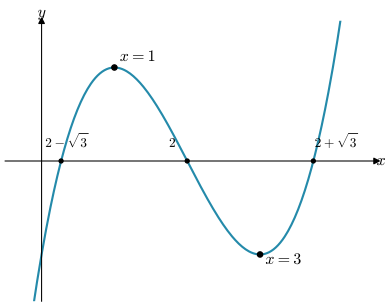
- If $x = 1$ and $x = 3$ are the extremum points of $f$, then $a = \boxed{\text{2-1}}$ and $b = \boxed{\text{2-2}}$. In that case, the solutions of $f(x) = 0$ in increasing order are $\boxed{\text{2-3}} < \boxed{\text{2-4}} < \boxed{\text{2-5}}$.
- Suppose $a = b$. If $f$ is increasing, then $\boxed{\text{2-6}} \le a \le \boxed{\text{2-7}}$.
Solution
1. The coefficients. $f'(x) = 3x^2 - 6ax + 3b$ must equal $3(x - 1)(x - 3) = 3x^2 - 12x + 9$: $6a = 12$ and $3b = 9$, so $a = 2$ and $b = 3$.
2. The roots. $f(x) = x^3 - 6x^2 + 9x - 2$. Testing $x = 2$: $8 - 24 + 18 - 2 = 0$. Dividing: $f(x) = (x - 2)(x^2 - 4x + 1)$, and $x^2 - 4x + 1 = 0$ gives $x = 2 \pm \sqrt3$. In order: $2 - \sqrt3 < 2 < 2 + \sqrt3$.
3. Monotonicity with $a = b$. $f'(x) = 3(x^2 - 2ax + a)$ must never be negative, so the discriminant must be $\le 0$: $4a^2 - 4a \le 0$, that is, $0 \le a \le 1$.
Answer
$a = 2$, $b = 3$; $2 - \sqrt3 < 2 < 2 + \sqrt3$; $0 \le a \le 1$.
Question 3: volumes by change of scale
Statement
In $xyz$-space, the solid $A$ is given by $\frac19x^2 + \frac14y^2 \le z^4$ ($0 \le z \le 1$).
- The solid $B$ is given by $x^2 + y^2 \le z^4$ ($0 \le z \le 1$). Its volume is $\boxed{\text{3-1}}$.
- The solid $A$ is obtained by stretching $B$ by a factor of $\boxed{\text{3-2}}$ along the $x$-axis and by a factor of $\boxed{\text{3-3}}$ along the $y$-axis.
- The volume of $A$ is $\boxed{\text{3-4}}$ times the volume of $B$.
- The volume of $A$ is $\boxed{\text{3-5}}$.
Solution
1. The solid $B$. The cross-section at height $z$ is a disk of radius $z^2$, with area $\pi z^4$. By Cavalieri’s principle,
$$V_B = \int_0^1 \pi z^4\,dz = \frac\pi5.$$2. The scaling. Replacing $x$ by $\frac x3$ and $y$ by $\frac y2$ in the inequality for $B$ gives the one for $A$. That is, $A$ is $B$ stretched by $3$ in $x$ and by $2$ in $y$.
3. The volume of $A$. Stretching in one direction multiplies the volume by the scale factor. So $V_A = 3\cdot2\cdot V_B = 6\cdot\frac\pi5 = \frac{6\pi}{5}$. (Directly: the cross-section of $A$ is an ellipse with semi-axes $3z^2$ and $2z^2$, with area $6\pi z^4$.)
Answer
$\frac\pi5$; $3$ and $2$; $6$; $\frac{6\pi}{5}$.