
Euler's Eyes
2026-10-11
incenter — angle bisectors internal
The three internal angle bisectors of a triangle meet at incenter, the center of the largest circle that fits inside it.
Who discovered
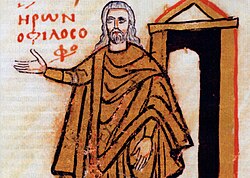
The construction is in proposition IV.4 of The Elements of Euclid (c. 300 BC): “inscribing a circle in a given triangle”. Euclid draws the angle bisectors from two angles, takes the meeting point and shows that it is the same distance from the three sides. As the third angle bisector also passes through this point, the three are competitors. A famous formula links the radius of this circle to the area: it is in the Metric of Heron of Alexandria (1st century AD), along with his formula for the area of the three sides.

The story
Book IV of The Elements is dedicated to inscribing and circumscribing figures in circles. incenter appears there not as a curious point, but as a solution to a practical construction problem: where to place the tip of the compass to draw the circle that touches the three sides.
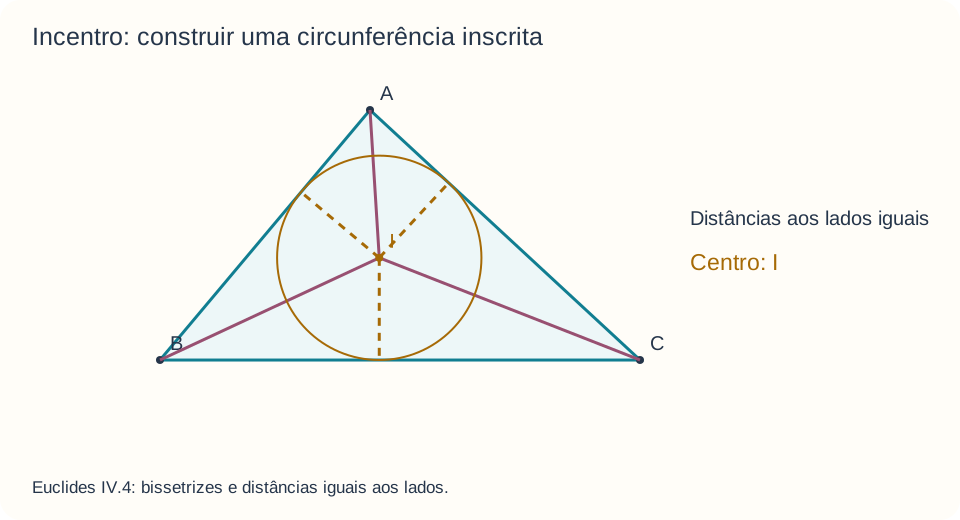
Heron showed that the area of a triangle is equal to the radius of the inscribed circle multiplied by half the perimeter. The idea is to divide the triangle into three triangles with apex at incenter, each with a height equal to the radius.
In everyday life
- Largest round table. In a room or on a triangular plot, the largest table, pool or round bed that fits is centered at incenter.
- Roundabouts. At a triangle-shaped three-way intersection, the equidistant point of the three streets is incenter.
- Sheet cutting. To cut the largest possible disc from a triangular scrap of metal or wood, the center of the cut is incenter.
- Watchpoint. A post the same distance from the three shores of a triangular lake is at incenter.
Sources: Elements, proposition IV.4 · Heron of Alexandria (MacTutor).
Theory and constructions
TeoremaCompetition from internal angle bisectors
The three internal angle bisectors of a triangle intersect at the same point, which is equal distance from the sides:
$$\overline{AS_1} \cap \overline{BS_2} \cap \overline{CS_3} = \lbrace S \rbrace, \qquad d_{S,a} = d_{S,b} = d_{S,c}.$$Demonstration. Let $S$ be the meeting of $\overline{BS_2}$ and $\overline{CS_3}$. As $S$ is in angle bisector of $\hat{B}$, $d_{S,a} = d_{S,c}$; as in $\hat{C}$, $d_{S,a} = d_{S,b}$. Therefore $d_{S,b} = d_{S,c}$, and $S$ is also in angle bisector of $\hat{A}$ (the internal points equidistant from the sides of an angle are in angle bisector).
Definiçãoincenter
The meeting point of the three inner angle bisectors is incenter. It is the center of the circle inscribed in the triangle (which touches the three sides).