
Euler's Eyes
2026-10-14
The art of conjecturing: counting the chances
To conjecture about something is to measure its probability. Therefore we define the art of conjecturing, or stochastics, as the art of measuring the probabilities of things as exactly as possible, so that in our judgements and actions we may always choose or follow what seems to us better, more satisfactory, safer or more carefully considered.
— Jakob Bernoulli, Ars conjectandi (1713), part IV
In 1654, Pascal and Fermat exchanged letters on how to divide the stakes of an interrupted game. In 1657, the Dutchman Christiaan Huygens published a fifteen-page booklet on the calculations of dice games. These were parlour problems: dice, cards, bets.
Jakob Bernoulli wanted much more. For him, probability was a measure of certainty, a number between 0, the impossible, and 1, the certain, which would serve to weigh testimony in a court, predict how long a person will live, value an insurance policy or decide whether a medicine works. He spent twenty years writing the book that would show how. He called it Ars conjectandi, “The art of conjecturing”.
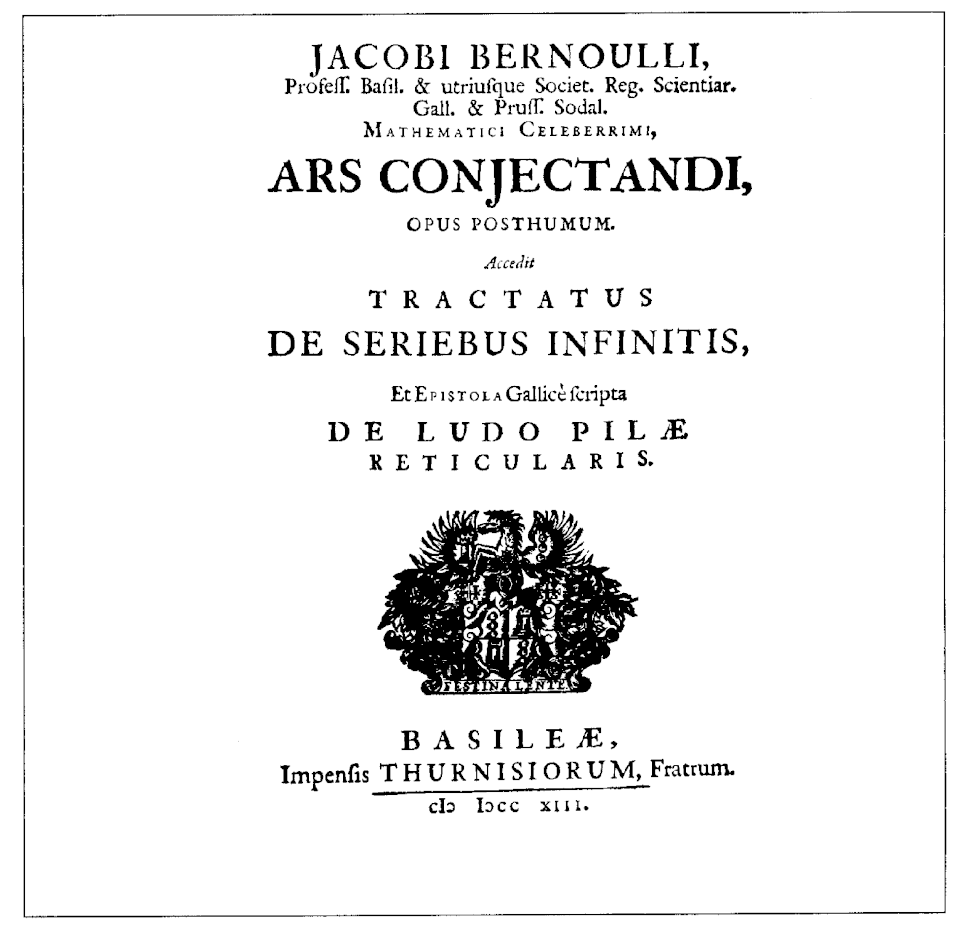
A book in four parts
The Ars conjectandi has four parts. The first reproduces Huygens’s book, with comments by Jakob that are longer than the original. The second is a complete course in combinatorics: permutations, combinations and, among them, the sums of powers that now bear Jakob’s name. The third applies all of this to dozens of games. The fourth, unfinished, deals with probability in civil, moral and economic life, and that is where the golden theorem is.
The Bernoulli trial
The simplest idea in the book became one of the most used in statistics. Imagine an experiment with only two possible outcomes: the coin comes up heads or not, the patient is cured or not, the part comes out defective or not. One outcome is called success, with probability $p$, and the other failure, with probability $q=1-p$. The word is just a label: in a factory, the “success” being counted may be finding a defect.
Today such an experiment is called a Bernoulli trial. Jakob’s question was: repeating the trial $n$ times, always under the same conditions and without one outcome influencing another, what is the probability of getting exactly $k$ successes?
The formula, step by step
Start with a small case. A die is thrown 3 times, and “success” is rolling a 6, with $p=\frac16$. What is the chance of exactly two 6s?
One possible sequence is 6, 6, other. Its probability is the product of the chances of each throw:
$$\frac16\cdot\frac16\cdot\frac56=\frac5{216}.$$But there are other orders with two 6s: 6, other, 6 and other, 6, 6. Each has the same probability, $\frac5{216}$, because the same factors appear in a different order. There are 3 orders, so
$$P(\text{two 6s})=3\cdot\frac5{216}=\frac{15}{216}\approx6.9\%.$$The number of orders is the number of ways of choosing which throws are successes: choosing 2 out of 3, or $\binom32=3$. In general, each sequence with $k$ successes and $n-k$ failures has probability $p^kq^{n-k}$, and there are $\binom nk$ of them. Adding up:
$$\boxed{P(k\text{ successes in }n\text{ trials})=\binom nk\,p^k\,q^{n-k}}$$The coefficients $\binom nk$ are the numbers of Pascal’s triangle, and the probabilities are the terms of the expansion of $(p+q)^n$. That is why the formula is called the binomial distribution. Since $p+q=1$, the sum of all the probabilities is $(p+q)^n=1$, as it should be.
A problem of Huygens
In the first part, Jakob comments on a question from Huygens’s book: how many times must a die be thrown for the chance of getting at least one 6 to exceed one half? The calculation is easier from the other side. The chance of no 6 in $n$ throws is $\left(\frac56\right)^n$, so
$$P(\text{at least one 6})=1-\left(\frac56\right)^n.$$With $n=3$ it gives $1-\frac{125}{216}\approx42\%$. With $n=4$ it gives $1-\frac{625}{1296}\approx51.8\%$. Four throws are enough. This was exactly the bet of the Chevalier de Méré that had prompted the letters of Pascal and Fermat.
Exercise: in a 10-question test with 4 options each, what is the chance of getting exactly 5 right by guessing them all?
Each question is a trial with $p=\frac14$ and $q=\frac34$. So
$$P=\binom{10}5\left(\frac14\right)^5\left(\frac34\right)^5=252\cdot\frac{3^5}{4^{10}}=252\cdot\frac{243}{1{,}048{,}576}\approx5.8\%.$$The most likely result, when guessing, is getting 2 questions right: $\binom{10}2\frac{3^8}{4^{10}}\approx28.2\%$.
Exercise: a couple plans four children. Assuming a chance of 1/2 for each sex, which is more likely: two boys and two girls, or three of one sex and one of the other?
Two and two: $\binom42\frac1{16}=\frac6{16}$. Three of one sex and one of the other: there are $\binom43=4$ ways of having three boys and another 4 of having three girls, or $\frac8{16}$. The “unbalanced” case is more likely, contrary to what intuition usually says.
Sources: Jakob Bernoulli, The Art of Conjecturing, translated with an introduction by Edith Dudley Sylla (Johns Hopkins, 2006) · Anders Hald, A History of Probability and Statistics and Their Applications before 1750 (Wiley, 1990) · biography of Jacob Bernoulli, MacTutor.
All topics on James Bernoulli · ← The marvellous spiral and the lemniscate · The golden theorem: the law of large numbers →