
Euler's Eyes
2026-10-14
The life of Joseph-Louis Lagrange
Timeline
- 1736Born on 25 January in Turin, capital of the Kingdom of Sardinia, as Giuseppe Lodovico Lagrangia.
- 1753At 17, reads an essay by Edmond Halley and decides to devote himself to mathematics.
- 1755Writes to Euler with the method that will give rise to the calculus of variations. In September he is appointed professor at the Artillery School in Turin, aged 19.
- 1757Helps found the scientific society that will become the Turin Academy of Sciences.
- 1764Wins the Paris Academy prize by explaining why the Moon always shows the same face.
- 1766Moves to Berlin to take Euler’s place at the Academy of Frederick the Great.
- 1770Proves that every whole number is a sum of four squares and begins studying the permutations of the roots of an equation.
- 1772Shares the Paris prize with Euler for the three-body problem, where the Lagrange points appear.
- 1787After Frederick’s death, moves to Paris, where he lives in the Louvre.
- 1788Publishes the Analytical Mechanics.
- 1790Joins the commission that will create the metric system.
- 1794Lavoisier is guillotined. Lagrange becomes a professor at the new École Polytechnique.
- 1797Publishes the Theory of Analytic Functions, with the notation $f'(x)$.
- 1808Napoleon makes him a count of the Empire.
- 1813Dies on 10 April in Paris and is buried in the Panthéon.
- At 19 he is a professor at the Artillery School. He writes to Euler the method that will give rise to the calculus of variations.
- He takes Euler’s place at the Academy of Frederick the Great. He proves the four-square theorem and finds the Lagrange points.
- He lives in the Louvre, publishes the Analytical mechanics, helps create the metric system and teaches at the École Polytechnique. He is buried in the Panthéon.
- 1736–1766 · Turin
- 1766–1787 · Berlin
- 1787–1813 · Paris
A father who lost everything
Lagrange was born in Turin in 1736, into a family of French origin on the side of his great-grandfather, who had served the Duke of Savoy. The boy was baptised Giuseppe Lodovico Lagrangia and signed his name in many ways over his life, until he settled on the French form, Joseph-Louis Lagrange. He was the eldest of eleven children, and only two reached adulthood.
His father was treasurer of the kingdom’s office of public works and fortifications, a prestigious post, and the family was rich. But he lost almost everything in financial speculation. In old age, Lagrange spoke of it with good humour:
If I had been rich, I probably would not have devoted myself to mathematics.
— Joseph-Louis Lagrange, according to his biographer Delambre
Halley and the conversion
His father wanted him to be a lawyer, and young Lagrange enjoyed studying Latin and the classics. Greek geometry bored him. The change came at around 17, when he happened to read a 1693 essay by the English astronomer Edmond Halley on the advantages of algebraic methods in optics. Lagrange was delighted by the idea of solving problems by calculation, without figures, and decided to study mathematics on his own. That preference never left him.
The start had a stumble. In 1754, at 18, he sent the mathematician Giulio Fagnano a letter with a formula for the successive derivatives of a product, a generalisation of Leibniz’s rule. Shortly afterwards he found that Leibniz himself had already known it. He was afraid of being taken for a plagiarist and began working with more ambition.
A professor at 19
On 12 August 1755, Lagrange wrote to Leonhard Euler, the most famous mathematician in Europe, then in Berlin. The letter contained a new method for finding the curve that makes a certain quantity as large or as small as possible: what would become the calculus of variations. Euler, who had been working on the same subject for years by geometric routes, replied enthusiastically and held back publication of his own work to give the young man the credit.
A month later, on 28 September 1755, Lagrange was appointed professor of mathematics at the Royal Artillery School in Turin. He was 19, and many of his students were older than he was. In 1757, with some of those students and friends, he founded a scientific society that would become the Turin Academy of Sciences, and he filled the first volumes of its journal with papers on sound, vibrating strings and mechanics.
The hidden face of the Moon
The Moon always shows the same side to the Earth, but it rocks slightly, in a motion called libration, which over a month lets us see about 59% of its surface. In 1764 the Paris Academy offered a prize to whoever could explain the phenomenon. Lagrange won, using for the first time the principle that would become the basis of the Analytical Mechanics. In 1766 he won another prize, on the moons of Jupiter. His name began to circulate among the academies of Europe.
The greatest mathematician for the greatest king
In 1766 Euler left Berlin and returned to St Petersburg. Frederick II, the Great, King of Prussia, asked d’Alembert to recommend a successor, and d’Alembert recommended Lagrange. The king’s invitation became famous for its tone: the greatest king in Europe wished to have the greatest mathematician in Europe at his court.
Lagrange arrived in Berlin in November 1766 and stayed twenty years. They were the most productive of his life. There he proved the four-square theorem, studied the permutations of the roots of equations, found the equilibrium points of the three-body problem and wrote the Analytical Mechanics. Unlike Euler, whom the king treated with disdain, Lagrange got on well with Frederick, who praised the regularity of his habits.
In 1767 he married a cousin, Vittoria Conti. They had no children. She fell ill and died in 1783 after years of illness, and Lagrange, who nursed her to the end, went through a period of depression.
Paris and the Revolution
Frederick died in 1786, and the climate at court changed. Lagrange received invitations from several cities and chose Paris, where he arrived in 1787 with an apartment in the Louvre paid for by King Louis XVI. The Analytical Mechanics came out in 1788, after great difficulty in finding a publisher. Legendre saw it through the press.
The following year came the Revolution. Lagrange, a foreigner under the king’s protection, stayed. In 1790 he joined the commission on weights and measures, which would create the metre and the kilogram, and he firmly defended base 10 against those who preferred base 12. In 1792, aged 56, he married again, to Renée-Françoise-Adélaïde Le Monnier, the daughter of an astronomer friend, much younger than he was. It is said that she was the one who insisted on the marriage, and that she was a devoted companion until the end of his life.
In 1793 a law ordered the arrest of foreigners born in enemy countries. The chemist Antoine Lavoisier, also a member of the commission, managed to have Lagrange exempted from it. Months later, Lavoisier himself was arrested, tried as a former tax farmer and guillotined on 8 May 1794. Lagrange said the next day:
It took them only an instant to cut off that head, and a hundred years may not be enough to produce another like it.
— Joseph-Louis Lagrange, on the death of Lavoisier (1794)
The professor at the Polytechnique
In 1794 the École Polytechnique was founded, and Lagrange, at 58, went back to teaching. Students recalled that he spoke softly with an Italian accent and sometimes lost himself in the middle of a proof to follow a new idea. Two books came out of those lectures, the Theory of Analytic Functions of 1797 and the Lessons on the Calculus of Functions of 1801. In them appear the notation $f'(x)$ and the word derivative, which we still use today.
Napoleon Bonaparte, who liked to surround himself with scientists, admired Lagrange and made him a senator, a grand officer of the Legion of Honour and, in 1808, a count of the Empire.
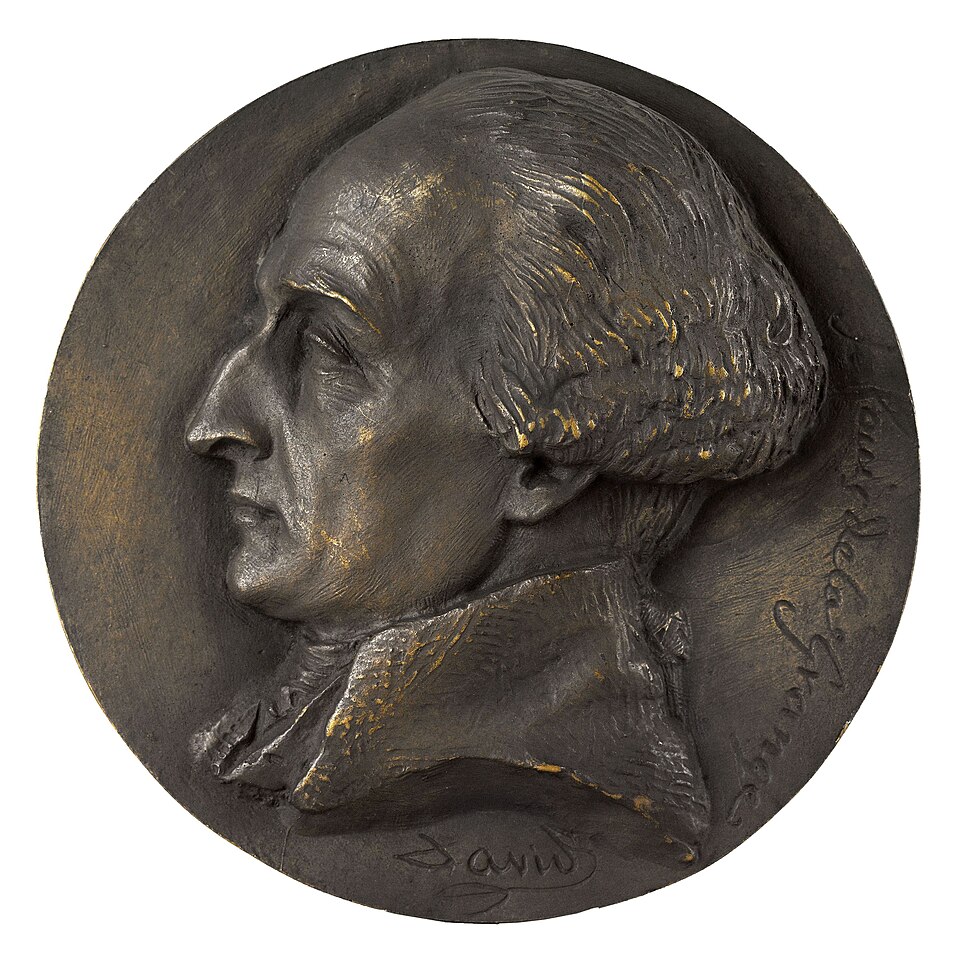
Lagrange kept working to the end, revising the Analytical Mechanics for a second edition. He died in Paris on 10 April 1813, aged 77, and was buried in the Panthéon. His name is one of the 72 engraved on the Eiffel Tower, and a statue of him stands in a square in Turin, the city where he was born.
Sources: biography of Lagrange, MacTutor · Jean-Baptiste Delambre, Notice sur la vie et les ouvrages de M. le comte J.-L. Lagrange (1814), in volume 1 of the Œuvres de Lagrange.
All Lagrange topics · The calculus of variations: a letter from a 19-year-old →