
Euler's Eyes
2026-10-11
Light and colours: the prism does not make the rainbow
In Newton’s time it was already known that a glass prism, with sunlight passing through it, produces a coloured band. The accepted explanation came from Aristotle and Descartes: white light is pure, and the glass modifies it, darkening it little by little. A small modification gave red; a large one, blue and violet.
Newton had his doubts. What if the colours were already inside white light, and the prism merely separated them?
The dark room
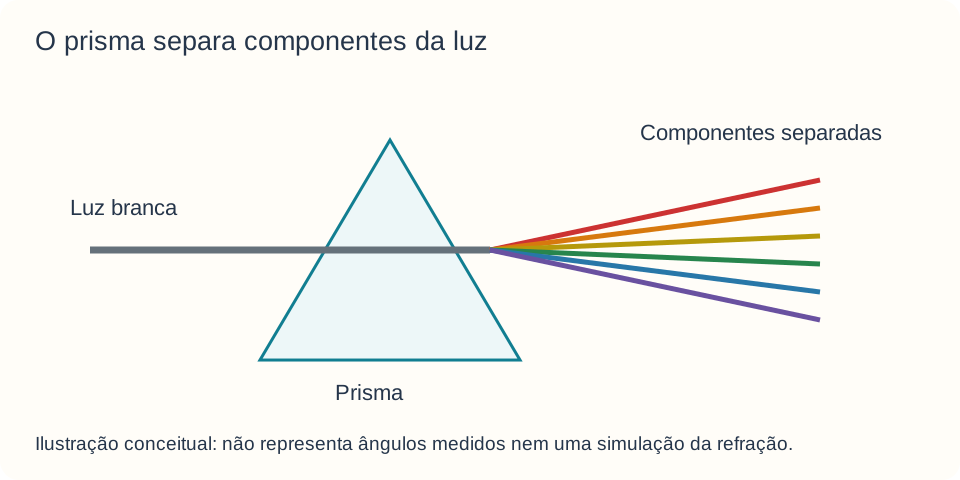
In 1666 Newton darkened a room, made a small hole in the window shutter and let in a thin beam of sunlight. In its path he placed a prism. On the opposite wall a coloured band appeared, from red to violet.
The first surprise was its shape. The hole was round, and a “modification” theory predicted a round coloured spot. But the band was five times longer than it was wide. To Newton this meant each colour was bent by a different angle: violet the most, red the least.
The crucial experiment
That did not prove anything yet. Perhaps the prism kept “making” colours. So Newton carried out what he called the experimentum crucis, the crucial experiment.
He made a hole in a board and let through only one colour of the band, say red, and sent that light through a second prism. If glass made colours, the second prism should turn the red into a new rainbow. It did not. The red came out red, merely bent, and always by the same angle. Blue did the same, with a larger bend.
Conclusion: each colour is an ingredient of white light, with its own degree of refraction. The prism does not make colours; it separates them. To close the argument, Newton brought the colours back together with a lens and a second prism and obtained white light again.
Refraction in numbers
Today we describe refraction by Snell’s law, discovered before Newton (Ibn Sahl, Snell and Descartes reached it independently):
$$n_1\sin\theta_1=n_2\sin\theta_2.$$The angles are measured from the line perpendicular to the surface, and $n$ is the refractive index of each medium. Newton’s discovery, in today’s language, is that the index of glass depends on the colour. For ordinary glass it is about $1.51$ for red and $1.53$ for violet. The difference is small but enough to fan out the colours.
For example, a ray entering glass from air ($n_1=1$) at $\theta_1=45°$: for red, $\sin\theta_2=\dfrac{0.707}{1.51}\approx0.468$, which gives $\theta_2\approx27.9°$. For violet, $\sin\theta_2=\dfrac{0.707}{1.53}\approx0.462$, or $\theta_2\approx27.5°$. Half a degree of difference, already at the first face of the prism.
The mirror telescope
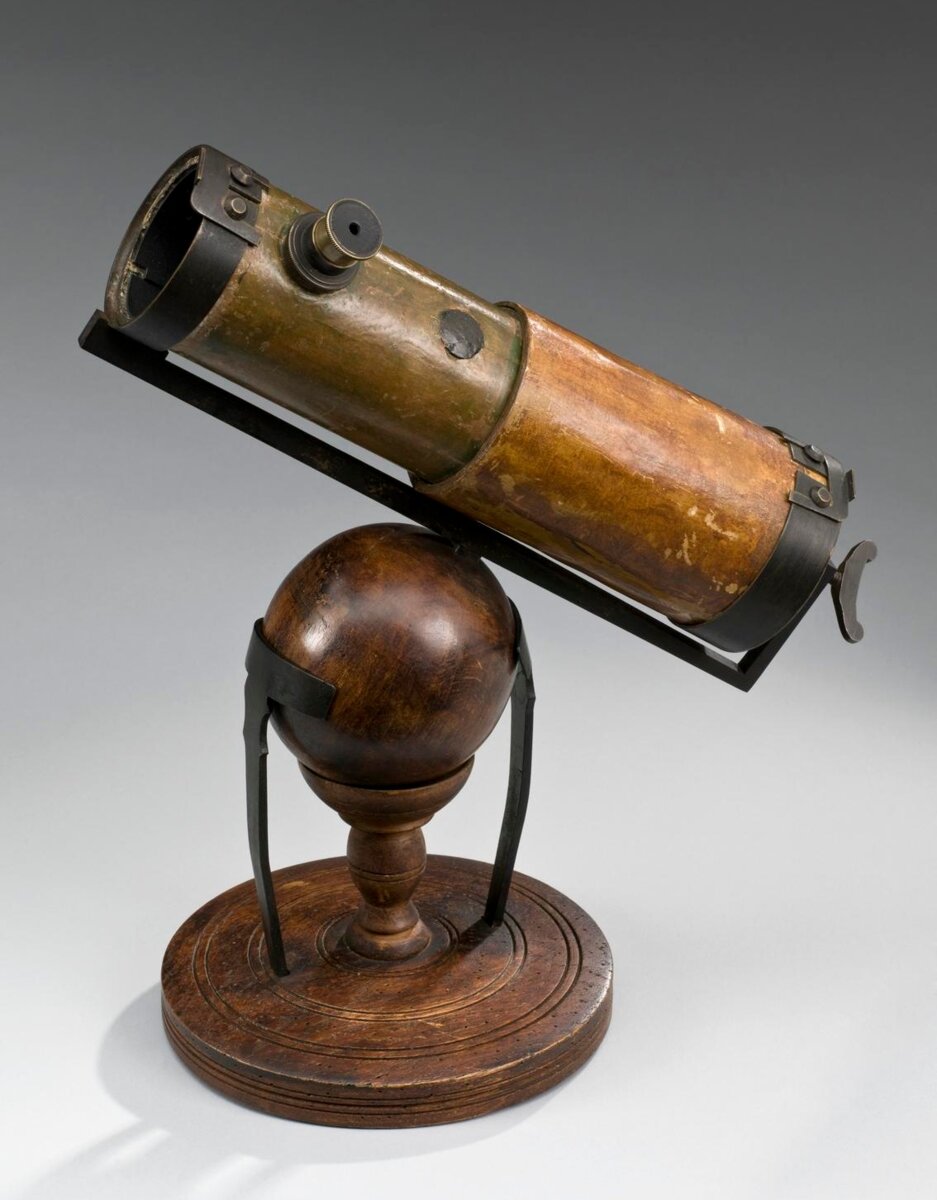
The discovery had a practical consequence. Telescopes of the time used lenses, and lenses, like prisms, bend each colour differently. Stars appeared with coloured, blurred edges. Newton concluded that the problem could not be solved with simple lenses and replaced the main lens with a curved mirror, which reflects all colours equally.
In 1668 he built the first working reflecting telescope, about 15 cm long, grinding the metal mirror himself. It was this instrument, presented to the Royal Society in 1671, that made him famous. The great telescopes of today, including James Webb, are reflectors.
In 1672 Newton published his theory of colours. Robert Hooke criticized it, and the quarrel was so unpleasant that Newton only published the complete book, Opticks, in 1704, a year after Hooke’s death.
Exercise: if the speed of light were the same in both media, would the ray change direction?
No. Equal speeds mean equal indices, $n_1=n_2$, and Snell’s law gives $\sin\theta_1=\sin\theta_2$. The ray goes straight on.
Sources: Newton’s optical work, Newton Project · 1672 letter on light and colours.
All Isaac Newton topics · ← Gravitation: from the apple to the Moon · Newton’s legacy →