
Euler's Eyes
2022-08-19
Pascal's triangle
Make coefficients appear
Highlight a line and read each number. In line 4, the 6 comes from 3 + 3 in the previous line.
Em telas pequenas, deslize o gráfico na horizontal para ler os detalhes.
From line 3 to the cube of a sum
- The line 3 has the coefficients 1, 3, 3, 1.
- The exponents of a decrease: 3, 2, 1, 0.
- The exponents of b increase: 0, 1, 2, 3.
- Thus, (a + b)³ = a³ + 3a²b + 3ab² + b³.
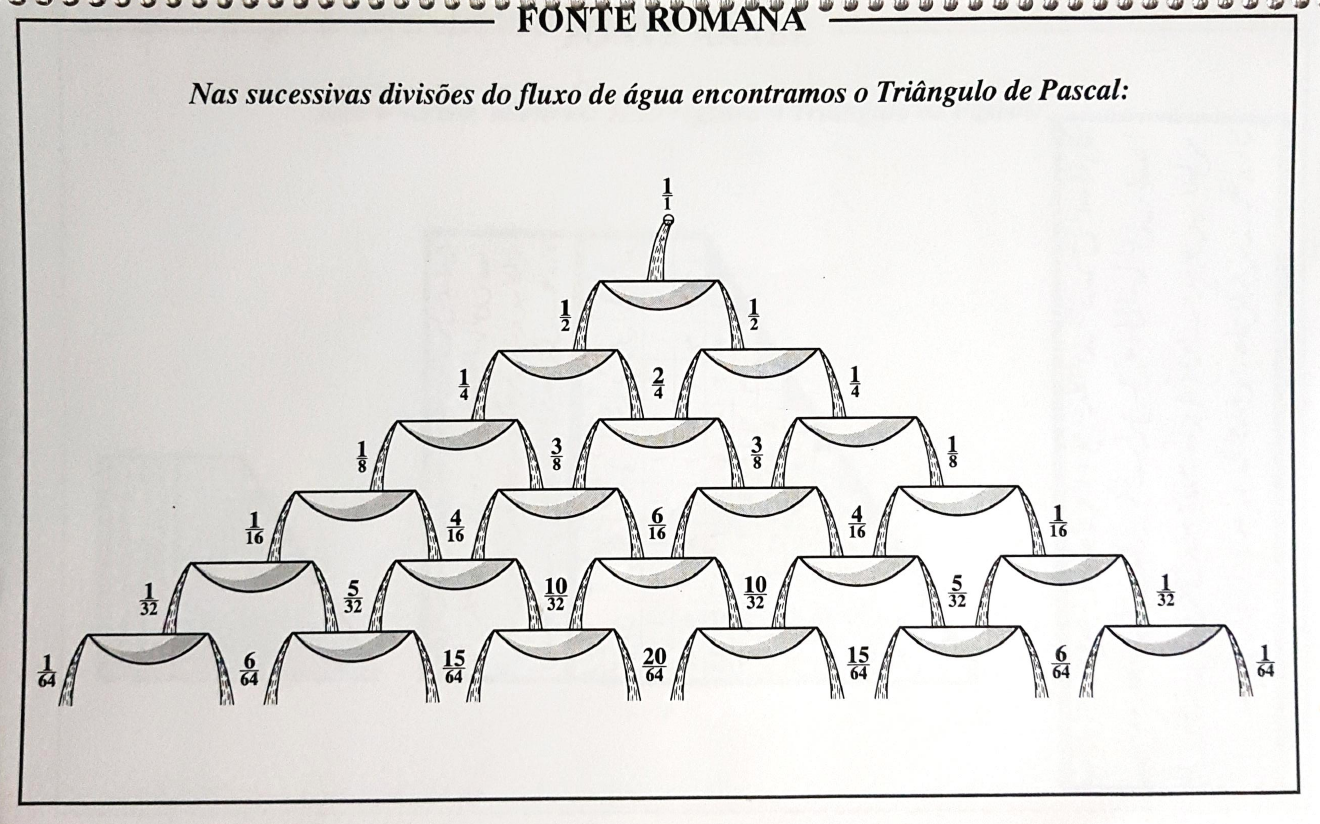
In the previous post, we talked about notable products. Here, we will extend the concept of notable products with Pascal’s triangle. Pascal’s triangle is a triangle of integers, where each number is the sum of the two numbers above it. Pascal’s triangle is a very useful tool for calculating binomial coefficients.
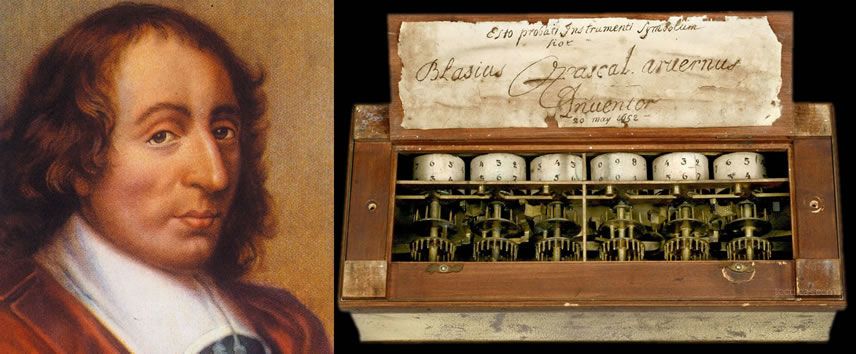
In addition to his masterpiece, Pascal’s Triangle, Blaise Pascal was one of the precursors of current computing, as with the La Pascaline machine he revolutionized the era with his mechanical calculator. We can quickly perform addition and subtraction calculations. He did this as a distraction, as his partner was a tax collector.
Help us build the math website. Donate as much as you can.

Traite du triangle arithmétique (1654 - 1754)
“All I know is that I’m going to die and that eu ignoro is a death I can’t avoid.”
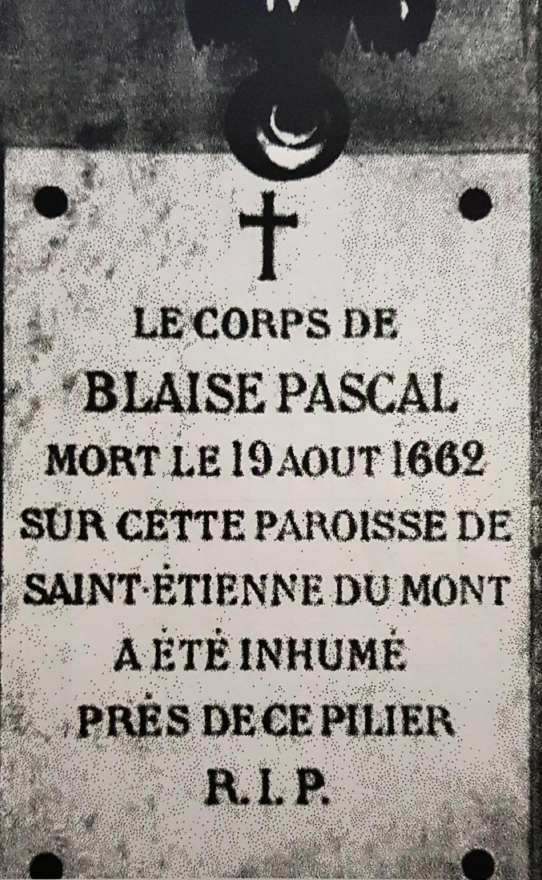
| Blaise Pascal | Pascal’s tombstone |
|---|---|
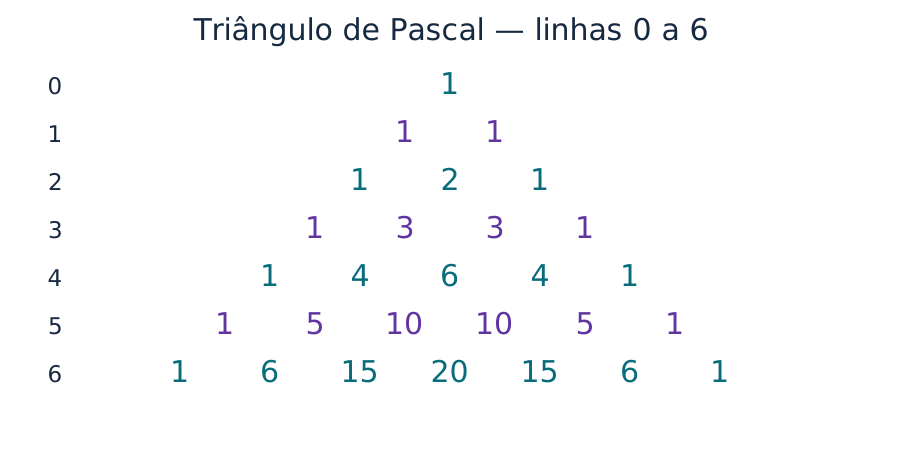
Ampliar figura para ler os detalhes
|
|
Here we will build Pascal’s triangle based on the results of several translated and adapted authors, with the aim of understanding the extent of Pascal’s philosophy.
“And the design of the arithmetic triangle is the construction figure…”
How did he arrive at this result?
Ampliar figura para ler os detalhes
| n | Coefficients |
|---|---|
| 1 | $1 \quad 1$ |
| 2 | $1 \quad \overbrace{2}^{1+1} \quad 1 $ |
| 3 | $1 \quad \overbrace{3}^{1+2} \quad \overbrace{3}^{2+1}\quad 1 $ |
| 4 | $1 \quad \overbrace{4}^{1+3} \quad \overbrace{6}^{3+3} \quad \overbrace{4}^{3+1}\quad 1 $ |
| $\vdots$ | $\vdots$ |
Comparison of remarkable product and Pascal’s triangle
Next, we will observe that notable products is a particular case of Pascal’s triangle.
| Notable product | Pascal’s triangle | Result |
|---|---|---|
| $(a+b)$ | $1 \quad 1 \quad \quad \quad $ | $1a + 1b$ |
| $(a+b)^2$ | $1 \quad 2 \quad 1 \quad \quad $ | $1a^2+ 2ab + 1b^2$ |
| $(a+b)^3$ | $1 \quad 3 \quad 3 \quad 1 \quad $ | $1a^3+ 3 a^2b+ 3 ab^2 + 1b^3$ |
| $(a+b)^4$ | $1 \quad 4 \quad 6 \quad 4 \quad 1$ | $1a^4 + 4a^3b + 6a^2b^2 + 4ab^3 + 1b4$ |
Historical Sources - Pascal’s Triangle
| Pomegranate |
|---|
|
| Europe |
|---|
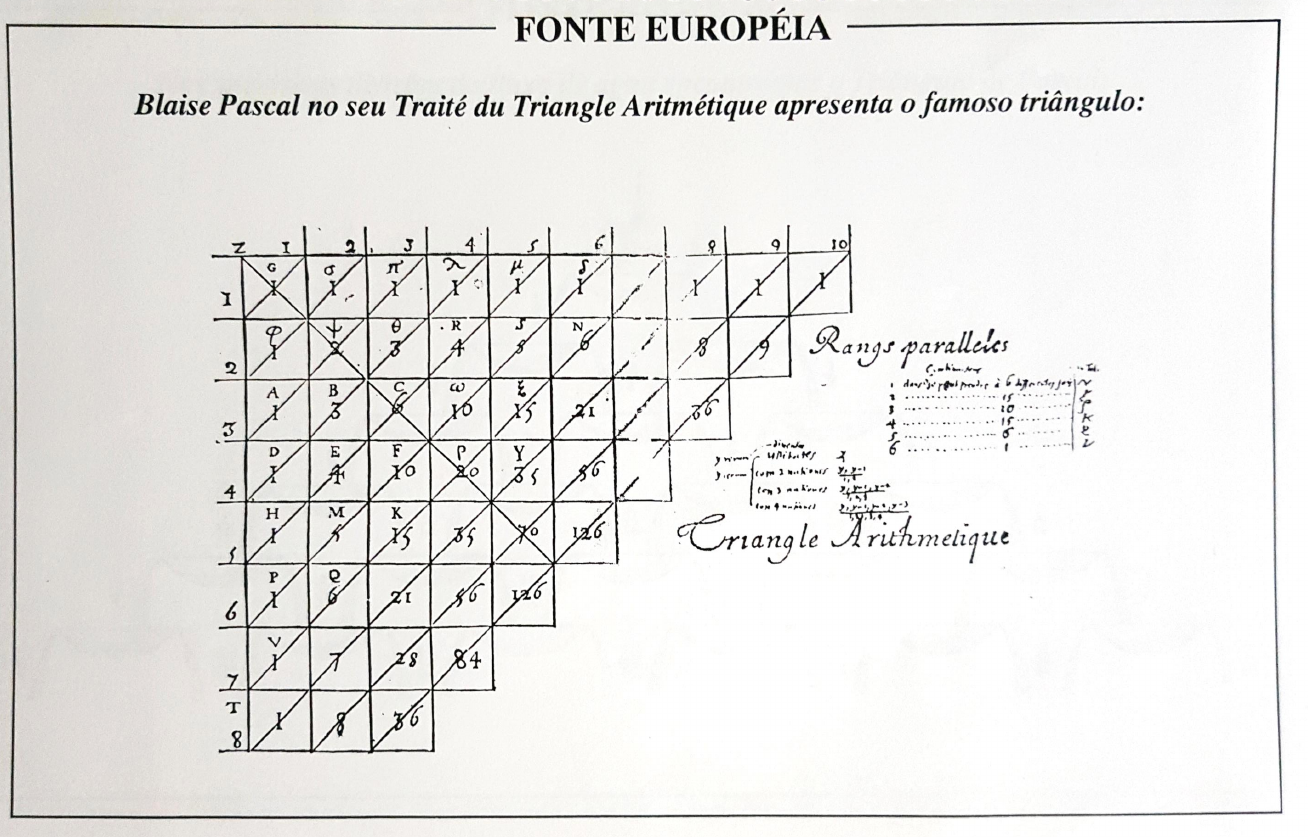
|
| Arabic |
|---|
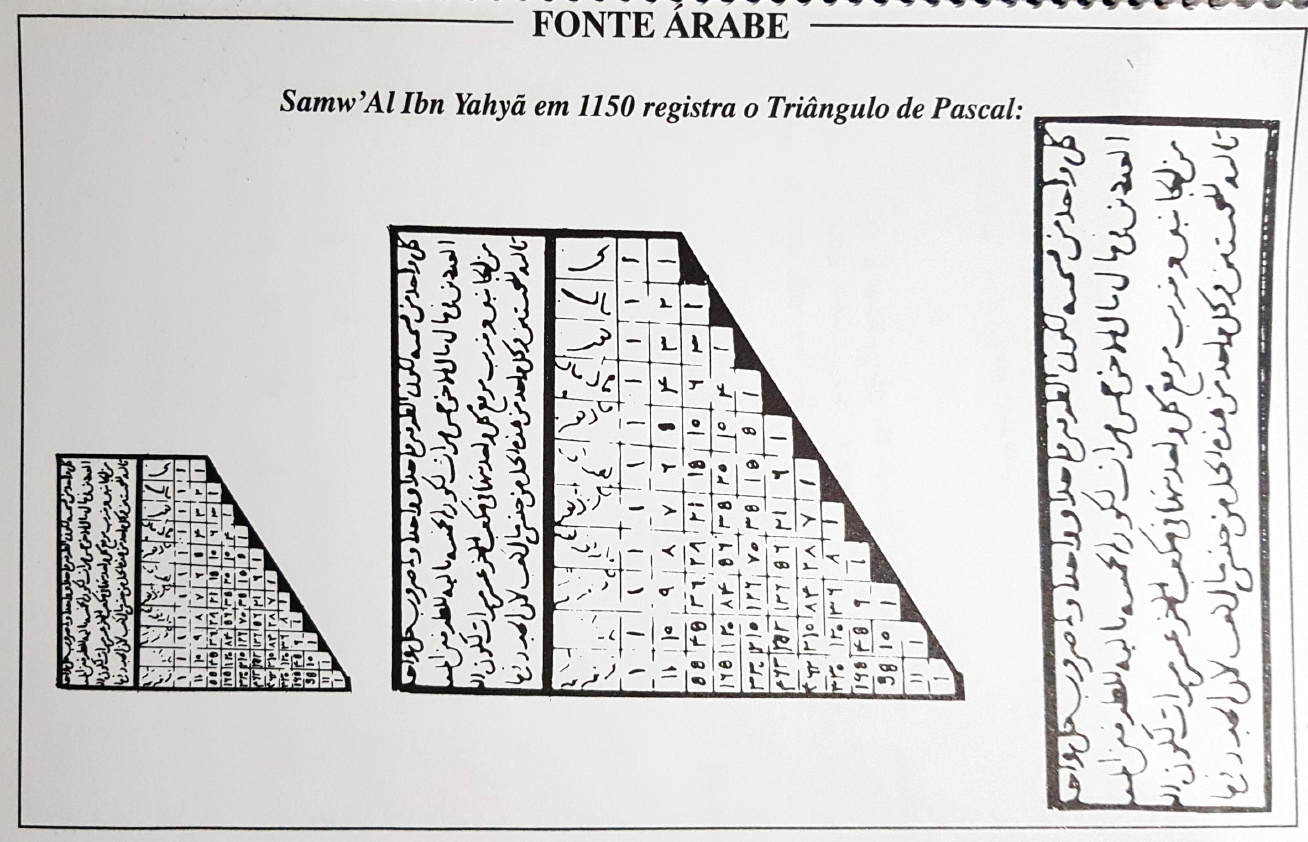
|
Application to polynomials
$$f(x)= (1+x)^n$$
“And the rooster crows for the first time!”
Drunk’s walk
Be it a bar, a drunk, your house, n steps and an intention…

To illustrate this example from Pascal, observe:

“And the rooster crows for the second time!”