
Euler's Eyes
2026-09-26
ENEM 2025 – Solved mathematics: questions 166 to 180
Source: INEP – proof and template of the 2nd day, Notebook 5 – Yellow.
The ENEM Mathematics and Technologies test 2025 was administered on the 2nd day and will from question 136 to 180. This post addresses questions 166 to 180. The numbering used here is that of the Notebook 5 – Yellow; us In other notebooks the same questions appear in a different order.
Template
| Question | Subject | Template |
|---|---|---|
| 166 | Volume Units | D |
| 167 | Agricultural production and line graph | A |
| 168 | Volume: cylinder minus prism | B |
| 169 | Probability with data | E |
| 170 | Units of measurement | A |
| 171 | Sequences: expression of the general term | D |
| 172 | Chart reading and fuel cost | D |
| 173 | Cost Comparison | E |
| 174 | Volume of the parallelepiped | B |
| 175 | Spatial geometry: cylinder in prism | E |
| 176 | Logarithm and quadratic function | A |
| 177 | Area of the semicircle | A |
| 178 | Equation: installments of financing | Canceled |
| 179 | Combinatorial analysis: combinations | C |
| 180 | Average speed | C |
Question 166: Ice cream cups (volume units)
Statement
The owner of an ice cream shop stores ice cream in 20 000 cm³ containers. He serves the ice cream in cups, in portions of 250 mL.
The number of bowls he can serve from a pot full of ice cream is
- A) 5.
- B) 8.
- C) 50.
- D) 80.
- E) 800.
Resolution
1. Same unit. $1 \text{ cm}^3 = 1 \text{ mL}$, so the pot has 20 000 mL.
2. Number of glasses.
$$\frac{20\thinspace 000}{250} = 80$$Answer: alternative D (80).
Beware of the catch: who thinks that $1 \text{ cm}^3 = 10 \text{ mL}$ or $1 \text{ L} = 100 \text{ mL}$ misses by a factor of 10 and falls into 8 or 800 (alternatives B and E).
To review, see Measure.
Question 167: Soybean production in five harvests (line graph)
Statement
Soybean productivity in a cultivated area is the average number of bags of 50 kilograms that are produced per hectare. The table shows the area cultivated and soybean productivity on a certain property, over five harvests, with periods of one year, from 2011 to 2016.
| Harvest | 11-12 | 12-13 | 13-14 | 14-15 | 15-16 |
|---|---|---|---|---|---|
| Cultivated area (hectare) | 200 | 220 | 250 | 250 | 200 |
| Productivity (bags of 50 kg per hectare) | 40 | 30 | 45 | 45 | 50 |
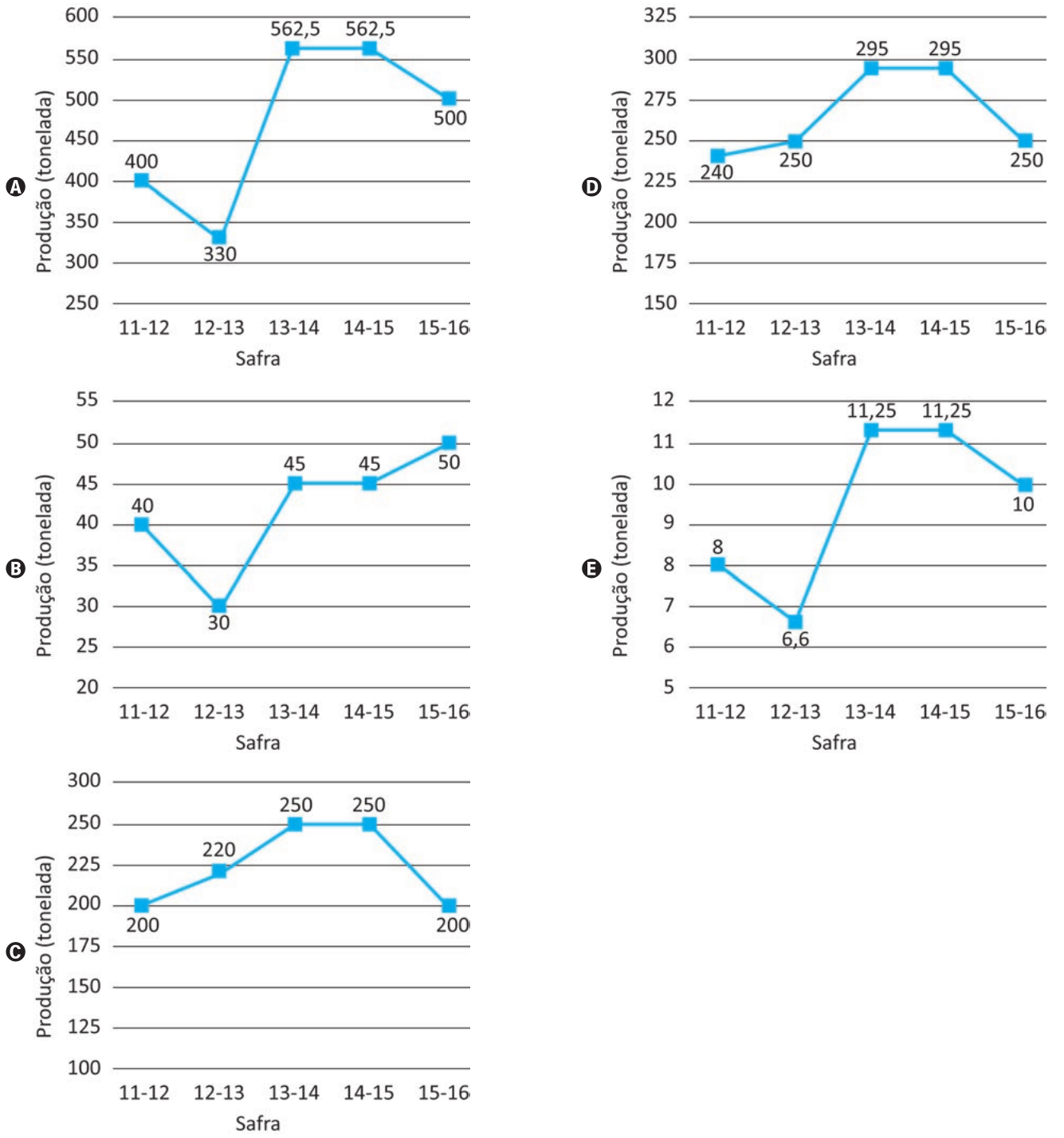
The line graph that represents the soybean production of this property, in ton, in these five harvests it is
Resolution
Production = area × productivity × 50 kg. Like $1 \text{ t} = 1000 \text{ kg}$, each bag is worth $0{,}05$ t.
| Harvest | Bags | Tons |
|---|---|---|
| 11-12 | $200 \cdot 40 = 8\thinspace 000$ | $8\thinspace 000 \cdot 0{,}05 = 400$ |
| 12-13 | $220 \cdot 30 = 6\thinspace 600$ | $330$ |
| 13-14 | $250 \cdot 45 = 11\thinspace 250$ | $562{,}5$ |
| 14-15 | $250 \cdot 45 = 11\thinspace 250$ | $562{,}5$ |
| 15-16 | $200 \cdot 50 = 10\thinspace 000$ | $500$ |
The values 400; 330; 562,5; 562,5; 500 are those in graph A.
Answer: alternative A.
Be careful with the catch: graphs B and C only show productivity and only the area, respectively. Graph E has the right shape, but values 50 times smaller: is the production in thousands of bags, without multiplying by 50 kg.
Question 168: Gold for the medals (volume of the cylinder minus the prism)
Statement
The figure illustrates the visual project for making a commemorative medal, with the shape of a straight circular cylinder, with diameter 6 cm and thickness 3 mm.
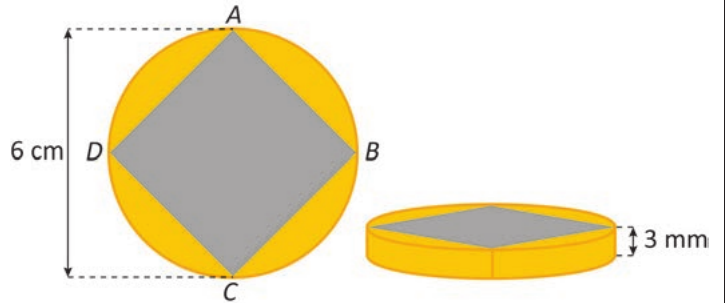
The figure ABCD has the shape of a square and is the base of a prism that passes through the entire medal. The region of the medal outside this prism will be struck in gold. It is intended to mint 100 of these medals.
Consider 3,1 as an approximate value for $\pi$.
What is the volume of gold, in cubic centimeters, needed to make these medals?
- A) 288
- B) 297
- C) 567
- D) 990
- E) 1 134
Resolution
Everything in centimeters: radius $r = 3$ cm and thickness $h = 3 \text{ mm} = 0{,}3$ cm.
1. Area of the circle.
$$\pi r^2 = 3{,}1 \cdot 9 = 27{,}9 \text{ cm}^2$$2. Area of the square. The square is inscribed in the circle, so its diagonal is the diameter, 6 cm. The area of a square with diagonal $d$ is $\frac{d^2}{2}$:
$$\frac{6^2}{2} = 18 \text{ cm}^2$$3. Gold volume of a medal. The gold part is the area between the circle and the square times the thickness:
$$(27{,}9 - 18) \cdot 0{,}3 = 9{,}9 \cdot 0{,}3 = 2{,}97 \text{ cm}^3$$4. One hundred medals.
$$100 \cdot 2{,}97 = 297 \text{ cm}^3$$Answer: alternative B (297).
Be careful with the catch: use the thickness as 3 cm instead of 0,3 cm Multiplies the result by 10 (990, alternative D).
To review, see Circle Area.
Question 169: Arthur with two dice against João with one (probability)
Statement
Three cubic dice, with faces numbered from 1 to 6, were used in a game. Arthur chose two dice, and João took the third. The game consists of both roll their dice, look at the numbers on the upturned sides and compare the highest number obtained by Artur with the number obtained by João. player who gets the highest number. In case of a tie, João wins.
The player who has the highest probability of winning is
- A) Artur, with probability of $\dfrac{2}{3}$
- B) João, with probability of $\dfrac{4}{9}$
- C) Artur, with probability of $\dfrac{91}{216}$
- D) João, with probability of $\dfrac{91}{216}$
- E) Artur, with probability of $\dfrac{125}{216}$
Resolution
They are $6^3 = 216$ equally likely results. Let’s count when João wins (it gets easier), that is, when Arthur’s highest number is smallest or equalto John’s.
1. Fixing the number $j$ of John. The larger of Arthur’s two dice is $\le j$ exactly when both Arthur’s data are $\le j$. It happens in $j \cdot j = j^2$ of Arthur’s 36 results.
2. Adding to $j = 1, \dots, 6$:
$$1^2 + 2^2 + 3^2 + 4^2 + 5^2 + 6^2 = 1 + 4 + 9 + 16 + 25 + 36 = 91$$So John wins in 91 of the 216 results: $P(\text{João}) = \frac{91}{216}$.
3. Arthur wins the rest:
$$P(\text{Artur}) = 1 - \frac{91}{216} = \frac{125}{216} \approx 58\%$$As $\frac{125}{216} > \frac{1}{2}$, Arthur has a better chance.
Answer: alternative E (Artur, with $\frac{125}{216}$).
Be careful with the catch: alternative D brings the correct probability of João, but he is not the favorite. The draw in favor of João does not compensate for the Arthur’s advantage is to roll two dice.
To review, see Equiprobable Events.
Question 170: Luminance measurement unit
Statement
The luminance of an object is the quantity that describes the amount of light produced or reflected by its surface. It is defined as the ratio between the luminous intensity, measured in candela (cd), and the square of the distance from the object to the focus of light, measured in meters (m).
The unit of measurement for the luminance of an object is
- A) $\dfrac{\text{cd}}{\text{m}^2}$
- B) $\dfrac{\text{m}^2}{\text{cd}}$
- C) $\dfrac{\text{cd}}{\text{m}}$
- D) $\dfrac{\text{m}}{\text{cd}}$
- E) $\dfrac{\text{m}}{\text{cd}^2}$
Resolution
The luminance is
$$L = \frac{\text{intensidade luminosa}}{(\text{distância})^2}$$The unit follows the same calculation: candela in the numerator, meter squared in the denominator:
$$\frac{\text{cd}}{\text{m}^2}$$Answer: alternative A (cd/m²).
Be careful with the catch: “ratio between A and B” is $\frac{A}{B}$, in that order. Inverting gives alternative B.
Question 171: Coins passing on a wheel (sequence)
Statement
Four friends, each with 100 coins, created a game, in which each one takes on one of the four positions, 1, 2, 3 or 4, indicated in the figure, and remains there until the end.
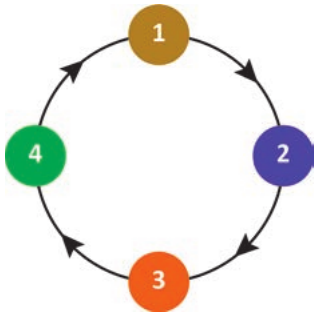
The development of the game takes place in rounds and, in all of them, each player transfers and receives a number of coins, as follows:
- the player in position 1 transfers 1 coin to the player in position 2;
- the player in position 2 transfers 2 coins to the player in position 3;
- the player in position 3 transfers 3 coins to the player in position 4;
- the player in position 4 transfers 4 coins to the player in position 1, completing the round.
At the end of round $n$, what is the algebraic expression that represents the number of player coins at position 1?
- A) $103 + 4n$
- B) $103 + 3n$
- C) $100 + 4n$
- D) $100 + 3n$
- E) $99 + 4n$
Resolution
1. Balance of a round to player 1. He gives 1 coin (to player 2) and receives 4 (from player 4):
$$-1 + 4 = +3 \text{ moedas por rodada}$$2. After $n$ rounds. He starts with 100 and wins 3 per full round:
$$M(n) = 100 + 3n$$Matching with $n = 1$: $100 - 1 + 4 = 103 = 100 + 3 \cdot 1$. Right.
Answer: alternative D ($100 + 3n$).
Be careful with the catch: alternative B ($103 + 3n$) uses the value after the 1st round as starting point, counting this round twice. And the alternatives with $4n$ forget that player 1 also gives 1 coin per round.
To review, see Arithmetic Progression.
Question 172: Traveling with a dual-fuel car (graphics and cost)
Statement
A person has a dual-fuel car, which runs on vehicular natural gas (CNG) and gasoline. The car’s performance, measured in km/m³, in the case of gas, or measured in km/L, in the case of gasoline, depends, among other factors, on the speed, in km/h, in which the car travels. This relationship is in accordance with these graphs.
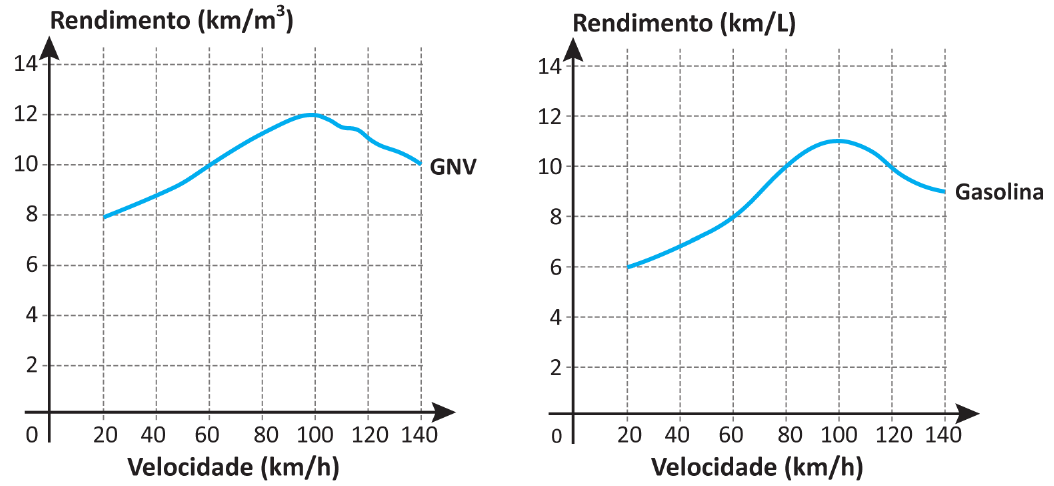
During a holiday, this person traveled 240 km. To obtain a estimated fuel expenditure, assume that throughout the journey a constant speed of 60 km/h. Consider that, during half the journey, it was used only CNG and, in the other half, only gasoline. What was paid for cubic meter of CNG and liter of gasoline corresponded, respectively, to R$ 2,00 and R$ 3,00.
What was the difference, in real terms, between total expenditure on gasoline and CNG?
- A) 4
- B) 8
- C) 14
- D) 21
- E) 30
Resolution
1. Efficiency at 60 km/h (read in the graphs). CNG: 10 km/m³. Gasoline: 8 km/L.
2. Distance with each fuel. Half 240 km: 120 km each.
3. Spending on CNG.
$$\frac{120}{10} = 12 \text{ m}^3 \quad\Rightarrow\quad 12 \cdot 2{,}00 = 24 \text{ reais}$$4. Spending on gasoline.
$$\frac{120}{8} = 15 \text{ L} \quad\Rightarrow\quad 15 \cdot 3{,}00 = 45 \text{ reais}$$5. Difference.
$$45 - 24 = 21 \text{ reais}$$Answer: alternative D (21).
Be careful with the catch: use the entire 240 km for each fuel doubles the difference (42, which is not an alternative). And you need to read both graphs at the point 60 km/h, not at the peak of the curve.
Question 173: Cheapest driving school
Statement
In one country, the first step to obtaining a driver’s license is contracting three products:
- package with 20 theoretical classes;
- package with 10 practical classes;
- vehicle rental for practical classes.
A person who intends to obtain a driver’s license researched the rental price of the vehicle and the prices for each theoretical class and each practical class in three driving schools. The table presents these values.
| Driving school | Value of each theoretical class (R$) | Value of each practical class (R$) | Vehicle rental (R$) |
|---|---|---|---|
| I | 10 | 80 | 400 |
| II | 30 | 50 | 200 |
| III | 20 | 40 | 400 |
It will purchase the three products from the same driving school so that the total cost in this first stage be as small as possible.
The driving school that will be hired is the
- A) I, with a total cost of R$ 1 400,00.
- B) II, with a total cost of R$ 280,00.
- C) II, with a total cost of R$ 1 300,00.
- D) III, with a total cost of R$ 460,00.
- E) III, with a total cost of R$ 1 200,00.
Resolution
Total cost = 20 × (theoretical class) + 10 × (practical class) + rent.
| Driving school | Theoretical | Practices | Rent | Total |
|---|---|---|---|---|
| I | $20 \cdot 10 = 200$ | $10 \cdot 80 = 800$ | 400 | 1 400 |
| II | $20 \cdot 30 = 600$ | $10 \cdot 50 = 500$ | 200 | 1 300 |
| III | $20 \cdot 20 = 400$ | $10 \cdot 40 = 400$ | 400 | 1 200 |
The lowest cost is that of driving school III, R$ 1 200,00.
Answer: alternative E (III, with R$ 1 200,00).
Be careful with the catch: alternatives B (R$ 280,00) and D (R$ 460,00) add up the values of one theoretical class, one practical and the rent, without Multiply by the package quantities.
Question 174: Bottles in the flush box (volume)
Statement
A flush box, attached to a toilet, is shaped like a straight rectangular parallelepiped whose internal dimensions of the base are 2,5 dm and 1,5 dm. In this box there is a float that interrupts the supply when the height of the water column reaches 2 dm, as shown in the figure.
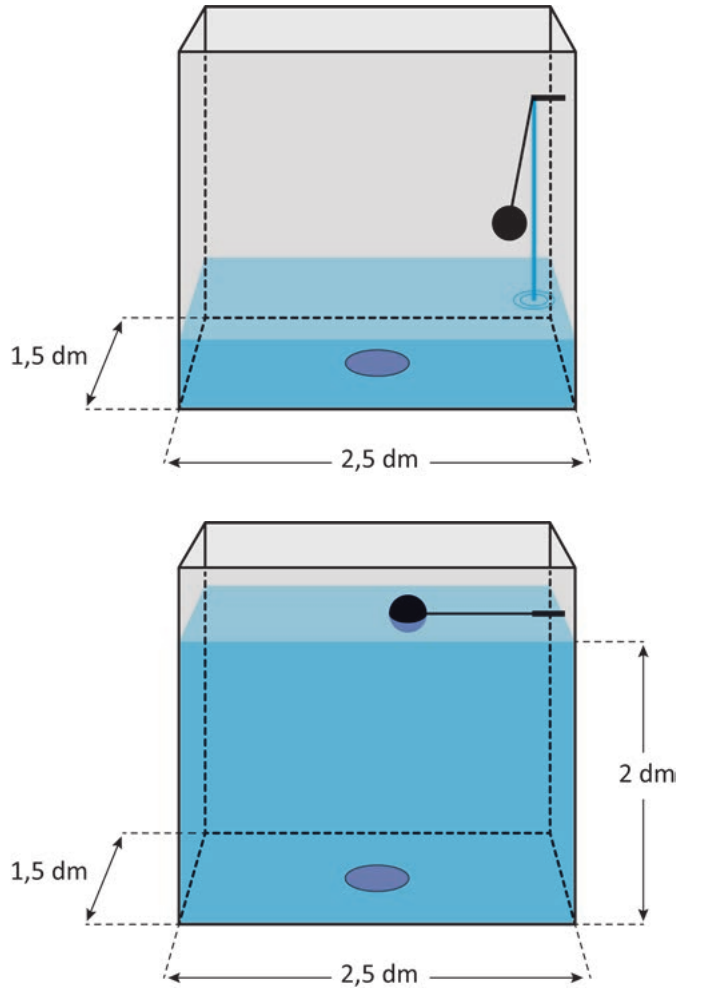
With each flush activation, the entire volume of water contained in the tank is poured into the vase. To reduce the volume of water dispensed with each operation, a person will place, inside this box, bottles of 300 mL, filled with sand and covered, so that they remain submerged when the supply is interrupted.
To ensure efficient operation, the minimum amount of water poured each time drive must be 5 L.
The maximum number of bottles that will be placed in this box, guaranteeing a efficient operation, is equal to
- A) 10.
- B) 8.
- C) 4.
- D) 3.
- E) 2.
Resolution
1. Volume of water without bottles. Up to a height of 2 dm:
$$2{,}5 \cdot 1{,}5 \cdot 2 = 7{,}5 \text{ dm}^3 = 7{,}5 \text{ L}$$2. Effect of the bottles. The float continues to turn off the water at a height of 2 dm. Each submerged bottle occupies 300 mL = 0,3 L of this space, which no longer contains water. With $n$ bottles, the poured water is
$$7{,}5 - 0{,}3n$$3. Efficient operating condition.
$$7{,}5 - 0{,}3n \ge 5 \quad\Rightarrow\quad 0{,}3n \le 2{,}5 \quad\Rightarrow\quad n \le 8{,}33\ldots$$As $n$ is an integer, at most 8 bottles (with 8, there are $7{,}5 - 2{,}4 = 5{,}1$ L left; with 9, only $4{,}8$ L).
Answer: alternative B (8).
Beware of the catch: rounding 8,33 up (9) would leave less than 5 L per flush. Also remember that $1 \text{ dm}^3 = 1 \text{ L}$.
Question 175: Pie boxes (cylinder inside a prism)
Statement
A confectioner began to produce pies in the shape of a straight circular cylinder, with base radius varying between 12 cm and 16 cm and height of 6 cm. These pies should be packed in boxes shaped like a straight prism with a square base, so that it is possible to accommodate the cake inside and still have at least 1 cm of space remaining. distance between the cake and the inner surfaces of the box, side and top. It originally has boxes in the desired format, whose dimensions internal are 14 cm long from the base side and 7 cm high, which do not meet your needs. Therefore, he will buy new boxes, with the same shape of the original boxes, but with a longer base side length, which are suitable for packaging all types of pies you produce.
The edge of the base of the new boxes must be at least as many centimeters larger than the original boxes?
- A) 4
- B) 12
- C) 16
- D) 18
- E) 20
Resolution
1. The biggest pie rules. The box needs to fit all the pies; the biggest has a radius 16 cm, that is, diameter 32 cm.
2. Minimum side of the base. Seen from above, the pie circle is inside the square base, with at least 1 cm clearance on each side:
$$1 + 32 + 1 = 34 \text{ cm}$$(The height already works: $6 + 1 = 7$ cm, the same as the original boxes.)
3. Increase compared to the original box.
$$34 - 14 = 20 \text{ cm}$$Answer: alternative E (20).
Be careful with the catch: using the radius (16) instead of the diameter leads to $16 + 2 - 14 = 4$ (alternative A). And forgetting about time off gives $32 - 14 = 18$ (alternative D).
Question 176: Machine internal pressure (logarithm and quadratic function)
Statement
A businessman uses machines whose internal pressure $P$, in atmosphere, depends on the continuous time of use $t$, in hours, and a positive parameter $K$, which defines the machine model, according to the expression:
$$P = 4 \cdot \log[-K \cdot (t + 1) \cdot (t - 19)]$$The manufacturer of these machines recommends to the user that the internal pressure of this type of machine does not exceed 10 atmospheres during operation.
The businessman intends to buy new machines of this type that should work, daily, for a continuous period of 10 hours. To do this, you need to define the machine model to be acquired by choosing the highest possible value of the parameter $K$, meeting the manufacturer’s recommendation.
The largest value to choose for $K$ is
- A) $10^{0{,}5}$
- B) $10^{8}$
- C) $\dfrac{10^{2{,}5}}{84}$
- D) $\dfrac{10^{2{,}5}}{99}$
- E) $25 \times 10^{-2}$
Resolution
1. Condition on pressure. We want $P \le 10$ for all $t$ between 0 and 10:
$$4 \log[-K(t + 1)(t - 19)] \le 10 \quad\Rightarrow\quad \log[-K(t + 1)(t - 19)] \le 2{,}5$$As the logarithm (in base 10) is increasing:
$$-K(t + 1)(t - 19) \le 10^{2{,}5}$$2. The largest value of $g(t) = -(t + 1)(t - 19)$ between 0 and 10. This is a parabola with downward concavity and roots $-1$ and $19$. The vertex is in the middle from the roots:
$$t_V = \frac{-1 + 19}{2} = 9$$which is within the range $[0, 10]$. The maximum value is
$$g(9) = -(9 + 1)(9 - 19) = -(10)(-10) = 100$$3. Major $K$. The condition must be valid even when the pressure is maximum ($t = 9$):
$$K \cdot 100 \le 10^{2{,}5} \quad\Rightarrow\quad K \le \frac{10^{2{,}5}}{10^2} = 10^{0{,}5}$$Answer: alternative A ($10^{0{,}5}$).
Be careful with the catch: alternative D uses the value at the end of file, $g(10) = 11 \cdot 9 = 99$. But the pressure is greater at $t = 9$ h than in $t = 10$ h, then the limit has to be calculated at the vertex.
To review, see Properties of Logarithms and Equation of 2th degree.
Question 177: Tunnel projects (semicircle area)
Statement
In a city, a tunnel will be built that crosses a mountain to facilitate car and bicycle traffic. Two projects were developed and the Schematics with the front views of these projects are presented in the figure.
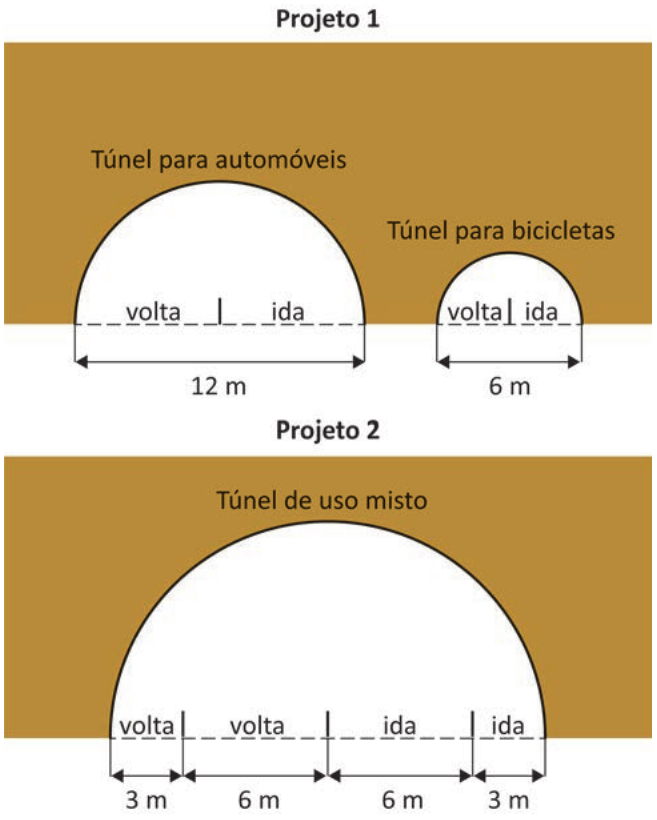
Project 1 has two tunnels, one exclusively for bicycles and the other for automobiles. Project 2 has a single tunnel, with spaces reserved for the exclusive traffic for bicycles and cars. In both projects, the tunnels have the straight semi-cylinder format of the same length, with round-trip routes to the two types of vehicles, separated by walls.
The project to be approved will be the one with the smallest section area transversal, as it will imply a smaller volume of material removed from the mountain.
Consider 3 as an approximation for $\pi$ and disregard the thickness of the walls.
The project to be approved is
- A) o 1, as it has a cross-sectional area measuring 67,5 m².
- B) o 2, as it has a cross-sectional area measuring 121,5 m².
- C) o 1, as it has a cross-sectional area measuring 135 m².
- D) o 2, as it has a cross-sectional area measuring 243 m².
- E) either of the two, as they have equal cross-sectional areas.
Resolution
The cross section of each tunnel is a semicircle, with area $\frac{\pi r^2}{2}$.
1. Project 1. Car tunnel with diameter 12 m ($r = 6$) and bicycles with diameter 6 m ($r = 3$):
$$\frac{3 \cdot 6^2}{2} + \frac{3 \cdot 3^2}{2} = 54 + 13{,}5 = 67{,}5 \text{ m}^2$$2. Project 2. A tunnel of diameter $3 + 6 + 6 + 3 = 18$ m ($r = 9$):
$$\frac{3 \cdot 9^2}{2} = \frac{243}{2} = 121{,}5 \text{ m}^2$$3. Comparison. $67{,}5 < 121{,}5$: Project 1 removes less material.
Answer: alternative A (the 1, with 67,5 m²).
Be careful with the catch: the widths add up to the same in both projects ($12 + 6 = 18$), which suggests equal areas (alternative E). But the area grows with the square of the radius: $6^2 + 3^2 = 45$ is much smaller than $9^2 = 81$. To the Alternatives C and D use the full circle instead of the semicircle.
To review, see Circle Area.
Question 178: Car installments (cancelled)
Statement
A car that costs 60 thousand reais is sold by a dealer that offers Two payment options, all with no down payment and no interest:
- option 1: payment in $n$ equal installments;
- option 2: payment in 6 more installments than in option 1 and, as a result, the value of each installment becomes R$ 500,00 less than the value of the installment in option 1.
In both payment options, the total amount to be paid for the car is the same.
What is the quantity $n$ of installments contained in payment option 1?
- A) 18
- B) 24
- C) 30
- D) 42
- E) 48
Situation
Question canceled by INEP. The official answer sheet of the Notebook 5 – Yellow records this question as “Cancelled”, without stating the reason. All candidates receive the question score.
Just as an exercise (this is not an official answer), the account set up by statement is as follows. The portion of option 1 is $\frac{60\thinspace 000}{n}$, and the option 2 is $\frac{60\thinspace 000}{n + 6}$. The difference between them is 500:
$$\frac{60\thinspace 000}{n} - \frac{60\thinspace 000}{n + 6} = 500 \quad\Rightarrow\quad \frac{360\thinspace 000}{n(n + 6)} = 500 \quad\Rightarrow\quad n(n + 6) = 720$$Solving for $n^2 + 6n - 720 = 0$, the positive root is $n = 24$ (in fact, $24 \cdot 30 = 720$). With $n = 24$, the installments would be R$ 2 500,00 and R$ 2 000,00.
For review, see Bhãskara.
Question 179: Gifts for three children (combinations)
Statement
A father bought eight different gifts (among which, a bicycle and a cell phone) to give to his three children. He intends to distribute the gifts in a that the oldest and youngest children receive three gifts each, and the middle one receive the remaining two gifts. The eldest will receive, among his gifts, or a bicycle or a cell phone, but not both.
In how many different ways can gifts be distributed?
- A) 36
- B) 53
- C) 300
- D) 360
- E) 560
Resolution
1. Gifts from eldest son (3 gifts). He receives exactly one of bicycle and cell phone:
- choose which one: 2 ways;
- choose the other 2 present among the 6 that are not bicycles or cell phones:
Total for oldest: $2 \cdot 15 = 30$ ways.
2. Gifts from the youngest (3 gifts). There are 5 gifts left (without restriction now):
$$\binom{5}{3} = 10$$3. Middle child. Keeps the remaining 2: 1 way.
4. Total.
$$30 \cdot 10 \cdot 1 = 300$$Answer: alternative C (300).
Be careful with the catch: alternative E (560) is the total without the restriction ($\binom{8}{3} \cdot \binom{5}{3} = 56 \cdot 10$). And forget that there are 2 choices between bicycle and cell phone gives 150, half the answer.
Question 180: Distance covered by the player (average speed)
Statement
The final of a football championship was played in 2 regulation times, in 45 minutes each, without additions, with an extension of 30 minutes, also without additions. A player came on at the start of the second half, who had a equipment to measure the distance covered during your participation in the game. At the end of the second regulation half, this player had covered 4,5 km. He maintained the same average speed in extra time as it had maintained in the second regulation time.
The distance covered by this player during his participation in the match, in kilometer, it was
- A) 4,5.
- B) 6,0.
- C) 7,5.
- D) 9,0.
- E) 12,0.
Resolution
1. Average speed in the 2nd half. He covered 4,5 km in 45 minutes:
$$v = \frac{4{,}5 \text{ km}}{45 \text{ min}} = 0{,}1 \text{ km/min}$$2. Distance in extra time(30 minutes):
$$0{,}1 \cdot 30 = 3{,}0 \text{ km}$$3. Total.
$$4{,}5 + 3{,}0 = 7{,}5 \text{ km}$$Answer: alternative C (7,5).
Be careful with the catch: the player didn’t played the 1st half. Count the 90 regulatory minutes at the same speed leads to 12,0 km (alternative E).
To review, see Fees.