Man is only a reed, the weakest in nature; but he is a thinking reed.
— Blaise Pascal, Pensées
Blaise Pascal (1623–1662) lived only 39 years and hardly ever had a day without pain. At 12 he rediscovered a theorem of Euclid on his own; at 16 he published a theorem on conics that Descartes refused to believe was a teenager’s work; at 19 he built an adding machine to help his father count taxes. Later he proved that air has weight, founded probability theory with Fermat and, at the end of his life, invented the bus.
In this trail we tell Pascal’s life and redo, with the calculations in full, eight of his discoveries. The figures are interactive: build the rows of the arithmetic triangle, split the stakes of an interrupted game and watch a hydraulic jack multiply a force.
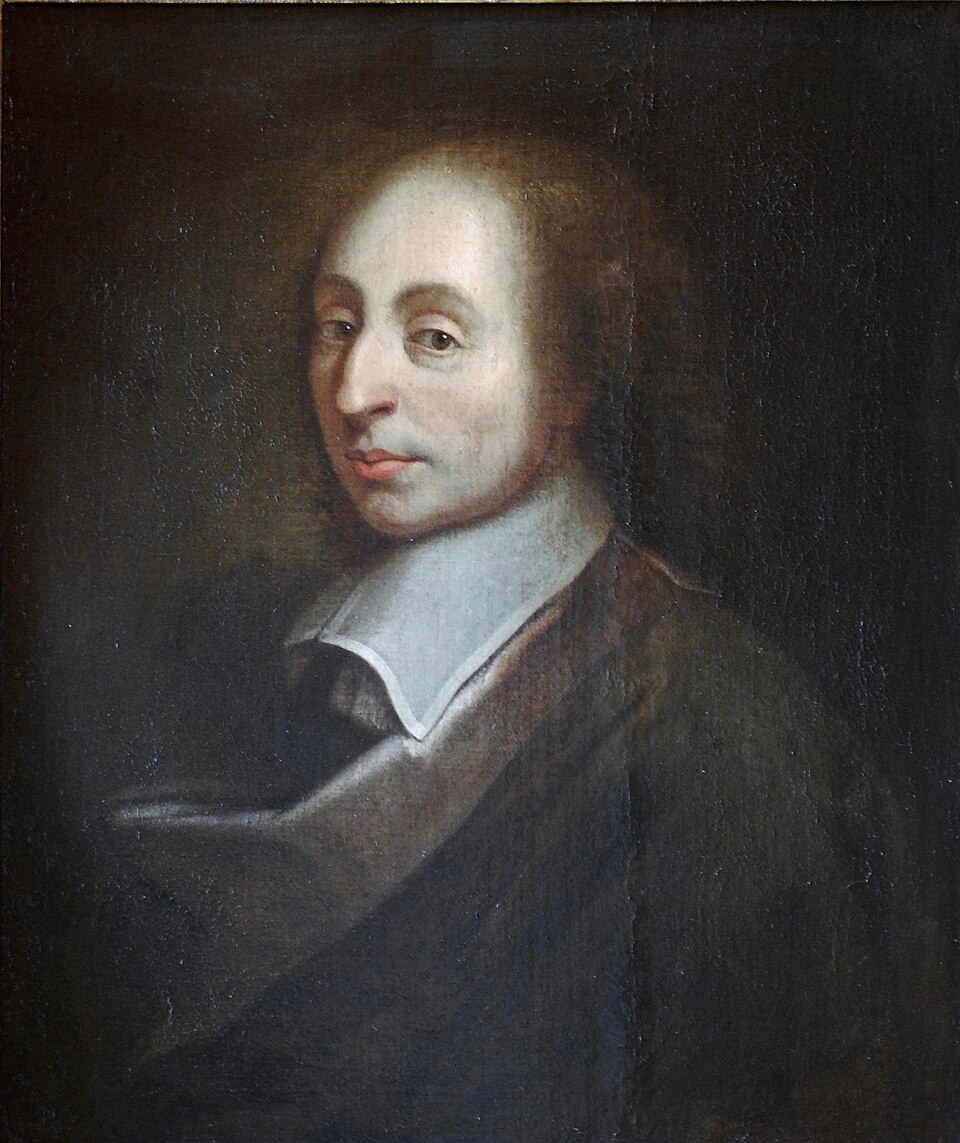
Who he was
Blaise Pascal
- Nascimento
- 19 June 1623, Clermont
- Morte
- 19 August 1662, Paris
- Origem
- France
- Áreas
- Geometry, combinatorics, probability, physics and philosophy
Reading guide
Biography
Discovery and proof
- Pascal’s triangle: build it by adding
- Combinations: counting without listing
- The Chevalier de Méré’s dice and the fair split
- The Pascaline: a sum made of gears
- The mystic hexagram: six points on a conic
- The cycloid: the toothache curve
- Pascal’s principle: multiplying forces with water
- The weight of air: the Puy de Dôme experiment