
Euler's Eyes
2026-10-14
Special relativity: a clock made of light
If I pursue a beam of light with the velocity c, the velocity of light in a vacuum, I should observe such a beam of light as an electromagnetic field at rest though spatially oscillating. There seems to be no such thing, however.
— Albert Einstein, Autobiographical Notes (1949)
At 16, at school in Aarau, Einstein asked himself a question: what would I see if I ran alongside a beam of light, at the same speed? According to Newton’s physics, the light would seem to stand still, like a car beside ours on the motorway. But Maxwell’s equations do not allow light at rest: for them, light always travels at $c\approx300{,}000$ km/s. Someone was wrong. Einstein took ten years to find out who.
Two postulates
In June 1905 Einstein sent the Annalen der Physik the paper “On the electrodynamics of moving bodies”. He started from two hypotheses:
- The laws of physics are the same for all observers moving at constant velocity. On a train moving without jolts, no experiment done inside reveals whether the train is at rest or in motion.
- The speed of light in a vacuum is the same, $c$, for all these observers, no matter how the source or the observer moves.
The second seems harmless, but it is scandalous. If you run at 100,000 km/s after a beam of light, you still measure the beam moving away from you at 300,000 km/s. For that to be possible, something has to give. Einstein showed that what gives is time.
The light clock
Imagine a clock made of two parallel mirrors, a distance $L$ apart, with a pulse of light bouncing between them. Each round trip is one tick. For someone beside the clock, the tick lasts
$$\Delta\tau=\frac{2L}{c}.$$Now put the clock inside a train passing you at speed $v$. For you, on the platform, the light does not go straight up and down: while it travels from one mirror to the other, the train moves on, and the light’s path is a diagonal, which is longer.
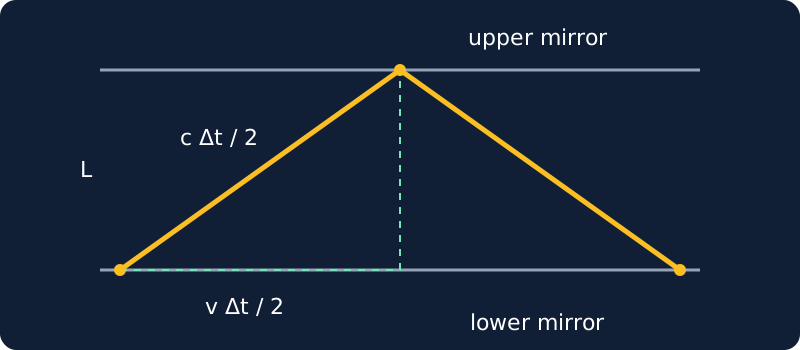
If the tick, as measured by you, lasts $\Delta t$, then in half a tick the light travels $c\frac{\Delta t}2$ and the train moves $v\frac{\Delta t}2$. The height is still $L$. By Pythagoras’s theorem,
$$\left(\frac{c\,\Delta t}2\right)^2=L^2+\left(\frac{v\,\Delta t}2\right)^2.$$Since $L=\frac{c\,\Delta\tau}2$, substituting and dividing everything by $\frac{c^2}4$:
$$\Delta t^2=\Delta\tau^2+\frac{v^2}{c^2}\Delta t^2\quad\Longrightarrow\quad \Delta t^2\left(1-\frac{v^2}{c^2}\right)=\Delta\tau^2.$$And we reach the formula for time dilation:
$$\boxed{\Delta t=\gamma\,\Delta\tau,\qquad \gamma=\frac1{\sqrt{1-v^2/c^2}}.}$$The number $\gamma$, the Lorentz factor, is always greater than 1. For you, the train’s clock runs slow. And since every clock, a heart, an atom, has to agree with the light clock, otherwise the passengers would discover they are moving, it is time itself on the train that passes more slowly.
| Speed | $\gamma$ | 1 second on the train lasts, on the platform |
|---|---|---|
| 300 km/h | $1.00000000000004$ | 1 second |
| $0.6c$ | $1.25$ | 1.25 seconds |
| $0.8c$ | $1.67$ | 1.67 seconds |
| $0.99c$ | $7.09$ | 7.09 seconds |
In everyday life $\gamma$ is so close to 1 that the effect is invisible. It only shows up near the speed of light.
The astronaut who comes back younger
An astronaut travels to a star and back at $0.8c$. By the ship’s clock the trip lasts 6 years. On Earth,
$$\Delta t=\frac{6}{\sqrt{1-0.8^2}}=\frac6{0.6}=10\ \text{years}$$go by. On returning, the astronaut is 4 years younger than the twin who stayed behind. This seems a paradox, because from the ship’s point of view it is the Earth that moves. The difference is that the astronaut turns round, accelerates and changes reference frame; the twin on Earth does not. The two situations are not symmetric, and careful calculations always give the same result: the one who travelled ages less.
The muons that reach the ground
This is not science fiction. Cosmic rays striking the atmosphere produce, about 10 km up, particles called muons, which live on average only $2.2$ microseconds before decaying and travel at $0.998c$. By Newton’s physics they would travel on average
$$0.998\cdot3\times10^8\ \text{m/s}\cdot2.2\times10^{-6}\ \text{s}\approx660\ \text{m}$$and almost none would reach the ground. But they arrive in their thousands, on every square metre, every minute. With $v=0.998c$, $\gamma\approx15.8$: for us, the muon’s internal clock runs almost 16 times slower, it lives about 35 microseconds and travels on average about $10.4$ km. Time dilation was measured this way in 1941, and confirmed precisely in particle accelerators and with atomic clocks carried on aeroplanes.
Lengths shrink
If times change, distances change too. For the muon, which sees itself at rest, it is the atmosphere that rushes towards it, and the 10 km layer appears shrunk by $\gamma$, to only about 630 m: there is time to cross it. In general, an object of length $L_0$ at rest, measured by someone who sees it pass at speed $v$, has length
$$\boxed{L=\frac{L_0}{\gamma}=L_0\sqrt{1-\frac{v^2}{c^2}}}$$in the direction of motion. This is the Lorentz contraction. A 3 m car at 300 km/h shrinks by about $10^{-13}$ m, less than the size of an atom. A 100 m spaceship at 260,000 km/s, or $0.867c$, has $\gamma\approx2.01$ and appears only about 50 m long.
Exercise: the nearest star, Alpha Centauri, is 4.37 light-years away. How long does the outward trip at 0.8c last, for the Earth and for the astronaut?
For the Earth, the ship covers 4.37 light-years at 0.8 light-years per year: $\frac{4.37}{0.8}\approx5.46$ years. For the astronaut, the time is divided by $\gamma=\frac53$: $5.46\cdot0.6\approx3.28$ years. From the astronaut’s point of view, the distance has shrunk to $4.37\cdot0.6\approx2.62$ light-years, covered in $\frac{2.62}{0.8}\approx3.28$ years: the two calculations agree.
Exercise: how fast must a clock move to tick off half the platform's time?
We want $\gamma=2$, that is, $\sqrt{1-v^2/c^2}=\frac12$. Squaring, $1-\frac{v^2}{c^2}=\frac14$, and $v=\frac{\sqrt3}2c\approx0.866c$, about 260,000 km/s. It is the speed of the spaceship in the example above, which shrinks to half its length.
Sources: Albert Einstein, “On the electrodynamics of moving bodies”, Annalen der Physik 17 (1905), in Einstein’s Miraculous Year, ed. John Stachel (Princeton, 1998) · Bruno Rossi and David B. Hall, “Variation of the rate of decay of mesotrons with momentum”, Physical Review 59 (1941) · Einstein Online, special relativity.
All topics on Albert Einstein · ← Brownian motion: counting the atoms · E = mc²: the energy hidden in mass →