
Euler's Eyes
2026-10-11
Similarity of triangles
Two figures are similar when they have the same shape, even if they are different sizes. It’s the mathematics of photos, maps and models.
Who discovered
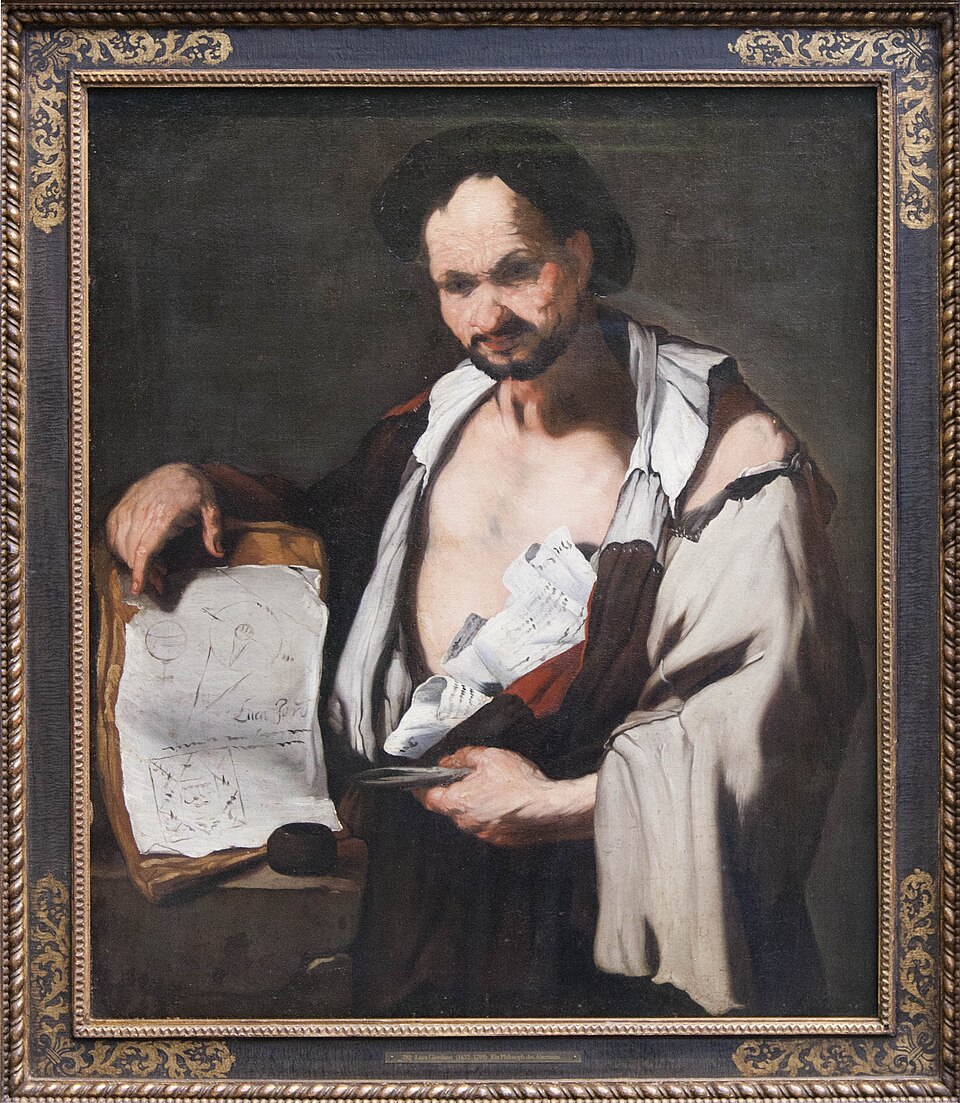
The idea is in the stories about Tales of Miletus, who would have measured the height of a pyramid by comparing its shadow with that of a stick. The complete theory is in book VI of The Elements by Euclid (c. 300 BC), which defines similar figures as those with equal angles and proportional sides. It depends on the theory of proportions by Eudoxus of Cnidus (4th century BC), from book V, which also allowed the treatment of ratios between incommensurable segments.

The story
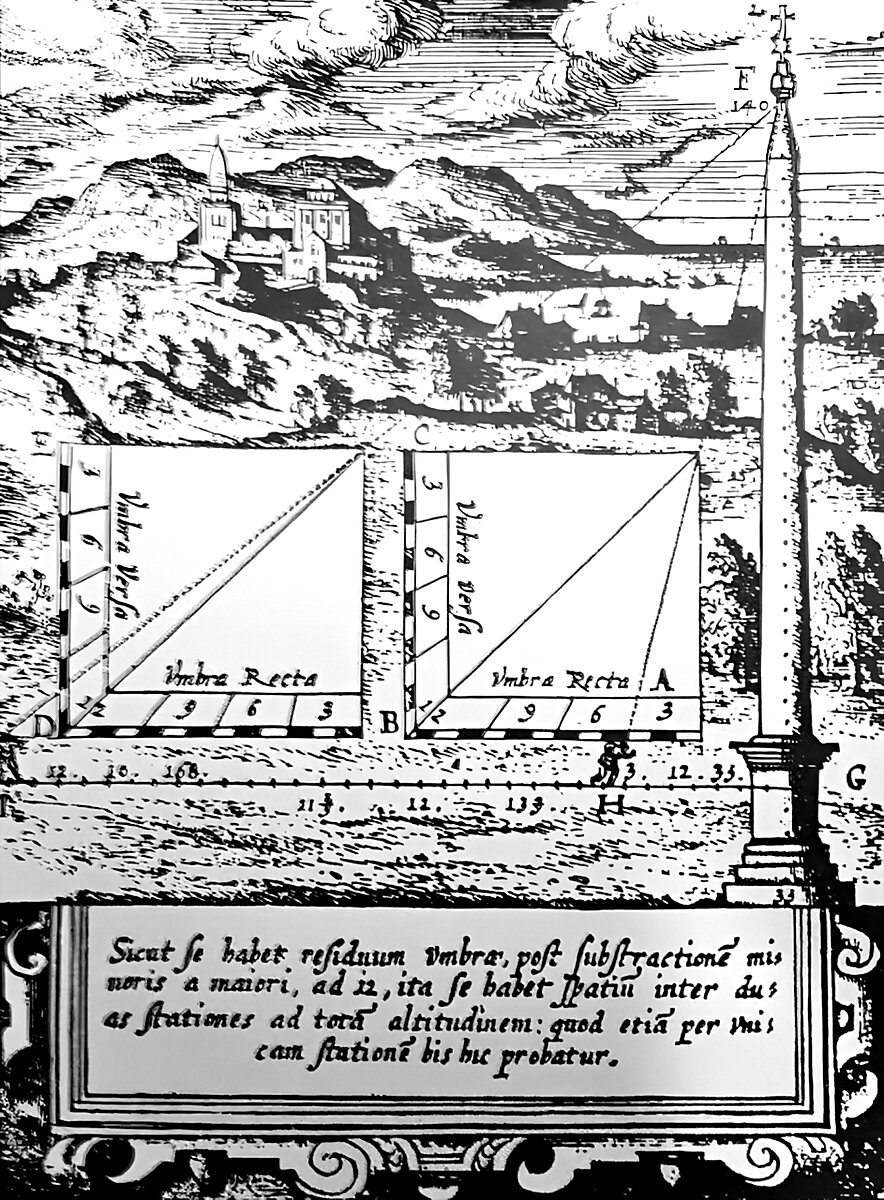
The shadow method became an instrument. From the Middle Ages onwards, astrolabes and quadrants were engraved with the shadow square, with two scales, the umbra recta and the umbra versa, to measure the heights of towers and the depths of wells without complicated calculations.
Around 270 B.C., Aristarchus of Samos used similar triangles to estimate the relative distances from the Earth to the Moon and the Sun. The numbers were far from the real ones, but the method—comparing similar triangles in the sky—was correct.
In everyday life
- Enlarge a photo. When “zooming” without distorting, all measurements are multiplied by the same factor.
- Mockups and miniatures. A cart in scale 1 : 43 has each measurement 43 times smaller than that of the real car.
- Height of a building by shadow. Compare the shadow of the building with that of a person of known height, at the same time.
- Projector and camera. The image on the screen or sensor is similar to the object, with size proportional to the distance.
Sources: Tales (MacTutor) · Elements, book VI · Aristarchus (MacTutor).
Theory and constructions
DefiniçãoSimilar triangles
Two triangles are similar (symbol $\sim$) if, and only if, they have three orderly congruent angles and proportional homologous sides:
$$\triangle ABC \sim \triangle A^{\prime}B^{\prime}C^{\prime} \iff \begin{cases} \hat{A} \equiv \hat{A}^{\prime},\ \hat{B} \equiv \hat{B}^{\prime},\ \hat{C} \equiv \hat{C}^{\prime} \\ \dfrac{a}{a^{\prime}} = \dfrac{b}{b^{\prime}} = \dfrac{c}{c^{\prime}} = k \end{cases}$$homologous sides (homo = same, logos = place) are one in each triangle and are opposite congruent angles. The number $k$ is the similarity ratio; if $k = 1$, the triangles are congruent.
Similarity is reflexive, symmetrical and transitive.
ExemploCalculating with the similarity ratio
If $\triangle ABC \sim \triangle A^{\prime}B^{\prime}C^{\prime}$, with $A^{\prime}B^{\prime} = 3$ cm, $A^{\prime}C^{\prime} = 7$ cm, $B^{\prime}C^{\prime} = 5$ cm and $AB = 6$ cm, the ratio is $k = \dfrac{6}{3} = 2$. So $BC = 2 \cdot 5 = 10$ cm and $AC = 2 \cdot 7 = 14$ cm.
TeoremaFundamental theorem
If a straight line is parallel to one of the sides of a triangle and intersects the other two at different points, then the triangle it determines is similar to the first:
$$\overline{DE} \parallel \overline{BC} \Rightarrow \triangle ADE \sim \triangle ABC.$$Demo
- Angles: such as $\overline{DE} \parallel \overline{BC}$, $\hat{D} \equiv \hat{B}$ and $\hat{E} \equiv \hat{C}$ (corresponding), and $\hat{A}$ is common.
- Sides: by Thales’ theorem, $\dfrac{AD}{AB} = \dfrac{AE}{AC}$.
- By $E$ we draw $\overline{EF} \parallel \overline{AB}$, with $F$ in $\overline{BC}$. $BDEF$ is parallelogram, so $DE = BF$, and by Tales $\dfrac{AE}{AC} = \dfrac{BF}{BC} = \dfrac{DE}{BC}$.
- Therefore $\dfrac{AD}{AB} = \dfrac{AE}{AC} = \dfrac{DE}{BC}$, and the triangles are similar.
ExemploApplying the fundamental theorem
In a triangle with $AB = 12$ cm, $AC = 13$ cm and $BC = 15$ cm, the parallel $\overline{DE}$ to $\overline{BC}$ is $DE = 5$ cm. Then $\dfrac{x}{12} = \dfrac{y}{13} = \dfrac{5}{15}$, that is, $AD = x = 4$ cm and $AE = y = \dfrac{13}{3}$ cm.