
Euler's Eyes
2022-10-01
Introduction to Radiciation
Not every root is irrational
Test 4, 9 and 16 within the root. Compare with 2, 3 and 5. Explain the difference.
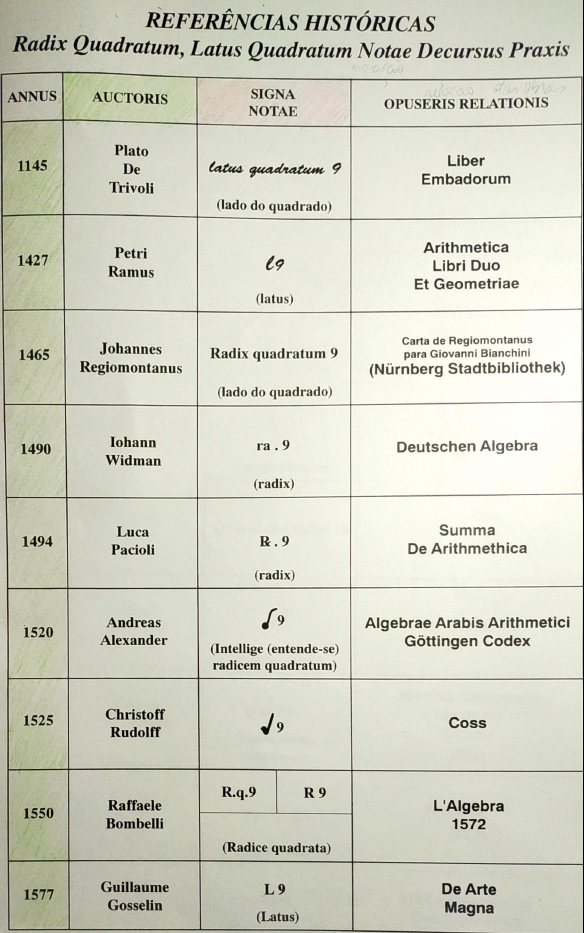
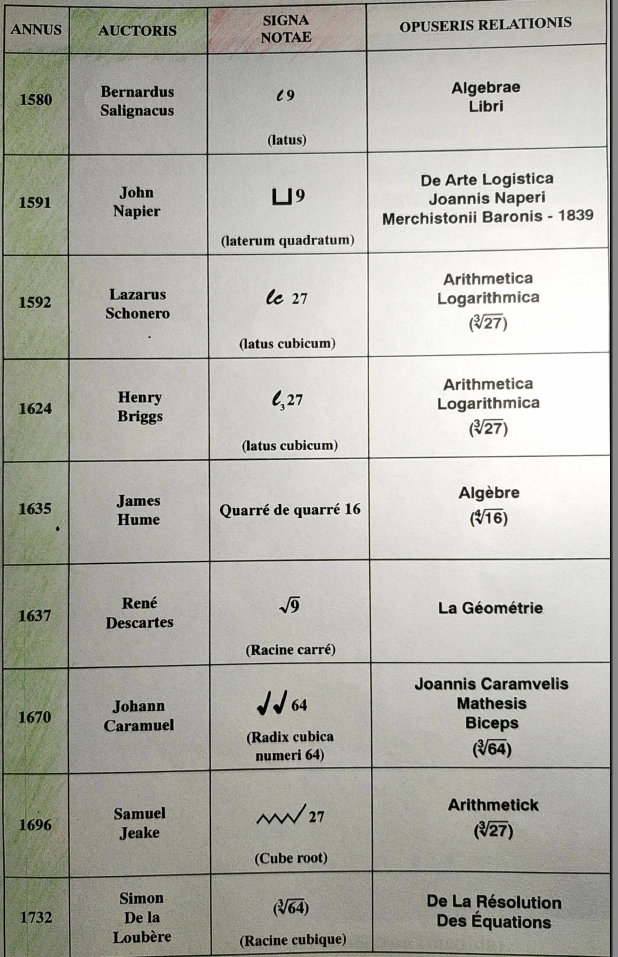
For many children the square root of a complex number and many teachers scare children by saying that it is something very complex. However, if we know where this term comes from, it is not something complex. Quite the contrary, it is simple and intuitive. This is information that has been lost over time, that is, we have become a sterile notation. The reader will see that semiotically active notations are those that evolved for the advancement of mathematics. The square root from the perspective of the Latin language (Latin) radix quadratum 4 aequalis 2, which we translate as the side of the square of area 4 is equal to 2.

Evolution of Notation
Below, we can see the evolution of the notation:
| Part 1 | Part 2 |
|---|---|
|
|
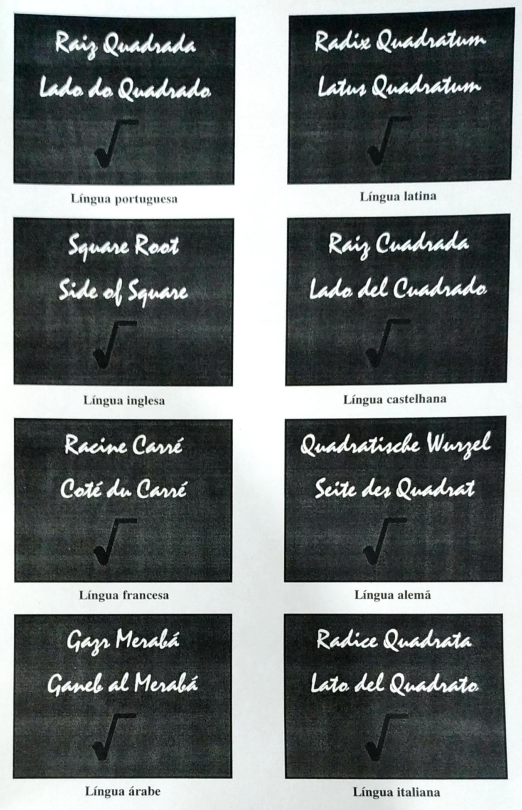
Because of these absurdities, these posts will help you understand this loss of information.
Radiciation or Fractional Potentiation
In this section, we will work on radiciation as a power with fractional numbers. For example:
$$\sqrt{4} = \sqrt[2]{4} = 4^{\frac{1}{2} } = (2^2)^{\frac{1}{2} } = 2^{\frac{2}{2} } = 2^1 =2$$
| Area of the square | side | Translation | Notation |
|---|---|---|---|
| 4 | 2 | side of the square 4 is equal to 2 | $\quad\sqrt{4}=2$ |
| 9 | 3 | side of the square 9 is equal to 3 | $\quad\sqrt{9}=3$ |
| 16 | 4 | side of the square 16 is equal to 4 | $\quad\sqrt{16}=4$ |
| 25 | 5 | side of the square 25 is equal to 5 | $\quad\sqrt{25}=5$ |
| 36 | 6 | side of the square 36 is equal to 6 | $\quad\sqrt{36}=6$ |
| 49 | 7 | side of the square 49 is equal to 7 | $\quad\sqrt{49}=7$ |
| 64 | 8 | side of the square 64 is equal to 8 | $\quad\sqrt{64}=8$ |
| 81 | 9 | side of the square 81 is equal to 9 | $\quad\sqrt{81}=9$ |
| 100 | 10 | side of the square 100 is equal to 10 | $\quad\sqrt{100}=10$ |
| 121 | 11 | side of the square 121 is equal to 11 | $\quad\sqrt{121}=11$ |
Cube root
The cube root is when the root index is 3.
$$\sqrt[3]{27} = 27^{\frac{1}{3} } = (3^3)^{\frac{1}{3} } = 3^{\frac{3}{3} } = 3^1 =2$$fourth root
The fourth root is when the root index is 4.
$$\sqrt[4]{16} = 16^{\frac{1}{4} } = (2^4)^{\frac{1}{4} } = 2^{\frac{4}{4} } = 2^1 =2$$nth root
The nth root is when the root index is n.
$$\sqrt[n]{k} = p$$- k: rooting
- n: index
- p: root
- $\sqrt{\quad}$: radical
Properties
Some properties can make it easier to use the root of numbers.
Property 1: root the radicand index is the same as the radical index.
$$\sqrt[n]{a^n}=a$$
In fact,
$$\sqrt[n]{a^n}=(a^n)^{\frac{1}{n} } = 2^{\frac{n}{n} } = a^1 =a$$Example 1:
$$\sqrt{4}=(2^2)^{\frac{1}{2} } = 2^{\frac{2}{2} } = 2^1 =2$$Property 2: fractional power.
$$\sqrt[n]{a^m}=a^{\frac{m}{n}}$$
Example 2:
$$\sqrt[4]{27}=(3^3)^{\frac{1}{4} } = 2^{\frac{3}{4} }$$Example 3:
$$\sqrt[3]{64}=(2^6)^{\frac{1}{3} } = 2^{\frac{6}{3} }=2^2=4$$Example 4:
$$\sqrt[3]{16}=(2^4)^{\frac{1}{3} } = 2^{\frac{4}{3} }= 2^{\frac{3}{3} + \frac{1}{3} }= 2^{\frac{1}{3} }~.~ 2^{\frac{3}{3} }=2\sqrt[3]{2}$$Property 3: multiplication of roots of equal indices.
$$\sqrt[n]{a}~.~\sqrt[n]{b}=\sqrt[n]{a~.~b}$$
In fact,
$$\sqrt[n]{a}~.~\sqrt[n]{b} = a^{\frac{1}{n}}~.~b^{\frac{1}{n}}=(a~.~b)^{\frac{1}{n}}= \sqrt[n]{a~.~b}$$Example 5:
$$\sqrt[3]{2}~.~\sqrt[3]{3} = 2^{\frac{1}{3}}~.~3^{\frac{1}{3}}=(2~.~3)^{\frac{1}{3}}= \sqrt[3]{2~.~3} = \sqrt[3]{6}$$Property 4: division of roots of equal indices.
$$\dfrac{\sqrt[n]{a}}{\sqrt[n]{b}}=\sqrt[n]{\dfrac{a}{b}}$$
In fact,
$$\dfrac{\sqrt[n]{a}}{\sqrt[n]{b}}= \dfrac{a^{\frac{1}{n}}}{b^{\frac{1}{n}}} = \left(\dfrac{a}{b}\right)^{\frac{1}{n}}= \sqrt[n]{\dfrac{a}{b}}$$Example 6:
$$\dfrac{\sqrt{5}}{\sqrt{4}}= \dfrac{5^{\frac{1}{2}}}{4^{\frac{1}{2}}} = \left(\dfrac{5}{4}\right)^{\frac{1}{2}}= \sqrt{\dfrac{5}{4}}$$These are the basic concepts of rooting. Wait for the next posts.