
Euler's Eyes
2026-10-25
Poisson's spot
At the beginning of the nineteenth century, most French physicists followed Newton: light was made of tiny particles, deflected by forces when they pass close to the edge of an object. The Englishman Thomas Young, in 1801, and the Frenchman Augustin Fresnel, from 1815, defended another idea: light was a wave, and the light and dark fringes that appear near shadows came from interference between waves.
The competition of 1818
In 1817 the Academy of Sciences set diffraction, the way light bends around obstacles, as the subject of its grand prize. The judging committee consisted of Arago, Biot, Gay-Lussac, Laplace and Poisson; three of them, Laplace, Biot and Poisson, were supporters of particles. Fresnel entered a long memoir in which he computed the fringes by adding up the contributions of waves coming from each point of the opening, and the results agreed with the measurements.
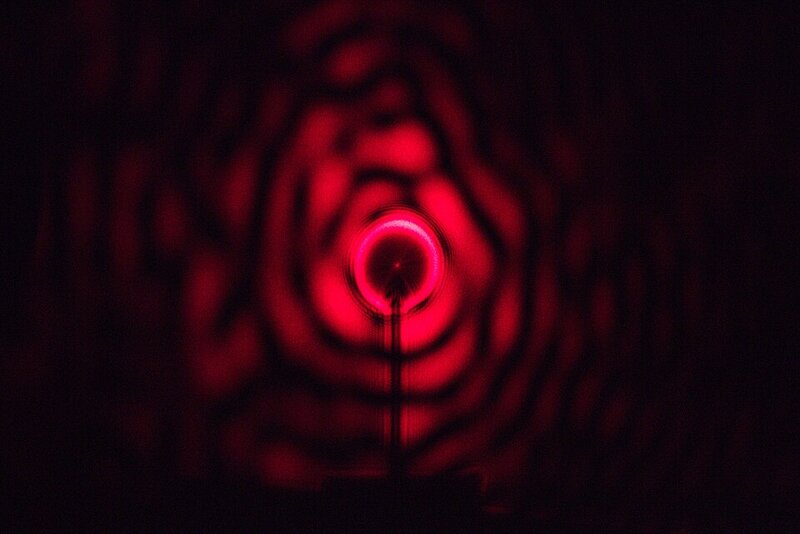
Poisson studied Fresnel’s integrals and applied them to a case Fresnel had not considered: the shadow of an opaque circular disc lit by a point source. For a point exactly on the axis, behind the centre of the disc, all the waves passing around the edge arrive with the same delay, by symmetry. The calculation gave an astonishing result: at the centre of the shadow there should be a bright point, as bright as if the disc did not exist. To Poisson, this was a reduction to absurdity of the theory.
Arago’s experiment
François Arago, a member of the committee, decided to check. He set up the experiment with a small metal disc glued to a glass plate and a very small light source, and there was the bright point at the centre of the shadow. Fresnel won the prize in 1819, and the wave theory began to prevail. The point came to be called Poisson’s spot, after the man who predicted it while trying to refute it, or Arago’s spot, after the man who saw it. It was later discovered that the astronomer Giacomo Maraldi had already observed it in 1723, without understanding what he was seeing.
Fresnel zones
There is an elegant way to understand the result, invented by Fresnel himself. Look at a point $P$ on the axis, at distance $z$ from the screen, and divide the wavefront into concentric rings, the Fresnel zones, chosen so that the distance to $P$ increases by half a wavelength from one ring to the next. The radius of the $n$-th zone is approximately
$$r_n \approx \sqrt{n\,\lambda z}.$$The waves from two neighbouring zones arrive half a wave apart and almost cancel. The contributions alternate in sign and decrease slowly:
$$A = a_1 - a_2 + a_3 - a_4 + \cdots \approx \frac{a_1}{2}.$$With no obstacle at all, the amplitude at $P$ is half the contribution of the first zone. Now place a disc that blocks the first $N$ zones. The sum now starts at $a_{N+1}$:
$$A = a_{N+1} - a_{N+2} + \cdots \approx \frac{a_{N+1}}{2}.$$Since the contributions decrease very slowly, $a_{N+1}$ is almost equal to $a_1$, and the brightness at the centre of the shadow is practically the same as with no disc. With a circular aperture, by contrast, the centre can be bright or dark according to whether the number of zones it lets through is odd or even. In the figure, compare the brightness on the axis behind a disc and behind an aperture of the same size:
Exercise: how many zones does a coin cover?
A coin of radius $a = 10$ mm is $z = 2$ m from a screen, lit by light of $\lambda = 600$ nm. How many Fresnel zones does it block?
The number of zones is $N = \frac{a^2}{\lambda z} = \frac{(10^{-2})^2}{6 \cdot 10^{-7} \cdot 2} = \frac{10^{-4}}{1.2 \cdot 10^{-6}} \approx 83$. Even blocking 83 zones, the theory predicts a bright point at the centre; in practice the edge of the coin must be very smooth, with irregularities much smaller than the zones, which is why the experiment works best with small polished discs.
Exercise: the dark centre
A circular aperture of radius $a = 1$ mm is lit with $\lambda = 500$ nm. The brightness on the axis is $I = 4 I_0 \sin^2\!\left(\frac{\pi N}{2}\right)$, with $N = \frac{a^2}{\lambda z}$, where $I_0$ is the brightness without the screen. At what distances is the centre dark? And where is it four times brighter than without the screen?
Dark when $N$ is even. $N = 2$ gives $z = \frac{10^{-6}}{2 \cdot 5 \cdot 10^{-7}} = 1$ m; $N = 4$ gives $z = 0.5$ m. The maximum brightness, $4 I_0$, occurs for odd $N$: $N = 1$ at $z = 2$ m, $N = 3$ at $z \approx 0.67$ m. An aperture can concentrate at the centre four times more light than the free wave: the first zone alone gives amplitude $a_1$, twice $\frac{a_1}{2}$.
Sources: Augustin Fresnel, “Mémoire sur la diffraction de la lumière”, Mémoires de l’Académie des sciences 5 (1821–1822, memoir awarded the prize in 1819) · François Arago, “Rapport fait par M. Arago à l’Académie des sciences, au nom de la commission qui avait été chargée d’examiner les mémoires envoyés au concours pour le prix de la diffraction”, Annales de chimie et de physique 11 (1819) · Jed Z. Buchwald, The Rise of the Wave Theory of Light (1989) · Eugene Hecht, Optics, ch. 10.
All topics on Siméon Denis Poisson · ← Poisson’s equation · The Poisson summation formula →